
scienceSimulators

The Lab

The XR School › Science › The Lab
Free Valve 8 VR experiences PC VR • Room scale
Released 5 April 2016 • Steam • Overwhelmingly positive: 95% of 4,400+ reviews • 21 interface languages

The Lab

Valve’s free collection of room scale VR experiments, set in a pocket universe inside Aperture Science. Most of it is pure fun, from archery to robot repair, but two stations stand out for schools: a walk‑through scan of a real human body and a hands‑on model of the solar system. It is also one of the best first experiences anyone can have in a headset.

Developer: Valve
Price: Free on Steam
Platform: PC VR via SteamVR
Subject: Science • Astronomy • Anatomy
7.4
/10
XR School Score
Recommended
Free • Superb introduction to VR • Human Medical Scan • Solar System • Mostly games rather than lessons • PC VR only
95% positive • Steam 4,440 English reviews
Overwhelmingly positive
Overview

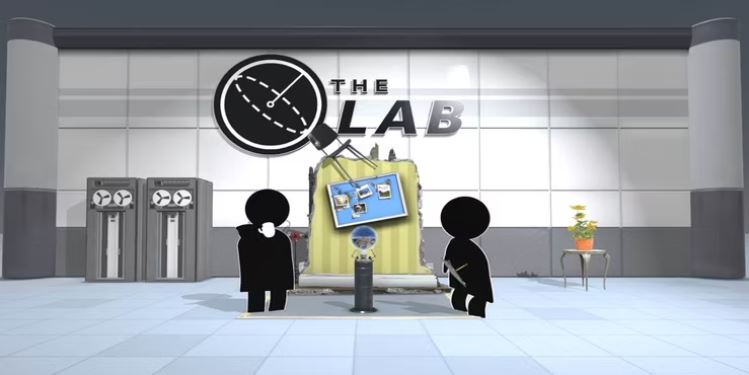
The Lab is a free compilation of virtual reality experiments from Valve, the company behind Steam and the Half‑Life and Portal games. It was released on 5 April 2016, just as room scale VR headsets first arrived in homes, and was designed to show what the new technology could do. You stand in a hub inside Aperture Science, the laboratory from the Portal series, and step through doorways into eight different experiences.

Almost a decade on it is still one of the most highly rated VR titles on Steam, with 95% of more than 4,400 English language reviews positive. Its strength is polish: every station teaches a new way of interacting, from picking things up to aiming a bow, and the whole collection works as a friendly, confidence building introduction for anyone who has never worn a headset.

Two Stations Worth a Lesson Human Medical Scan lets you walk around and inside a detailed 3D model built from a real medical scan of a human body, so you can see organs and bones in place and at life size. Solar System puts a scale model of the planets in your hands, letting you grab, move and compare them. Both make strong ten minute hooks for biology and physics lessons.
The Eight Experiences
🫀
Human Medical Scan
Explore a 3D model created from a real medical scan of a human body.
🪐
Solar System
Handle and compare the planets in an interactive model of the solar system.
🖼️
Postcards
Visit photographed real‑world locations rebuilt in 3D, with a robot dog for company.
🤖
Robot Repair
A short, funny story where you try to fix a robot in Aperture Science.

The other four are games: Slingshot and Longbow are physics based target and castle defence challenges, Xortex is a retro style space shooter, and Secret Shop is a whimsical fantasy shop with hidden surprises. They are great fun and teach good VR skills, but they are entertainment rather than learning.

Content Note Valve notes that The Lab contains cartoon violence in some games and the human medical scan. The violence is light and comical, but preview Longbow and Slingshot before letting younger students loose, and introduce the medical scan calmly as a real body seen from the inside.
Curriculum Value
First VR experience
9.5
Value for money
10
Science content
5.5
Curriculum fit
4.5
Hardware accessibility
4.0
Strengths and Limitations
Strengths
  • Completely free
  • Best in class introduction to VR controls
  • Human Medical Scan for biology
  • Solar System model for physics and astronomy
  • Very polished and reliable
  • Overwhelmingly positive reviews
  • Interface in 21 languages
Considerations
  • PC VR only: Quest needs a PC link
  • Needs room scale space for some stations
  • Half the content is games, not learning
  • Cartoon violence in some games
  • Science stations are short and light on facts
  • Spoken audio in English only
For Teachers: Start Here, Then Go Deeper If your school has a PC VR headset, The Lab is the ideal first session: students learn to move, grab and point in a safe, fun setting before you move on to subject apps. For lessons, go straight to Human Medical Scan to support KS3 and GCSE work on organs and organ systems, or Solar System for KS2 Earth and Space and KS3 astronomy. Follow up with deeper apps such as Human Anatomy VR or SpaceEngine.
Free
Steam • PC VR via SteamVR • Standing or room scale
Get on Steam → More science apps →
Quick Facts
Developer
Valve
Released
5 April 2016
Price
Free (Steam)
Platform
PC VR via SteamVR • VR only
Play area
Standing or room scale
Steam reviews
Overwhelmingly positive: 95% of 4,440 (English)
Experiences
Slingshot, Longbow, Xortex, Postcards, Human Medical Scan, Solar System, Robot Repair, Secret Shop
Languages
Interface in 21 languages • English audio
Minimum PC
Intel i5‑4590 • 4 GB RAM • GTX 970 or R9 290
Verdict
The Lab is free, beautifully made and one of the best ways to introduce students to virtual reality. As a learning tool it is a mixed bag: Human Medical Scan and Solar System are genuinely useful lesson hooks, while the rest is light hearted gaming. Use it as an induction session and for those two science stations, then move on to dedicated educational apps for deeper learning. If you have a PC VR setup, there is no reason not to install it.

Gareth Griffiths

Gareth Griffiths is a scientist and the founder of World of Teaching, a free library of over 1,000 teacher made PowerPoints. He set up The XR School to help teachers, schools and parents find virtual and augmented reality apps that genuinely help young people learn, and to give an honest view of what each app teaches, which headsets it needs and what it costs.