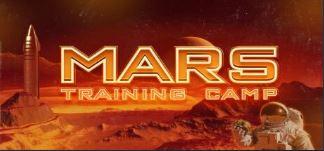
🚀 Based on Current Mars Mission Plans — Not Science Fiction
Mars Training Camp VR is explicitly designed around the actual plans NASA, SpaceX and international space agencies have published for human Mars operations — not a fictional future or a distant hypothetical. The SpaceX Starship you explore is the real vehicle planned to carry humans to Mars. The habitat design, food growing systems, rover operations and emergency procedures are based on published mission architecture. For science students studying space exploration, this contemporaneity is a significant strength — it is a simulation of what may actually happen within their lifetimes.
Platform: Meta Quest · Steam ·
Price: ~$9.99 ·
Developer: SIMWERX LLC ·
Released: September 2023 · All ages
About the Experience
What is Mars Training Camp VR?
Mars Training Camp VR is a realistic VR simulation of the initial human operations on Mars, developed by SIMWERX LLC and released in September 2023. It places the player in the role of an astronaut at a Martian base camp — exploring the surface, responding to emergencies, maintaining life-support systems and gathering scientific data, all based on the actual mission architectures that NASA, SpaceX and partner agencies have published for near-future crewed Mars missions.
The simulation is grounded in remarkable detail for an indie title: the SpaceX Starship — the actual vehicle planned to carry the first humans to Mars — sits on the Martian surface. The base includes food gardens simulating the kind of closed-loop life support agriculture being researched for long-duration missions. The robot dog companion that monitors and maintains your oxygen levels reflects real research into robotic assistants for hazardous extraterrestrial environments. Each element is drawn from real mission planning rather than speculative science fiction.
The game features an in-world economy: collecting rock samples earns cash awards, which can be used to progress through the simulation. This mechanic mirrors the real scientific priority of Mars surface geology — identifying rocks with biosignatures or evidence of past water activity is the central scientific objective of every Mars mission planned or active, from Perseverance to future crewed expeditions.
Five distinct emergency and task scenarios are included: responding to a fire at the base, rescuing a teammate stranded on the surface, building the launch pad for departure, fixing damaged equipment, and maintaining oxygen levels — each simulating the kind of life-critical operations that real Mars astronauts will need to perform. For science and PSHE teachers discussing the challenges of human spaceflight, these scenarios provide compelling concrete examples of the engineering and human challenges involved.
Features
Life on Mars
🚀
SpaceX Starship & Martian Surface Exploration
The SpaceX Starship — the actual vehicle that SpaceX has been developing to carry humans to Mars — is present on the Martian surface as both a visual landmark and a functional part of the simulation. The player explores the surrounding terrain on foot and by rover across the rust-red Martian landscape, experiencing the planet's environment: the thin atmosphere, the distinctive reddish dust, the dramatic sky. Mars has roughly 38% of Earth's surface gravity — movement in the simulation reflects this lighter gravitational pull. The surface terrain is designed to reflect what Mars actually looks like from rover and satellite imagery, rather than a Hollywood interpretation.
🔬
Rock Sample Collection — The Search for Evidence of Mars Life
Collecting rock samples is the core scientific objective — and one of the central real-world missions of every Mars rover and planned crewed expedition. The player gathers samples across the Martian surface, with awards for successful collection, mirroring the sample caching missions of NASA's Perseverance rover and the planned crewed sample return missions of the late 2030s. The quest for evidence of ancient or extant Mars life — searching for biosignatures in rocks that may have formed in ancient lake beds or hydrothermal environments — is framed as the driving scientific purpose, giving students immediate context for why Mars geology matters beyond simple exploration.
🐕
Robot Dog Medic — Oxygen Management & Life Support
A robot dog companion monitors and helps maintain the player's oxygen level throughout the simulation — one of the most immediate life-critical challenges of any Mars mission. The Martian atmosphere is approximately 0.6% the density of Earth's and is almost entirely carbon dioxide; without a functioning spacesuit and life-support system, survival time on the surface is measured in seconds. Robotic companions of this type — inspired by Boston Dynamics' Spot robot — are being actively researched for hazardous extraterrestrial and industrial environments. The robot dog mechanic gives students a tangible way to engage with the engineering challenge of keeping astronauts alive on Mars, and directly connects to current robotics research.
🌿
Food Gardens & Emergency Scenarios
The base includes food gardens — closed-loop agriculture systems designed to grow food in the Martian habitat, reflecting real research into growing crops on Mars (including NASA and ESA experiments on growing plants in simulated Martian soil and controlled-environment agriculture for long-duration missions). Five distinct emergency and operations scenarios add structured challenge: responding to a fire at the base, rescuing a stranded teammate, building the launch pad, fixing broken equipment, and managing oxygen consumption. Each scenario reflects a real category of life-critical operation that crewed Mars missions will need to rehearse extensively — making them directly relevant to discussions of the human factors challenges of interplanetary spaceflight.
School Value
Curriculum & Educational Fit
Astronomy / space science92%
Engagement / immersion88%
STEM careers inspiration85%
Biology / astrobiology72%
Mars Training Camp VR is most powerful as an immersive context-setter for Space and Astronomy units in KS3 and KS4 Science. The simulation makes abstract facts about Mars — its thin atmosphere, its lower gravity, the temperature extremes, the search for evidence of past life — concrete and experiential. A student who has stood on the Martian surface in VR and managed their oxygen levels with a robot dog companion has a fundamentally different emotional relationship to a lesson on Mars exploration than one who has only read about it.
For GCSE and A-level Physics, the Mars environment covers: comparative planetary science (atmosphere, gravity, temperature), orbital mechanics context (why Mars missions take 6–9 months), and the engineering challenges of human spaceflight. For Biology, astrobiology — the search for evidence of life on Mars — is a genuinely exciting and curriculum-relevant topic: what biosignatures are geologists looking for in Mars rocks? What does the presence of ancient riverbeds and lake beds tell us about Mars's potential for life? For PSHE and Citizenship, the ethics of space exploration, international cooperation (or competition) in space, and the long-term future of humanity as a multi-planetary species are rich discussion topics. For STEM careers, the simulation directly illustrates the work of astronauts, aerospace engineers, robotics engineers, geologists and life-support engineers — careers that are actively growing as the space economy expands.
Best use in school: KS3–4 Space/Astronomy unit · GCSE Physics — planetary science, space exploration · A-level Physics — comparative planetology · Biology — astrobiology, search for Mars life · PSHE — future of humanity, ethics of space exploration · STEM careers inspiration · Space Week / enrichment sessions.
XR School Verdict
Immersion & atmosphere9/10
Scientific authenticity8/10
STEM careers inspiration8/10
Age appropriateness9/10
Curriculum structure4/10
Polish / production values5/10
Bottom line: A genuinely ambitious and scientifically grounded simulation of near-future human Mars operations — built around what NASA and SpaceX are actually planning, not Hollywood fiction. The SpaceX Starship, robot dog companion, food gardens, emergency scenarios and rock sample collection give students a richer understanding of the real challenges of Mars exploration than any lesson could convey. Best as an immersive context-setter for a Space or Astronomy unit, supported by teacher-led discussion rather than used as a standalone curriculum tool.
Pros & Cons
✓ Based on real current Mars mission plans
✓ SpaceX Starship — the real Mars vehicle
✓ Robot dog companion — real robotics link
✓ Rock sample collection — real Mars science
✓ Food gardens — life support agriculture
✓ 5 emergency/ops scenarios
✓ Oxygen management mechanic
✓ All ages · zero content concerns
✓ Genuine STEM career inspiration
✓ ~$9.99 · Quest + Steam
✗ No structured curriculum lessons
✗ Small developer · limited reviews
✗ Production values indie-level
✗ Works best with teacher support
Quick Info
| Platform | Meta Quest · Steam |
| Price | ~$9.99 |
| Developer | SIMWERX LLC |
| Released | September 2023 |
| Based on | Real Mars mission plans |
| Vehicle | ✓ SpaceX Starship |
| Companion | ✓ Robot dog medic |
| Scenarios | 5 (fire, rescue, build, fix, O₂) |
| Science focus | Rock samples · Mars life · O₂ |
| Age | ✓ All ages |
| Best for | Science · Astronomy · KS3–5 |
🔴 Mars — Key Science Facts
🌡️ Temperature: −60°C average · −125°C at poles
⬇️ Gravity: 3.72 m/s² (38% of Earth's)
💨 Atmosphere: 0.6% Earth's density · 95% CO₂
📏 Distance: 54–401 million km from Earth
🛸 Travel time: 6–9 months one-way
🌊 Evidence: Ancient riverbeds, lake deltas
🧬 Life search: Biosignatures in ancient rocks
🚀
Get on Meta Store
Mars Training Camp VR · ~$9.99