
Astronomy

Cosmic XR

Home Science Astronomy Cosmic XR
🌌
🪐
🌌 Astronomy · Space · Mixed Reality · Hand Tracking · Meta Quest · All headsets
⭐ 4.8★ · 135 reviews · 85% five-star · "Blueprint for education sector VR"

Cosmic XR

Cradle Earth in your palms. Spin Saturn's rings. Dive through dark matter filaments into the heart of the cosmic web. In Mixed Reality, the universe floods your living room — planets, galaxies and black holes floating in your real space, manipulated with bare hands. From cosmic web to Sagittarius A*, Cosmic XR takes you on the grandest scale journey possible — from the edge of the observable universe all the way to your classroom. Developed by Yoon Park / BRDY Studios, Los Angeles.

Check store (~€9) Meta Quest 2/3/3S/Pro Mixed Reality + VR Hand tracking 12 languages April 2025
Get on Meta Store
XR Rating
4.8
⭐⭐⭐⭐⭐
Platform: Meta Quest 2/3/3S/Pro  ·  Price: ~€9 (check store)  ·  Developer: BRDY Studios / Yoon Park (LA)  ·  Released: April 22, 2025  ·  User rating: 4.8★ · 135 reviews · 85% five-star
About the App

What is Cosmic XR?

Cosmic XR is a mixed reality space exploration experience developed by Yoon Park of BRDY Studios in Los Angeles and launched on Meta Quest in April 2025. It is one of the most highly rated new science apps on the platform — 4.8 stars from 135 reviews, with 85% of users awarding five stars — and has attracted attention from both general VR enthusiasts and educators for its exceptional implementation of mixed reality hand tracking to make space exploration feel genuinely tactile and personal.

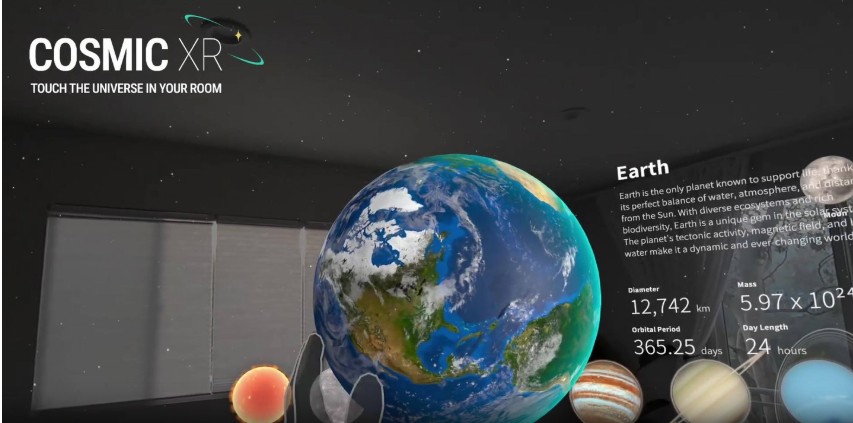
The core concept is simple and brilliant: rather than sending you to space, Cosmic XR brings space to you. Using the passthrough cameras on Quest 3/3S/Pro, the universe appears in your real room — planets float at arm's reach, galaxies billow across your ceiling, the cosmic web stretches through your living space. You reach out with bare hands and touch it. Pick up Earth. Spin Saturn's rings. Hold the Milky Way in your palms. The experience works on Quest 2 in full VR mode without passthrough.

"I wanted people to feel the scale and beauty of the universe — not just see it, but touch it." — Yoon Park, developer of Cosmic XR

That design intention — feel, not just see — is what distinguishes Cosmic XR from other space visualisation tools. The hand interaction makes scale personal in a way no flat screen can replicate. Holding a to-scale representation of Earth while looking up at the Milky Way above you produces the kind of perspective shift that changes how students understand their place in the universe.

Independent reviewers have singled out the ambient music — sometimes compared to the score of Interstellar — as contributing significantly to the experience's meditative, contemplative quality. The passthrough opacity slider allows a seamless transition between full immersion in VR space and the mixed reality mode where the universe coexists with the real room, which has proved particularly valuable in classroom settings.

Content

The Journey — From the Edge of Everything to Your Hands

🕸️
The Cosmic Web & Dark Matter Filaments
Wander through the largest known structure in the universe — the cosmic web — a glowing lattice of dark matter filaments stretching across billions of light-years. See how galaxies are not scattered randomly but are delicately woven into the web of gravity. This is the universe at its grandest scale, made visible and navigable. Outstanding for GCSE and A-Level Physics units on the large-scale structure of the universe and dark matter.
🌐
Laniakea Supercluster
Discover the immense region our galaxy calls home — Laniakea spans over 500 million light-years, encompassing hundreds of thousands of galaxies drifting together through space. Nested within it: the Virgo Supercluster, then the Local Group, and finally the Milky Way. This zoom — from supercluster to our galaxy — is one of the most powerful scale demonstrations in the experience, making comprehensible our galaxy's address in a structure we can barely conceive of.
🌀
The Milky Way & Andromeda
Trace the graceful spiral arms of our home galaxy from an impossible external vantage point — then meet our galactic neighbour Andromeda, watching its spiral arms unfold as it drifts slowly toward us across billions of years on a collision course that will merge the two galaxies into one. This destiny-collision is one of the most striking astronomical facts for students encountering it for the first time.
🕳️
Sagittarius A* — The Supermassive Black Hole
Approach the edge of known physics at Sagittarius A*, the supermassive black hole anchoring the Milky Way — 4 million times the mass of our Sun. See light bend, time distort, and reality begin to unravel at its gravitational horizon. This is perhaps the most dramatically rendered moment in the experience, and connects directly to A-Level Physics and GCSE Astronomy content on black holes, general relativity and the galactic centre.
🪐
Solar System — Touch the Planets
Cradle Earth in your palms. Spin Saturn's rings with a flick of your fingers. Watch storms churn across Jupiter's surface in real time. Explore iconic moons — Ganymede, Titan, Callisto. Inspect human-made explorers: the ISS, Mars rovers, and the Space Shuttle. Each object can be grabbed, rotated, scaled up and studied. This hands-on solar system interaction is the most curriculum-anchored section for KS3 and GCSE Science.
Classroom Use

Why Mixed Reality Makes This Safer for Schools

"The setup is seamless — truly plug-and-play. I could safely manage five students all in close proximity with no fuss, getting clear, real-time oversight of the whole session. The fact that it's in mixed reality helps so much. Kids stay aware of their real-world surroundings, eliminating that usual VR disorientation and keeping everyone grounded."
— Teacher review, Meta Store

The mixed reality mode is the most important feature from a classroom deployment perspective. In standard VR, students are fully occluded from their real environment — they cannot see their classmates, the furniture, or the teacher. This creates genuine safety and supervision challenges, particularly with younger students. In MR mode, the universe exists within the students' real room: they can still see each other, remain spatially aware, and a teacher can watch the whole class without VR headsets going rogue.

The adjustable passthrough opacity means this isn't binary — you can run at partial transparency for the best of both worlds, or at full passthrough for maximum safety with the cosmic content overlaid on the real environment. At full MR, students can point at planets and discuss them with each other in real time. It's a genuinely collaborative learning mode that standard VR cannot offer.

User Reviews

What Are People Saying?

"Wow — honestly just wow! So beautifully created, factually very informative and the visuals are mind blowing. I could sit for hours just enjoying being amongst the stars, planets and other galaxies."
"It's like having a magical, interactive planetarium in your home. The mixed reality integration is impressive, letting celestial bodies float around your real space in a way that feels both educational and awe-inspiring."
"Cosmic XR is definitely a blueprint for other developers to follow in the education sector. It perfectly balances intuitive control and student safety with powerful, collaborative MR learning."
"Putting the universe at your fingertips is very humbling. Perspective is everything and this app gets it right. A must have in your MR arsenal."
"It brings back happy memories of going on a field trip to the planetarium 30 years ago — but with this, it's literally at your fingertips."
Independent reviewer (mixed-news.com): "Whether you are trying out VR for the first time or have been using it for many years: Cosmic XR is a timelessly beautiful experience that belongs in every VR collection."
Curriculum Fit

School & Curriculum Value

KS3 Science (Space)
92%
GCSE Astronomy / Physics
95%
A-Level Physics (Astrophysics)
90%
Wellbeing / Enrichment
92%
Engagement
97%
Ease of use
94%

Cosmic XR delivers exceptional curriculum value across KS3–A-Level science. The solar system section maps directly to KS3 Earth and Space, GCSE Physics Space topics, and GCSE Astronomy content. The cosmic web, Laniakea, galaxy types, Sagittarius A* and black hole physics are all directly relevant to A-Level Physics Astrophysics. The mixed reality passthrough mode is a genuinely important classroom feature — it keeps students spatially aware, allows real-time teacher oversight, and enables collaborative discussion around shared cosmic objects floating in the room. At ~€9 for all Quest headsets (including Quest 2 in VR mode), this is one of the best-value science apps on the platform. The 4.8★ rating across 135 reviews is among the highest of any educational VR app we have reviewed. Described by a teacher reviewer as "a blueprint for other developers to follow in the education sector."

XR School Verdict
Visual spectacle10/10
Scientific content9/10
Hand interaction10/10
MR classroom safety10/10
Planet texture (zoomed)7/10
Value for money10/10
Bottom line: One of the finest educational VR experiences on Meta Quest — full stop. Cosmic XR earns its 4.8★ rating through outstanding science content, brilliantly implemented hand tracking, and a mixed reality mode that solves the biggest classroom deployment challenge in VR. At ~€9 for all Quest headsets including Quest 2, it is an essential purchase for any school with science on the curriculum. An absolute must-have.
🌌 The Scale Journey
Cosmic Web
Billions of light-years · dark matter filaments
Laniakea Supercluster
500M light-years · our galactic neighbourhood
Galaxies · Milky Way · Andromeda
Spiral arms · galactic collision in 4.5bn years
Sagittarius A*
4M solar masses · light-bending gravity
Solar System
All planets · moons · ISS · Mars rovers
Your Hands
Touch, grab, rotate, scale — in mixed reality
Pros & Cons
✓ 4.8★ — 85% five-star — exceptional rating
✓ Hand tracking — touch the universe
✓ Mixed reality — classroom-safe passthrough
✓ Adjustable VR↔MR opacity slider
✓ All Quest headsets — incl. Quest 2
✓ 12 languages including Chinese, Japanese
✓ Cosmic web to solar system in one journey
✓ Meditative Interstellar-esque music
✓ ~€9 — outstanding value
✗ Planet textures low-res when very close up
✗ Solo developer — update pace may vary
✗ MR passthrough requires Quest 3/3S/Pro
Quick Info
PlatformQuest 2/3/3S/Pro
Price~€9 (check store)
DeveloperBRDY Studios / Yoon Park
ReleasedApril 22, 2025
User rating4.8★ · 135 reviews
Mixed Reality✓ Passthrough + opacity slider
Hand tracking✓ No controllers needed
Languages12 incl. Chinese, Japanese
Best forKS3–A-Level Science · GCSE Astronomy
🌌
Get on Meta Store
Cosmic XR · ~€9
© The XR School · VR & AR Apps for Education