✅ All Ages · Ideal for Schools
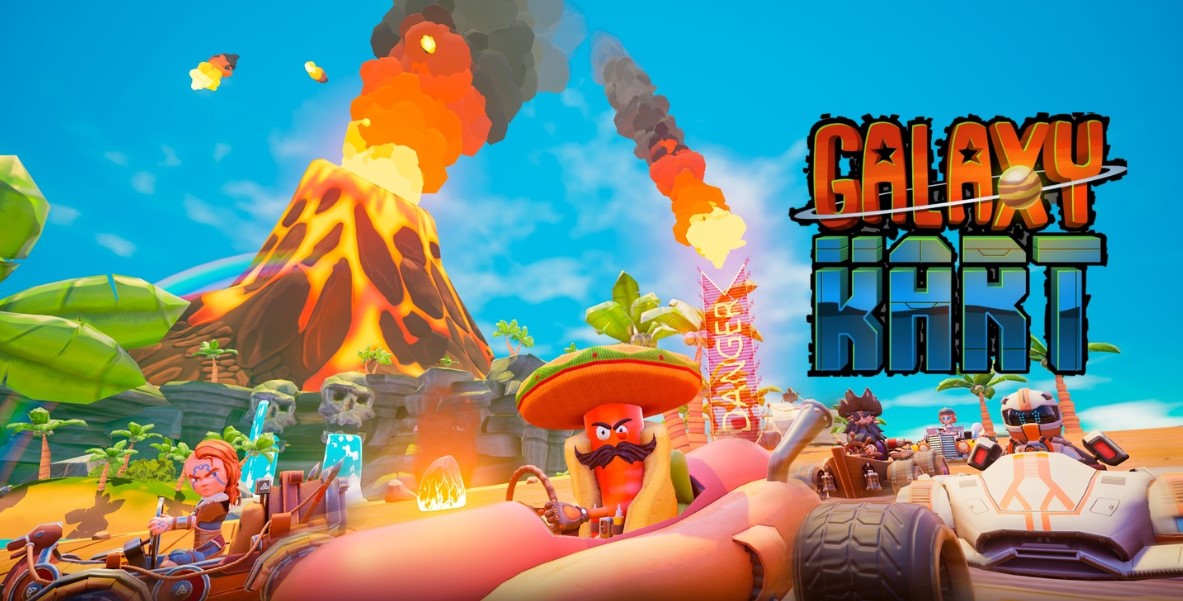
Galaxy Kart has no mature content — it's a cartoonish kart racer in the tradition of Mario Kart. Wacky characters, colourful cosmic tracks and item-based combat involve no violence or age-inappropriate themes. It is one of the most immediately usable VR games in a school context: the physical controls are intuitive, the gameplay loop is instantly understood, and it works brilliantly as a group experience where students take turns and cheer each other on. Suitable for all secondary ages and above without any caveats.
Platform: Meta Quest 2/3 · PSVR2 · PC VR (Steam) ·
Price: $19.99 (frequent sales · free trial) ·
Developer: VRMonkey ·
Released: August 8, 2024 · cross-platform
About the Game
What is Galaxy Kart?
Galaxy Kart is an arcade kart racing game developed by VRMonkey, a studio led by CEO Pedro Kayatt. The original inspiration was a direct one: Kayatt played Mario Kart VR at Bandai Namco's VRZone in Shinjuku, Tokyo, and was immediately struck by the fact that nobody at home could have the same experience. He gathered his team, prototyped a game, and spent five years refining it through App Lab into the full Quest store release that launched in August 2024.
The game is available on Meta Quest, PSVR2 and PC VR — one of the few VR kart racers to span all three major platforms — with cross-platform multiplayer. Each character has their own unique hero ability, and the roster has expanded post-launch with free updates adding the Samurai character Tomoe and Crash Dummy Dan alongside a training mode and a Mega-missile power-up designed to target race leaders.
What makes it different from other kart racers: The physical interaction. In Galaxy Kart you don't press a button to use an item — you physically reach out and grab it from the air, then fling it at an opponent. Boomerangs must actually be thrown. Nitro is activated by physically hitting the boost. The steering wheel is gripped with one or both hands. This physicality transforms a familiar genre into something that is genuinely unique to VR — the tactile satisfaction of lobbing a well-aimed boomerang past another kart has no equivalent in flatscreen gaming.
One of the most impressive things about Galaxy Kart is how well it manages motion comfort. The low, ground-level kart perspective eliminates the vertigo that plagues many VR racing games. Optional blinders reduce peripheral movement during tight corners for those prone to motion sickness — but multiple reviewers note these aren't even necessary once you're accustomed to the game. Developer tip for fast laps: keep eyes on the ground, find the boost pads, and combo boosts with ramps without stopping skill use.
Features
On the Starting Grid
🤲
Physical VR Controls — Steering, Throwing, Boosting
The controls are the game's defining feature. You grab the steering wheel with one or both hands and pull the trigger to accelerate. Items picked up from boxes must be physically grabbed from the air and used — boomerangs are flung at opponents with a throwing motion, nitro boost canisters are activated by pressing them, shields are held up. This makes item use harder than in Mario Kart (where it's a single button press) but dramatically more satisfying when you land a well-aimed throw across the track.
🌌
Cosmic Tracks — Multiple Galaxies & Worlds
Tracks span different galaxies and themed worlds — each with its own visual identity, hazards and layout. Boost pads and ramps are scattered throughout; the developer's own tip for fast times is to combo boosts with ramps and never stop activating skills. The course design is inventive and rewards learning — each track has its own optimal line through the boost network, giving experienced players a meaningful advantage over newcomers.
🦸
Unique Characters with Hero Abilities
Each character has their own unique hero ability that changes how you approach races — adding a layer of strategy beyond pure driving skill. The roster has grown post-launch with free updates: Tomoe the Samurai and Dan the Crash Dummy have both been added at no cost, alongside a training mode for newer players and the Mega-missile power-up (specifically designed to target race leaders). Characters and karts can be customised.
🌀
Motion Comfort — Surprisingly Good for a Kart Racer
The low ground perspective of a kart naturally reduces the sensation of uncomfortable speed that affects many VR racing games. Optional blinders — peripheral vision reducers that activate during tight turns — are available for those more prone to motion sickness. Multiple reviewers across platforms report no motion sickness at all during normal play, making this one of the most accessible VR racing titles for first-time VR players. The training mode also lets new players get comfortable before competitive races.
👥
Cross-Platform Multiplayer
Multiplayer works across Meta Quest, PSVR2 and PC VR — one of the broader cross-platform implementations in VR racing. Championship mode provides structured single-player and competitive play. Note: online lobbies have historically been quiet — the game's playerbase is not large, which can make finding online races in public lobbies challenging. For school use with multiple Quest headsets, direct room-code private matches remove this issue entirely and make it an excellent head-to-head activity. A free trial is available so students can try before any purchase.
School Value
Curriculum & Educational Fit
Engagement / group fun96%
VR intro / first experience90%
Physics (forces, friction)60%
Computing (game design, AI)55%
Galaxy Kart is not a curriculum tool — it's an enrichment and engagement experience, and an exceptionally good one. Its primary value in a school VR library is as a universal crowd-pleaser that works for everyone: the controls are immediately intuitive, the gameplay is universally understood, there is zero content concern, and watching classmates race while waiting a turn creates natural group energy that few VR experiences match.
For Physics, the kart's handling provides an accessible starting point for discussing friction, centripetal force, and the physics of cornering — how speed, mass and turning radius interact. The boost-ramp combo system can illustrate kinetic energy transfer. For Computing, the character hero ability system and item balancing are excellent discussion points for game design, balance and AI difficulty. The cross-platform multiplayer implementation across Quest, PSVR2 and PC VR is also a useful conversation starter about network architecture. Particularly recommended as a first VR experience for students new to headsets — the familiar Mario Kart-style format reduces the cognitive load of learning VR controls, letting students focus on the experience itself.
XR School Verdict
Physical controls & feel9/10
Group / spectator fun9/10
Motion comfort8/10
Track & character variety7/10
Progression system5/10
Online multiplayer activity4/10
Bottom line: The best kart racing game on standalone VR and one of the most universally enjoyable VR experiences available at any price. Completely clean content, intuitive controls, excellent motion comfort and irresistible group energy make it an ideal school VR library addition. The progression system is a grind and online lobbies are quiet — but for school use with private matches these don't matter at all.
Pros & Cons
✓ Best VR kart racer on Quest
✓ Physical item throwing — genuinely fun
✓ Excellent motion comfort
✓ All ages · zero content concerns
✓ Free trial available
✓ Quest · PSVR2 · PC VR · cross-play
✓ Free post-launch characters & content
✓ Training mode for beginners
✓ Brilliant first VR experience
✗ Progression system is a grind
✗ Online lobbies often empty
✗ Limited tracks vs Mario Kart
Quick Info
| Platform | Quest 2/3 · PSVR2 · PC VR |
| Price | $19.99 (+ free trial) |
| Developer | VRMonkey |
| Released | August 8, 2024 |
| Inspiration | Mario Kart VR · Bandai Namco |
| Multiplayer | ✓ Cross-platform |
| Content | ✓ All ages |
| Motion comfort | ✓ Excellent |
| Best for | All ages · Group play · VR intro |
🏁
Get on Meta Store
Galaxy Kart · $19.99 + free trial
🏎️ VR Racing on Quest
Galaxy Kart (this) — arcade kart racing, combat items, all ages, brilliant group fun.
RACECLUB — formula racing sim, time attack, lap times, physics. Older students.
Aces of Thunder — aerial combat, WWII aircraft, historical simulation. 14+.