Overview
What Is It?
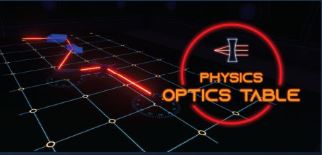
Physics: Optics Table is an educational VR laboratory from Xennial Digital — the Florida-based studio behind the Biology Dissection Lab and Molecule Builder — that puts students at a virtual optics bench equipped with lasers, lenses, mirrors, and prisms. Released in October 2020 on Steam, it is part of Xennial Digital's XD Learning Portal series of curriculum-aligned VR science experiences.
The core experience is the manipulation of optical components in real time to observe, measure, and understand the behaviour of light. Students position a laser source, then introduce lenses, mirrors, or prisms into the beam path and watch the light respond accurately — bending at glass surfaces, reflecting from mirrors at the angle of incidence, splitting into spectral colours through prisms. The simulation updates in real time as components are moved, rotated, or adjusted.
The application supports multiplayer sessions, allowing a teacher to lead a class through guided optical experiments together — more than one student can be present in the virtual lab at the same time. Performance tracking records student interactions, and teacher-led tutorials guide students through key concepts and experiments.
Content
The Optics Physics Covered
Physics: Optics Table covers the core topics of geometric optics at GCSE and A-level — the phenomena that govern how light behaves when it encounters different media and surfaces. These are topics where visual, interactive simulation has a genuinely significant advantage over static diagrams.
🔀
Refraction & Snell's Law
When light passes from one medium to another it bends — the faster it travels in the new medium, the more it bends. Snell's Law (n₁ sin θ₁ = n₂ sin θ₂) quantifies this relationship. In a real school optics lab, demonstrating Snell's Law requires careful beam alignment and measurement. In VR, students can adjust the angle of incidence and observe the refraction directly and immediately, with no alignment errors.
↩️
Reflection & the Law of Reflection
The angle of incidence equals the angle of reflection — the fundamental law of reflection. Students can position mirrors, adjust angles, and immediately verify the law. Concave and convex mirrors produce different image types; converging and diverging effects can be explored with positioned mirrors.
🌈
Prisms & Dispersion
A prism separates white light into its constituent colours because different wavelengths refract by different amounts — the refractive index of glass varies with wavelength. Students can pass a laser through a prism and observe the spectral separation. This directly illustrates both Snell's Law in action and the wave nature of light.
🔍
Lenses — Converging & Diverging
Convex (converging) and concave (diverging) lenses modify light beam paths in predictable ways determined by focal length and object position. Students can manipulate lenses in the beam path and observe image formation — real and virtual images, focal points, the lens formula in action — without the alignment challenges of a physical optics bench.
Why VR is the right medium for optics.
A physical optics bench requires careful alignment of components on a track, accurate angle measurement, and patience with tiny adjustments that don't always produce the expected result. In VR, the alignment is perfect, the light responds instantly and visually, and students can focus on understanding the phenomenon rather than fighting the equipment. The dynamic, real-time visual feedback of a VR optics table removes the barriers that make physical optics practicals frustrating for many students.
Developer
Xennial Digital — A Consistent Quality Signal
Xennial Digital is the same Florida-based studio responsible for the Biology Dissection Lab (5.0★, praised by a 30-year teaching veteran as uniquely effective) and Molecule Builder (endorsed by Penn State University's IMEX programme). Their track record of curriculum-accurate, school-deployable VR applications gives Physics: Optics Table an inherited quality signal.
Physics: Optics Table is part of Xennial Digital's XD Learning Portal — a suite of educational VR experiences designed to complement science curriculum teaching. Like their other titles, it takes a focused, topic-specific approach rather than attempting to cover broad curriculum territory in a single app.
Classroom
How to Use It in Teaching
Physics: Optics Table is designed around two complementary use cases — guided teacher-led sessions and independent student exploration.
👩🏫
Teacher-led multiplayer sessions
Teacher-led tutorials guide the class through a sequence of optics experiments — the teacher demonstrates a setup and students observe or replicate it. The multiplayer mode means students are physically present in the same virtual lab environment, able to see and interact with the same apparatus.
🔬
Independent investigation
Students work independently through optics experiments — arranging components, measuring angles, testing Snell's Law with different media, and comparing converging and diverging lens behaviour. Performance tracking records their interactions for teacher review.
📐 The real advantages over physical optics practicals.
Real optics benches require careful component alignment, take significant setup time, and are sensitive to vibration and ambient light. Students often spend more time on alignment than on understanding the physics. VR removes these barriers: the alignment is perfect, the setup is instant, and students can iterate through configurations rapidly. This is not a replacement for physical practicals (handling real equipment has its own value) but a preparation and reinforcement tool that deepens understanding of what the physical experiments show.
Honest View
What to Be Aware Of
⚠️
PC VR only — not on Meta Quest standalone. Schools running standalone Quest fleets cannot use this without a connected Windows PC. Requires SteamVR and compatible PC VR hardware. This limits deployment to schools that have either PC-tethered VR setups or desktop PCs with PC VR headsets.
⚠️
No public reviews available. The Steam listing has no publicly visible user reviews, making independent quality assessment difficult. The Xennial Digital developer track record (Biology Dissection Lab, Molecule Builder) is the strongest available quality signal. Teachers should request a demo or trial before purchasing for classroom use.
⚠️
Pricing not publicly confirmed. The Steam price was not clearly available at the time of this review — check the Steam store page for current pricing. Xennial Digital positions their education titles for institutional buyers as well as consumers; a school licence enquiry via xennialdigital.com may be worthwhile for volume purchases.
✅
Snell's Law and optics as a topic genuinely benefits from VR. Real optics practicals are notoriously fiddly — alignment, ambient light, measurement precision all create barriers between students and the physics. A VR optics table removes every one of those barriers, letting students focus entirely on the phenomenon. This is one of the strongest subject-VR matches in this entire physics series.
✅
Xennial Digital's curriculum accuracy is established. The same developer who built the 5-star Biology Dissection Lab and Penn State-endorsed Molecule Builder built this. Their educational rigour and school deployment focus gives Physics: Optics Table credibility that new entrants to the market cannot match.
✅
Multiplayer and teacher tutorials are rare features at this price point. Most physics VR apps are single-player. Physics: Optics Table's multiplayer mode supports genuine teacher-led whole-class lab sessions — a meaningful deployment capability that distinguishes it from more consumer-oriented tools.
Our Verdict
XR School Scores
Curriculum Relevance
9 / 10
Snell's Law, refraction, reflection, lenses, and prisms are all GCSE and A-level Physics Required Content. Optics is a topic where VR simulation offers particularly clear advantages over static diagrams and fiddly physical practicals.
VR Suitability for the Topic
10 / 10
Optics is one of the best physics topics for VR simulation — real-time visual light behaviour, instant response to component manipulation, no alignment challenges. The medium and the content are exceptionally well matched.
Classroom Infrastructure
8 / 10
Multiplayer mode, teacher-led tutorials, and performance tracking are genuinely school-appropriate features. PC VR only is the practical constraint — standalone Quest schools need a connected PC.
Evidence Base
7 / 10
Xennial Digital's established track record in educational VR (Biology Dissection Lab 5.0★, Molecule Builder Penn State-endorsed) provides strong indirect quality evidence. No independent public reviews of the Optics Table specifically are available.
Classroom Fit (Quest schools)
5 / 10
PC VR only. Schools running standalone Quest fleets need a PC connection. For schools with PC VR capability the multiplayer mode is excellent; for Quest-only schools the barrier is significant.
Bottom Line
Physics: Optics Table fills a specific and well-justified niche: an interactive VR optics bench for Snell's Law, refraction, reflection, lenses, and prisms — one of the physics topics that most consistently frustrates students in physical labs due to alignment challenges and equipment sensitivity. Built by Xennial Digital (the Biology Dissection Lab team) with multiplayer, teacher tutorials, and performance tracking, it is a properly school-focused product. The PC VR only requirement is the key practical constraint for Quest-fleet schools. For schools with PC VR capability, or as a complementary tool used before physical optics practicals to build conceptual understanding, it is an excellent and highly targeted resource. Check the Steam store for current pricing and request a trial — Xennial Digital's track record in educational VR makes a strong prior case for its quality.