
Virtual Mechatronics Lab
Virtual Mechatronics Lab
Assemble and disassemble real electric motors, operate an industrial production line, manage a waste sorting facility — all in VR. University-grade mechatronics training built on peer-reviewed research by four European universities and Erasmus+ funding. Free to download.
What is Virtual Mechatronics Lab?
Virtual Mechatronics Lab (ViMeLa) is a free VR training platform for mechatronics education, available on Meta Quest. It was developed as part of the Erasmus+ Strategic Partnership project (Ref: 2017-1-PL01-KA203-038675) led by Lodz University of Technology in Poland, with partners at Ss. Cyril and Methodius University in Skopje, University of Tartu in Estonia, and the University of Pavia in Italy.
Mechatronics — the integration of mechanical engineering, electrical engineering and computer science — is one of the most important technical disciplines for modern manufacturing. The ViMeLa project was created to address a specific and well-documented problem: students studying mechatronics at university level typically have very limited access to the expensive industrial machinery they need to learn on. Labs are overbooked, equipment gets damaged, certain experiments are too hazardous to run freely, and students who miss a session may not be able to repeat it in the same semester.
Published peer-reviewed research in the journal Technology, Knowledge and Learning (Springer, 2020) evaluated the tool's effectiveness and found strong positive feedback from both educators and students, confirming it as a genuine aid to knowledge acquisition rather than a novelty. The 3D models were built to exact technical documentation of real devices — this is not a simplified simulation, it is a faithful digital representation of actual industrial machinery.
Three Industrial Training Scenarios
The core scenario. Students work with 3D models of real electric motors — built from authentic technical documentation — and can virtually assemble and disassemble individual components: rotor, stator, permanent magnets, windings, bearings, housing, brushes and rotor bars. The simulation module presents the operating principles of different motor types used in mechatronic systems.
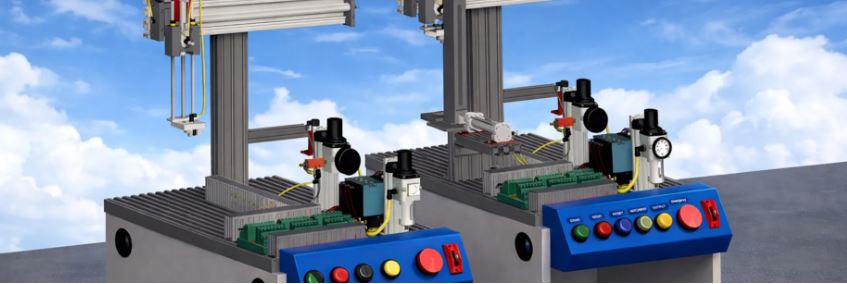
A virtual industrial warehouse with an automated package sorting conveyor line. Students select appropriate components, program PLC (Programmable Logic Controller) controllers, and configure sensors to control the sorting process. This scenario teaches the industrial automation fundamentals that are central to modern manufacturing — a subject almost impossible to teach at school level without access to extremely expensive equipment.
An industrial and domestic waste sorting line with belt conveyor, using capacitive sensors to detect and separate different materials. Students configure the sensing parameters and observe how material composition affects detection signals — the capacitance of detected material determines the sensing current through a defined transfer function. Cross-curricular with environmental engineering and sustainability.
SMSCP Skilldrive Training Sim
The same Virtual Mechatronics Lab team has published a second free app: SMSCP Skilldrive Training Sim, which simulates key modules of the Siemens Mechatronic Systems Certification Program (SMSCP) — one of the most internationally recognised mechatronics qualifications in industry.
It has two scenes: a Sensors Scene (virtually connect and test different types of sensors in real time) and a Gears Scene (explore gear types, their operation and real-world applications). Each module includes educational panels, theory summaries and an interactive quiz.
Together, Virtual Mechatronics Lab and SMSCP Skilldrive form a complementary pair: the former covers broad mechatronics scenarios (motors, production line, sorting); the latter targets the specific skills and theory mapped to the Siemens certification pathway. Both are free.
Peer-Reviewed Evidence
Unlike most VR education apps, Virtual Mechatronics Lab has a substantial body of published academic research behind it. The project has been presented and evaluated at multiple international conferences and in peer-reviewed journals, including a 2020 paper in Technology, Knowledge and Learning (Springer Open Access) that specifically evaluated its educational effectiveness.
Who Is This For?
This app's primary audience is vocational engineering — BTEC Level 3 Engineering, T-Level Engineering and Manufacturing, HNC/HND in Engineering, and university-level mechatronics courses. It is the most technically advanced free VR education app on Meta Quest. Secondary school students studying A-Level Design Technology or Physics may find the electric motor scenario relevant to their content, but the industrial automation scenarios are genuinely university/vocational level in depth. For BTEC and T-Level teachers, this is a genuinely rare free resource for a subject area where VR content is almost non-existent.
How Does It Compare?
3 scenarios
Electric motors
Production line
Peer-reviewed
GCSE-level
Electricity
Nuclear
Teacher portal
Broader STEM
KS3–KS4 level
Chemistry, biology
EU Erasmus+
Physics through play
KS3–KS4 level
Chain reactions
All ages
SMSCP Skilldrive Training Sim — simulates modules of the Siemens Mechatronic Systems Certification Program. Sensors scene + Gears scene, each with theory panels and interactive quiz.
View on Meta Store →| Platform | Meta Quest |
| Price | FREE |
| Project | ViMeLa · Erasmus+ KA203 |
| Lead university | Lodz University of Tech. |
| Partners | Skopje · Tartu · Pavia |
| Scenarios | 3 (motors, production, sorting) |
| Age / level | 16+ / vocational / HE |
| Subject | Mechatronics · DT · Eng. |
| Research | Springer 2020 — peer reviewed |
| Companion app | SMSCP Skilldrive (free) |