
Chemistry

The VR Chemistry Lab

Home β€Ί Science β€Ί Chemistry β€Ί The VR Chemistry Lab
🧫
βš›οΈ
Hβ‚‚O
COβ‚‚
πŸ”¬ Chemistry Β· Molecular Science Β· VR Β· All Meta Quest
πŸŽ“ Research-Backed

The VR Chemistry Lab

Conduct school chemistry experiments in a virtual lab β€” then shrink to the size of a molecule and interact with the chemistry as it happens at the atomic scale. A peer-reviewed, research-backed experience built by an academic for under $3.

$2.99 Lowest-priced app in this series
πŸ“„ Peer-reviewed (Hu-Au & Okita, 2021)
πŸ₯½ All Meta Quest headsets πŸŽ“ Elliot Hu-Au, Ed.D. Β· Columbia University ⭐ 4.1β˜… Β· 7 ratings
Overview

What Is It?

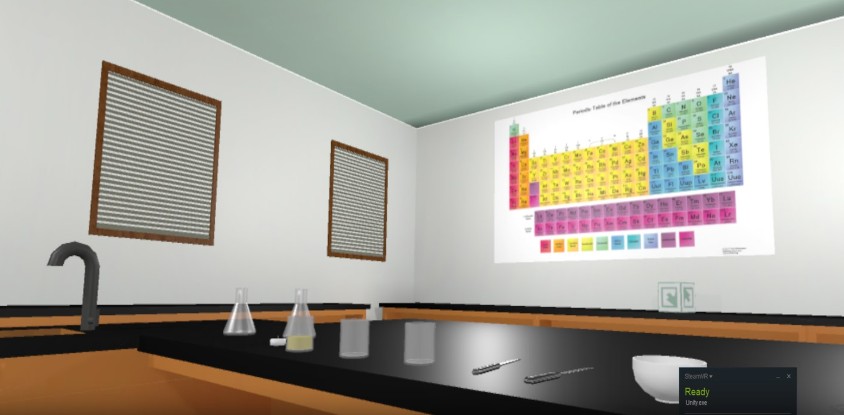
The VR Chemistry Lab is a standalone Meta Quest app that does two genuinely distinct things β€” and the combination of them is what makes it special. First, it simulates a school chemistry laboratory where students can conduct experiments at a virtual lab bench. Second, it lets you shrink down to the size of a molecule and enter the experiment at the atomic scale, interacting with the molecules as the chemistry happens around you.

It was built by Elliot Hu-Au, now an Assistant Professor of Computer Science Education at Montclair State University, as a Master's research project at Teachers College, Columbia University in 2017. It took four years of research and refinement before its public release on the Meta App Lab in November 2021. That development arc is not incidental: it reflects a deliberate commitment to understanding whether and how VR actually improves chemistry learning β€” rather than just assuming it does.

The result is peer-reviewed educational software at $2.99 β€” the most thoroughly validated and the least expensive app in this chemistry series. It is still a work in progress, with more content planned, but what exists already delivers on its core promise.

Research Foundation

Built on Learning Science

Unlike most educational VR apps that simply apply VR to a subject and hope for the best, The VR Chemistry Lab was designed from the ground up on established learning theory and validated through empirical research.

🧱 Constructivism
Students build understanding by actively constructing knowledge through experience β€” not passive reception. The hands-on lab activities and manipulable molecular models are deliberate applications of constructivist design.
🀲 Embodied Cognition
Learning is shaped by physical interaction with the environment. By letting students manipulate molecules and equipment with their hands in 3D space, the app engages the body in cognition β€” which research suggests enhances retention of abstract concepts.
πŸ“„ Comparable to Real Labs
A peer-reviewed study (Hu-Au & Okita, 2021) found the VR Chemistry Lab provides comparable learning outcomes to real-life laboratory situations. This is a meaningful evidence base β€” particularly for contexts where physical lab access is limited.
The bridge metaphor

Hu-Au describes the app as designed to be "a bridge between the real-life chemistry experience and a model of the abstract concepts that are usually difficult to visualize." This framing is important: The VR Chemistry Lab is explicitly designed as a complement to physical lab work, not a replacement β€” and as a vehicle for the molecular-level visualisation that no physical lab can provide.

Content

Two Experiences in One App

The VR Chemistry Lab contains two distinct modes that together span both macro and molecular-scale chemistry β€” a combination that distinguishes it from apps that operate at only one scale.

πŸ§ͺ
The Chemistry Lab

A virtual school chemistry laboratory where students interact with the bench, equipment, and reagents. Activities include conducting experiments and a game that simulates catalyzing a chemical reaction. Users reported finding the graphics polished and the educational content engaging β€” though some interface interactions (measuring spoons, tool handling) can feel awkward, and hand tracking is not yet supported.

Lab bench experiments Chemical reaction game Equipment interaction Catalysis simulation
βš›οΈ
The Molecular World

The headline feature β€” and one of the most distinctive experiences in any chemistry VR app reviewed on this site. Students shrink to the size of molecules and enter the experiment at the atomic scale, surrounded by life-size molecular models of the chemicals involved. This is an experience physically impossible in any real laboratory: being present inside a reaction as it happens, exploring and interacting with the molecules themselves.

Life-size molecules Enter the reaction Molecule building Atomic-scale exploration
πŸ” Why the molecular world matters. The shift between macro lab scale and molecular scale in a single experience is genuinely unusual. Students can conduct an experiment, then immediately shrink inside it to see why it works at the molecular level. This directly addresses one of chemistry education's hardest problems: helping students connect the observable macro world with the abstract molecular explanations that underpin it.
Developer

Who Built It

Elliot Hu-Au, Ed.D. is an Assistant Professor of Computer Science Education at Montclair State University, where he runs the Hu-Au XR Lab researching human-computer interactions and immersive learning. He holds a doctorate in Instructional Technology and Media from Teachers College, Columbia University and an undergraduate degree in Astrophysics from UC Berkeley.

The VR Chemistry Lab is both his ongoing research tool and a commercial product he develops and maintains himself alongside his academic career. It has been featured in Columbia University's "Diving into the Metaverse" programme and used at TC Columbia for student demonstrations. Hu-Au also runs virtualrealityforeducation.com, a website sharing VR research with the education field.

πŸ›οΈ The Columbia / Teachers College connection. The VR Chemistry Lab originated as doctoral research at one of the world's most respected education research institutions. The peer-reviewed publication (Hu-Au & Okita, 2021) confirming comparable learning outcomes to real labs was produced through that academic context β€” giving the app an evidence base that the vast majority of educational VR products simply don't have.
User Feedback

What Users Are Saying

With 7 ratings (4.1β˜…) and 2 written reviews, the sample is small β€” but the feedback is detailed and consistent. Both positive and critical points are worth noting.

βœ… What users praise
Educational value and immersive experience
Polished graphics and engaging content
Molecular exploration particularly impressive
Strong potential for education
⚠️ What users flag
Some interface issues β€” measuring spoons, tool interaction feel awkward
No hand tracking β€” controller-only
Minor glitches as expected from an App Lab origin
Desire for more content and future updates
EH
Elliot Hu-Au, Ed.D.
Creator Β· virtualrealityforeducation.com

"For less than a cup of coffee or bubble tea you can do numerous experiments in a chemistry lab or experience life-size atoms and molecules. It is designed to be a bridge between the real-life chemistry experience and a model of the abstract concepts that are usually difficult to visualize."

Source: virtualrealityforeducation.com Β· 2021
Honest View

What to Be Aware Of

⚠️
Limited content at present. As a solo-developer academic project, the volume of experiments is modest compared to dedicated products like VLab Education or the Dissection Lab. Users want more β€” and Hu-Au has indicated more is coming β€” but at the time of review the experience is focused rather than extensive. Given the $2.99 price, the content-to-cost ratio is still excellent.
⚠️
Some interface rough edges. Users specifically noted awkward interactions with certain lab tools (measuring spoons) and the absence of hand tracking. As an App Lab origin product developed by one person, these are expected limitations β€” not dealbreakers, but worth knowing before deploying in a class.
⚠️
Solo academic developer. Hu-Au builds and maintains this alongside a full-time academic career. Updates and new content come on a research timeline, not a commercial product schedule. The app is actively maintained but the pace of development reflects those constraints.
βœ…
Peer-reviewed evidence base. A published study (Hu-Au & Okita, 2021) found comparable learning outcomes to real laboratory situations. In a field full of products making educational claims without evidence, this is genuinely significant. It is one of only a small number of educational VR apps on any platform with a peer-reviewed efficacy study behind it.
βœ…
The molecular world is unique. No other app in this series lets students enter an experiment at molecular scale while it is happening. This is a genuinely unrepeatable experience β€” not available in any physical lab β€” and it directly addresses the most common source of confusion in school chemistry: connecting visible reactions to the atomic-level models that explain them.
βœ…
$2.99 β€” the lowest price in this entire series. Works on all Quest headsets including Quest 2. There is virtually no financial barrier to getting this onto school headsets and letting students try it.
Our Verdict

XR School Scores

Educational Value 8 / 10
Research-backed comparable learning outcomes, sound theoretical design, unique macro-to-molecular bridge. Content breadth is modest at present but the depth of what's there is strong.
Molecular World Experience 10 / 10
Entering an experiment at molecular scale is genuinely unique in this review series. Users specifically called this out as impressive. Nothing else reviewed here offers this experience.
Ease of Use 6 / 10
Some interface interactions are awkward (measuring spoons, tool handling). No hand tracking. Minor App Lab-origin glitches. Not a showstopper, but the polish is noticeably lower than dedicated commercial products.
Classroom Fit 7 / 10
Works on all Quest headsets. No curriculum packs (teacher builds own context). Interface issues mean some supervision may be needed. Best suited as a 20–30 minute exploration activity with a clear molecular-scale learning objective.
Value for Money 10 / 10
$2.99. Peer-reviewed learning efficacy. Works on all Quest headsets. Lab simulation plus unique molecular world. At this price there is zero financial barrier β€” just install it.
Bottom Line

The VR Chemistry Lab is something unusual in educational VR: a $2.99 app with a peer-reviewed efficacy study showing it delivers comparable learning outcomes to real laboratory work. Built over years of doctoral research at Teachers College, Columbia University, it is grounded in learning science β€” constructivism and embodied cognition β€” in a way that most commercially produced apps are not. Its standout feature is the molecular world mode, where students shrink inside a chemical reaction and interact with the molecules at atomic scale β€” a genuinely unique experience unavailable in any other app in this series. The interface has rough edges and the content library is modest for now, but at $2.99 on all Quest headsets, the barriers to trying it are essentially zero. Highly recommended as a complement to any GCSE or A-level chemistry unit covering particle models, reactions, or molecular structure.

Quick Facts
Price $2.99
Developer Elliot Hu-Au, Ed.D.
Institution Columbia Univ. / Montclair State
Platforms All Meta Quest headsets
Meta rating β˜…β˜…β˜…β˜…β˜† 4.1 (7)
Research Peer-reviewed (2021)
Origins Columbia TC Master's project 2017
Hand tracking Not yet
Age Rating Everyone
Curriculum Fit
KS3 Chemistry β˜…β˜…β˜…β˜…β˜†
GCSE Chemistry β˜…β˜…β˜…β˜…β˜…
A-Level Chemistry β˜…β˜…β˜…β˜…β˜†
University / HE β˜…β˜…β˜…β˜†β˜†
Macro–Molecular Bridge β˜…β˜…β˜…β˜…β˜…
πŸ“„ Research Paper

Hu-Au, E. & Okita, S. (2021) β€” peer-reviewed study confirming comparable learning outcomes to real-world lab situations. Published via Teachers College, Columbia University.

virtualrealityforeducation.com β†’
βš›οΈ Unique in This Series

No other app reviewed here lets you shrink inside a chemical reaction at molecular scale while it's happening. This is a genuinely unrepeatable experience β€” not available in any physical lab or any other VR chemistry app in this series.

Review by The XR School Β· Chemistry Β· Science