
ChemistryFree

Tablecraft

Home Science Chemistry Tablecraft
⚗️
🧪
He
Ra
Au
⚗️ Chemistry · Periodic Table · VR · All Meta Quest
🆓 Free

Tablecraft

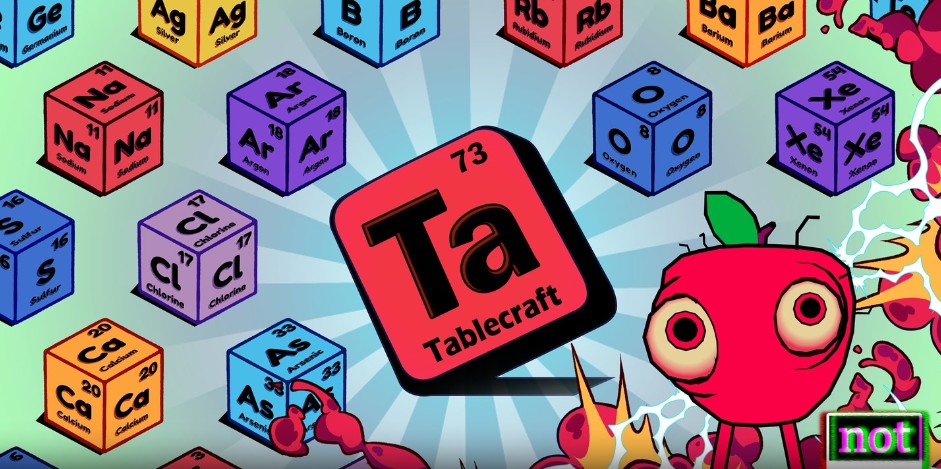
A free VR mad-science sandbox — combine real elements from the Periodic Table to craft over 80 recipes, discover 900+ isotopes, manage radioactive decay, run a lab shop, and feed your inventions to a mutant creature. Science never looked this fun.

★★★★☆ 4.35 35 verified reviews
🏛️ $1M NSF Grant
🏆 Games for Change 2025 Award
🥽 Quest 2 / 3 / 3S / Pro 🔬 Not Suspicious 🧬 118 elements · 900+ isotopes 🚧 Early Access
🚧 Early Access — Tablecraft launched in early access in January 2025. The developer has noted that major new features are currently paused while the studio supports another title. The core experience is complete and free to play, but expect continued development and updates over time.
Overview

What Is It?

Tablecraft is a free VR science sandbox from Not Suspicious — a two-person indie studio founded by UCF/FIEA alumni and Fulbright Scholars Rafael Brochado and Guillaume Bailey. It has been in development since 2017, backed by a $1 million National Science Foundation grant, and launched on the Meta Quest Store in January 2025. It won a Games for Change 2025 Award — recognition that places it among the most distinguished educational games of its year.

The core concept is deceptively simple: you combine atomic blocks representing real chemical elements to craft physical objects, using a device called the Pro-Craftinator. The Periodic Table is your ingredient list. The chemistry is real — element properties, atomic mass, group behaviour, isotope variants, and radioactive decay all behave consistently with actual chemistry. But the framing is anything but a textbook: this is a mad-scientist sandbox where helium makes things float, radium makes things glow (and makes other blobs ill from radiation poisoning), and you feed your creations to a mutant creature in your lab.

The result is something genuinely unusual in chemistry education: an experience that makes the Periodic Table feel like a toybox rather than something to memorise — while still teaching students real element properties, atomic masses, groups, and isotope behaviour through direct interaction.

Gameplay

How It Works

⚗️
The Pro-Craftinator & Element Combining
Your central tool lets you combine atomic blocks — each representing a real element — to create objects from a list of over 80 recipes. The recipes are grounded in actual element properties: making glass requires silica, steel requires iron and carbon, and so on. Students learn chemistry by doing rather than memorising.
☢️
Isotopes & Radioactive Decay
Modify the neutrons in any atomic block to explore over 900 isotopes of all 118 elements. Radioactive isotopes shake and rattle in your hand until they decay into stable forms — a physical, visceral representation of nuclear instability. The Isotope Index tracks every variant and its decay chain. This goes well beyond standard GCSE and into A-level nuclear chemistry territory.
🏪
Lab Shop & Visitor Requests
As word of your inventions spreads, visitors arrive with requests. Trading crafted objects funds further research and provides more elements — adding a resource-management loop that drives continued exploration and incentivises students to push further into the Periodic Table.
🐾
The Mutant Pet
Your mutant laboratory creature reacts differently depending on what you feed it. Helium makes it float. Radium makes it glow — and irradiates nearby blobs. This is equal parts absurd fun and surprisingly accurate chemistry — and exactly the kind of memorable anchor that makes element properties stick. Students will remember that helium is lighter than air long after forgetting it from a textbook.
Science Content

The Chemistry Inside the Game

Tablecraft teaches chemistry through direct experience rather than instruction. Students who spend time with it will absorb the following, whether they realise it or not:

Element symbols & names Atomic mass Periodic Table groups Element properties & behaviour Neutrons & isotopes Radioactive decay Stable vs unstable isotopes Nuclear stability Compound composition (recipes) Matter & materials science
🧬 Beyond the basics. The isotope system and radioactive decay mechanics go further than GCSE chemistry demands — they touch on A-level and even undergraduate nuclear chemistry. This makes Tablecraft genuinely useful across a wider age range than most chemistry apps.
Voices

What People Are Saying

T
Experienced Science Teacher
30 years' teaching experience · 6th and 8th grade science

"In the 30 years I've been teaching, I believe Tablecraft is effective at engaging students who aren't passionate about the classroom environment — including students who have learning disabilities and those who are normally hardest to motivate."

Source: Not Suspicious · notsuspicious.biz/tablecraft
OS
Orlando Science Center
Museum partner · STEM education organisation · Orlando, Florida

"Our volunteers often report particularly long lines of both adults and children interested in playing it. We love the way you've turned the Periodic Table into something that's tangible, fun and interactive for students and visitors. Your work aligns excellently with our own ongoing efforts and mission to inspire science learning for life."

Source: Not Suspicious · notsuspicious.biz/tablecraft
G4C
Games for Change
2025 Award Winner · games4change.org

Games for Change is the world's leading not-for-profit dedicated to games for social impact. A 2025 award from this organisation places Tablecraft among the most recognised educational games of its year — evaluated against games from major studios worldwide.

Source: Games for Change 2025 · games4change.org
Classroom

Who It Works Best For

Tablecraft has a particular strength that deserves direct attention: it reaches students who conventional chemistry teaching doesn't. The teacher testimonial above — from someone with 30 years of classroom experience — specifically calls out students with learning disabilities and those who are hardest to motivate as being especially engaged.

This is not an accidental effect. The NSF-funded research behind the game was specifically designed to address the problem of chemistry being perceived as difficult and inaccessible for first-time learners. The game targets exactly the students most at risk of being put off chemistry at the point of first contact — typically around Year 9 when the Periodic Table first appears in earnest.

🎯 First-exposure learners
Students encountering the Periodic Table for the first time — KS3/Year 9 — get a sandpit to explore before formal instruction. Curiosity first, memorisation later.
🎯 Hard-to-motivate students
The sandbox structure, mutant pet, and shop system provide intrinsic motivation that bypasses the resistance many students have to formal chemistry instruction.
🎯 GCSE & A-level consolidation
The isotope and radioactive decay system goes beyond GCSE and into A-level territory — providing genuine stretch for higher-attaining students in the same experience.
Honest View

What to Be Aware Of

⚠️
Early access with features paused. Not Suspicious has been transparent that Tablecraft's roadmap has been partially put on hold while the studio supports its other title, Airspace Defender. The core game is complete, but planned additions are delayed. This is an honest indie-studio reality, not a red flag — but buyers should know the state of play.
⚠️
Small review sample. 35 verified reviews is a modest dataset. The 4.35★ average is encouraging, but we'll have a clearer picture as the user base grows. The teacher and institutional testimonials are arguably more informative at this stage.
⚠️
No structured curriculum materials. Like Out of Scale, this is a sandbox experience rather than a structured lesson product. Teachers need to build their own framing — though the open-ended nature is also what makes it accessible for reluctant learners.
Free, with all Quest headsets supported. Zero cost, works on Quest 2 — the most common school headset. There is no barrier to trying it with a class beyond putting it on the headsets.
$1M NSF funding + Games for Change Award. This is not a hobbyist project. Federal science education research funding and a major games-for-impact award together signal that the educational design has been scrutinised and validated at a serious level.
Built by researchers, not just developers. Both founders are Fulbright Scholars who studied at UCF's Florida Interactive Entertainment Academy — specifically to build educational VR. This has been a research project from day one, not a commercial venture that added educational labels after the fact.
Our Verdict

XR School Scores

Educational Value 9 / 10
NSF-funded, Games for Change award-winning, grounded in real chemistry across all 118 elements and 900+ isotopes. Genuinely teaches Periodic Table familiarity through play rather than rote.
Engagement & Fun Factor 9 / 10
The Orlando Science Center reports long queues of children and adults wanting to play. A 30-year veteran teacher describes it reaching students that nothing else does. The mutant pet is inspired.
Ease of Use 8 / 10
Sandbox structure means no strict on-rails guidance — students set their own pace. Sitting, standing and room-scale all supported. Early access status means some rough edges may remain.
Classroom Fit 8 / 10
Free, Quest 2 compatible, open-ended sandbox that works as enrichment or introduction. No built-in curriculum — teacher adds context. Strong fit for start-of-topic engagement or free-choice STEM sessions.
Value for Money 10 / 10
Free. All 118 elements, 900+ isotopes, crafting, radioactive decay, shop management, and a mutant pet. At zero cost on Quest 2, the only investment is the time to put it on the headsets.
Bottom Line

Tablecraft is the most distinctive chemistry app in this review series — a sandbox with genuinely good science that has been six years in the making, backed by $1 million in NSF funding, and designed with a specific mission: make the Periodic Table feel like a toybox. It reaches students that conventional chemistry teaching doesn't, which makes it especially valuable as a classroom tool. It is free, works on Quest 2, and won a Games for Change 2025 Award. The early access status and lack of built-in curriculum are the only honest caveats. Install it, use it at the start of a Periodic Table unit, and let the mutant pet do the rest.

Quick Facts
Price Free
Developer Not Suspicious
Platforms All Quest headsets
Launch January 2025 (EA)
Meta rating ★★★★☆ 4.35 (35)
NSF Grant $1,000,000
Award Games for Change 2025
Elements All 118
Isotopes 900+
Recipes 80+
Age Rating Everyone
Curriculum Fit
KS3 Chemistry ★★★★★
GCSE Chemistry ★★★★★
A-Level Chemistry ★★★☆☆
Primary / KS2 ★★★☆☆
STEM Enrichment ★★★★★
💬 Developer Community

Not Suspicious actively seeks feedback on their Discord channel and tests Tablecraft with real students and science centre visitors. If you use it in a classroom, consider sharing your experience with the developers.

notsuspicious.biz/tablecraft →
🏛️ Research Backing

Tablecraft has been awarded a $1 million grant from the National Science Foundation to support its development as a VR first-exposure tool for physical sciences. NSF education funding requires peer review and demonstrated research value — this is serious institutional validation.

Review by The XR School · Chemistry · Science · Free