
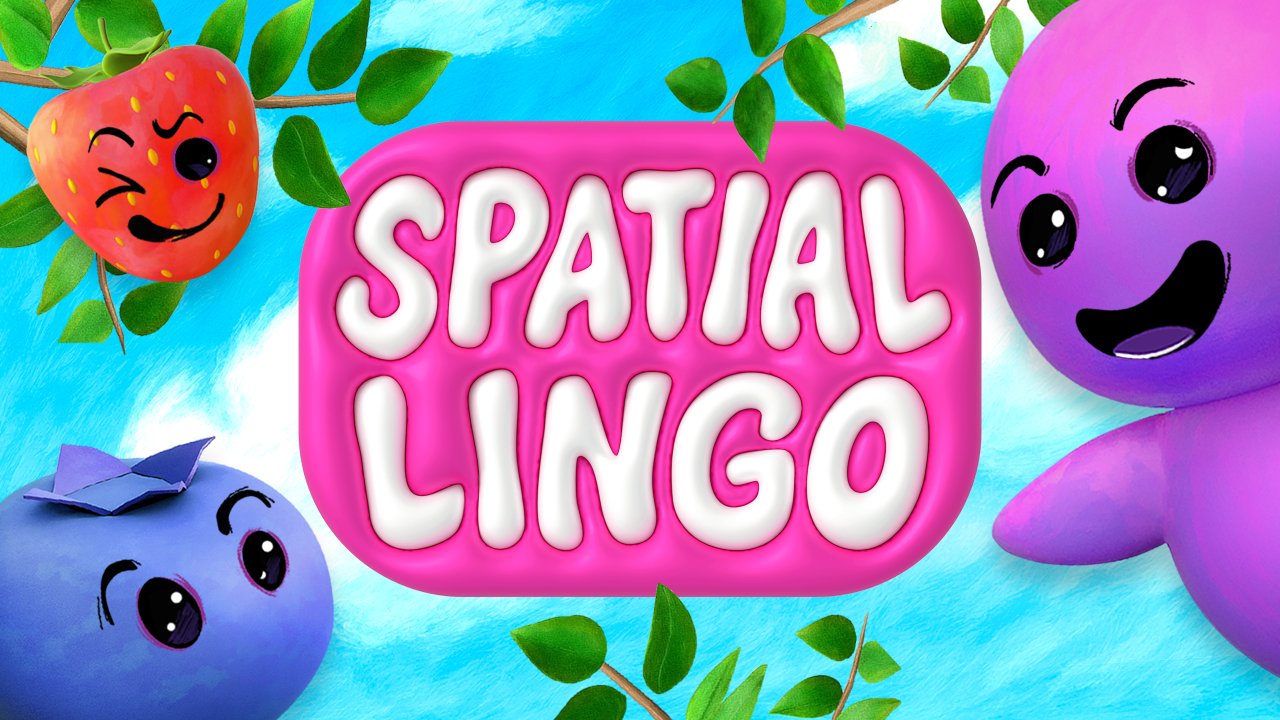
Spatial Lingo: Language Practice
Spatial Lingo
Look at the mug on your desk and the word taza appears floating above it. Spatial Lingo uses your Quest’s cameras to recognise the real objects in your room, labels them in your target language, and asks you to say sentences out loud while a cheerful guide called Golly Gosh checks how you did. It is free, it is genuinely clever, and it is the clearest glimpse yet of where mixed reality language learning is heading.
Quest 3 and 3S only
Spatial Lingo: Language Practice is a free mixed reality app published by Meta and built for it by the immersive studio Magnopus. It arrived on the Meta Horizon Store on 17 December 2025, and in January 2026 Meta released its full source code on GitHub under the MIT licence. Meta describes it as a showcase app: a working example of what developers can build by combining the Quest’s passthrough cameras with on‑device object detection and a large language model. That dual purpose matters, because Spatial Lingo is both a learning app you can use today and a template other developers are already building on.
The idea is simple and instantly understandable. Instead of placing you inside a virtual restaurant or train carriage, as Mondly VR does, Spatial Lingo keeps you in your own room. The headset recognises everyday objects around you, such as a chair, a cup, a laptop or a plant, and floats translated labels above them. You then practise using those words in speech, and an AI evaluates whether you used them correctly.
Golly Gosh speaks the target language aloud, so you hear correct pronunciation before you attempt it yourself. The evaluation goes beyond single word recognition: Meta says the AI checks whether the target words are used correctly, including verb conjugation and basic sentence structure. The default setup practises Spanish, and the app can also be used to practise English, which makes it relevant to learners of English as an additional language as well as Spanish students.
Object detection runs on the headset itself, using a YOLO model trained on a standard dataset of everyday object types. Cropped images of detected objects are then sent to Meta’s Llama API, which generates the vocabulary, translates it and judges your spoken answers. Speech is transcribed and Golly Gosh’s voice is synthesised with Meta’s Voice SDK. The practical consequence is that the app needs an internet connection throughout, and that it recognises common household items far more reliably than specialist or unusual objects.
The two complement each other well. Spatial Lingo builds the first layer of everyday vocabulary in a setting the learner already knows; Mondly VR then puts that vocabulary to work in simulated real world situations.
- Completely free, with no ads or in‑app purchases
- Labels real objects in your own room, a strong memory aid
- AI checks full spoken sentences, not just single words
- Golly Gosh models pronunciation and keeps feedback encouraging
- Language Tree gives younger learners a visible reward
- Works with hand tracking or controllers
- Comfortable for all users: no artificial movement
- Open source, so schools and developers can study or adapt it
- Only English and Spanish at present
- Horizon Store listing is for US users only
- Quest 3 and 3S only: no Quest 2 or Quest Pro support
- Needs a constant internet connection
- Beginner vocabulary only, no structured course
- Single player, and needs some clear floor space
- Very few store ratings so far (around 2.6/5 from 5)
- Developer
- Meta (Oculus DevTech Samples) • built by Magnopus
- Released
- 17 December 2025 • open sourced January 2026
- Price
- Free • no ads
- Platform
- Meta Quest 3 • Quest 3S
- Practise
- English or Spanish
- Type
- Mixed reality (passthrough) • single player
- Input
- Hands, controllers and voice
- Comfort
- Comfortable • room scale
- Internet
- Required
- Download size
- About 0.5 GB
- Best level
- A1 beginner vocabulary