
Biology

Ocean Rift

The XR School › Science › Biology › Ocean Rift
$9.99 • One‑time purchase Llyr ap Cenydd • Picselica Education mode • 40+ narrated points Meta Quest • PC VR
The world’s first VR aquatic safari park • 4.1 stars from 781 Quest reviews • Mixed reality mode on Quest

Ocean Rift

Swim with dolphins, come face to face with a great white shark, drift over coral reefs and explore the ruins of Atlantis. Ocean Rift is an underwater safari park with more than a dozen habitats and an education mode that narrates facts about the animals as you meet them. It has been a favourite first VR experience for years, and it still holds up.

Developer: Llyr ap Cenydd
Publisher: Picselica Ltd
Price: $9.99 (Quest and Steam)
Subject: Marine biology • Habitats • Adaptation
8.0
/10
XR School Score
Highly Recommended
Beautiful habitats • Narrated education mode • Standalone on Quest • Hand tracking • Low price • Sharks can startle young players
4.1 • Meta store 781 reviews
Very positive
Overview

Ocean Rift calls itself the world’s first VR aquatic safari park, and it has a strong claim to the title. It began life in 2013 as a free demo for the original Oculus Rift development kit, was created by developer Llyr ap Cenydd and is published by Picselica Ltd. It has since appeared on Gear VR, Oculus Go, the first Quest, Steam and today’s Meta Quest headsets, where it launched on 21 May 2019.

The Quest version offers 14 habitats (the Steam listing describes 12), including coral reefs, mangrove swamps, shipwrecks, the deep sea, the Arctic and the lost city of Atlantis. Among the residents are dolphins, sharks, orcas, turtles, sea snakes, rays, manatees, sea lions and whales, plus some prehistoric marine reptiles. The main animals use procedural animation, which gives them natural, lifelike movement rather than looping routines.

An Education Mode Built In What lifts Ocean Rift above a simple aquarium is its education mode. More than 40 narrated information points introduce the animals and their habitats, so students learn while they explore rather than just looking. Pair that with genuinely impressive encounters, such as a whale gliding overhead, and you have a lesson starter that makes ocean ecosystems real.
What You Can Explore
🪸
Coral reefs
Bright, busy reef ecosystems full of fish, turtles and rays.
🧊
Arctic waters
Cold water habitats with the animals adapted to survive there.
🌊
The deep sea
Dark, mysterious depths that show how life changes with depth and light.
🏛️
Shipwrecks and Atlantis
Fun, imaginative areas that keep younger explorers engaged.
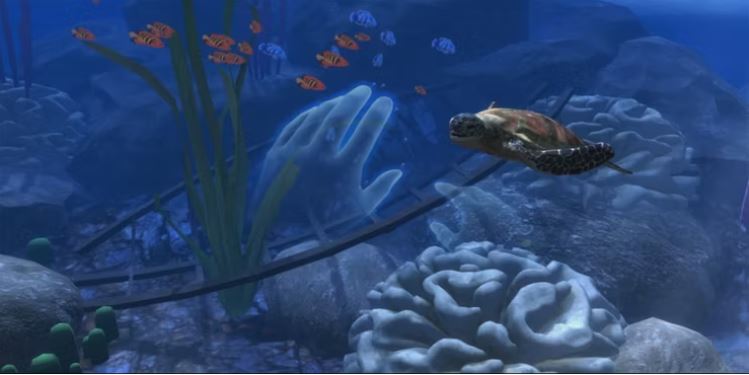
Turn the Classroom Into an Aquarium An update in December 2023 added a mixed reality mode for Quest 3, Quest 2 and Quest Pro. You draw windows on your real walls with your fingers, and each one opens onto the underwater world, so sea life appears to swim past the classroom. You can even replace the ceiling with a glass view of the ocean above. It is a gentle option for students who find full immersion overwhelming.
Ocean Rift vs theBlu
Feature
Ocean Rift
theBlu
Freedom
Swim freely across many habitats
Mostly fixed viewpoint scenes
Learning
40+ narrated information points
Atmosphere over facts
Mixed reality
Yes, on Quest
Not a feature focus
Best for
Exploring and learning about species
Calm, cinematic wonder moments

See also our reviews of theBlu and Paleo Dive, which takes the same idea back to prehistoric oceans.

Curriculum Value
Engagement
9.0
Science content
7.2
Value for money
9.0
Ease of use
8.5
Hardware accessibility
8.5
Strengths and Limitations
Strengths
  • Runs standalone on Meta Quest, no PC needed
  • 14 habitats with lifelike animal movement
  • Education mode with 40+ narrated points
  • Mixed reality window mode on Quest
  • Controllers or hand tracking
  • Seated, standing or room scale
  • Works offline
  • Rated for everyone, low price
Considerations
  • Sharks and the deep sea can startle younger children
  • Atlantis and dinosaurs mix fact with fantasy
  • Steam version has more mixed reviews (78% of 128)
  • Information points are short, not lesson length
  • Free swimming can cause motion sickness
For Teachers: A Field Trip You Can Repeat Ocean Rift fits KS2 work on living things and their habitats, KS3 and GCSE Biology on ecosystems, adaptation and interdependence, and geography lessons on oceans. Give students a habitat each, ask them to record three animals and one adaptation they noticed, then share back with the class. Point out which areas are imaginative, such as Atlantis, so students separate fact from fiction. Start younger or nervous students in mixed reality mode, and use seated play to reduce motion sickness.
$9.99
Meta Quest 2, 3, 3S and Pro • Also on Steam • Check stores for UK prices
Get on Meta Quest → Get on Steam → More biology apps →
Quick Facts
Developer
Llyr ap Cenydd
Publisher
Picselica Ltd
Released
Quest: 21 May 2019 • Steam: 13 September 2017
Price
$9.99 (Quest and Steam)
Headsets
Meta Quest 2, 3, 3S, Pro • PC VR via SteamVR
Ratings
Quest: 4.1 from 781 • Steam: 78% of 128
Content
14 habitats (Quest) • 40+ narrated information points
Languages
English, French, German, Japanese, Korean, Spanish
Age rating
Everyone
Internet
Not required
Verdict
Ocean Rift remains one of the best ways to bring marine biology to life in a classroom. It runs standalone on Quest, costs very little, and its education mode adds real learning to some genuinely awe inspiring encounters. The mixed reality mode is a thoughtful extra for younger or anxious students. Some fantasy elements and the odd scary shark need a word of warning, but for teachers covering habitats, adaptation or ocean ecosystems, it is an easy recommendation.

Gareth Griffiths

Gareth Griffiths is a scientist and the founder of World of Teaching, a free library of over 1,000 teacher made PowerPoints. He set up The XR School to help teachers, schools and parents find virtual and augmented reality apps that genuinely help young people learn, and to give an honest view of what each app teaches, which headsets it needs and what it costs.