EducationPhysics

Belle II in VR

The XR School › Physics › Belle II in Virtual Reality
Free Virginia Tech Particle collisions • Detector tour SteamVR • Rift • Desktop
Released 5 March 2018 • Made by physicists, artists and educators at Virginia Tech • Free on Windows, Mac and Linux

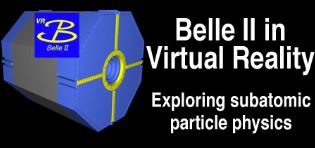
Belle II in Virtual Reality

Stand inside the Belle II particle detector in Japan and watch electrons and positrons collide, with the debris of each collision streaming out through the detector around you. A free, research grade visualisation built by the team behind real particle physics.

Developer: Virginia Tech team (ICAT, Physics, School of Education)
Price: Free
Platform: SteamVR, Rift, desktop and browser
Subject: Physics • Particle physics
6.6
/10
XR School Score
Recommended for A Level
Free • Built by working physicists • Real detector geometry • Five built in collision events • Basic presentation • Little guidance for beginners
Free • Steam Education tagged
Overview

Belle II in Virtual Reality is a free visualisation of the Belle II experiment, a particle detector at the KEK laboratory in Japan that studies the collisions of electrons with their antimatter partners, positrons. It was released on Steam on 5 March 2018 by a team from Virginia Tech, combining the university's Institute for Creativity, Arts and Technology, its Department of Physics and its School of Education. Virginia Tech is part of the international Belle II collaboration.

Inside the app you can walk through a model of the detector built from its real geometry and watch simulated collision events play out, with particles flying outwards through the detector's layers. Five events are built in, and more can be loaded from a folder. Besides SteamVR, it was offered free for Rift and Go through the Oculus Store, and the team also provides desktop versions for Windows, Mac and Linux and a browser version that need no headset.

Seeing the Invisible Particle physics is hard to teach because none of it can be seen. Belle II in VR turns abstract ideas, such as particles, antiparticles and annihilation, into something students can walk around and watch happen. It is the kind of tool real physicists use to understand their own detectors.
What Students Can Do
🔍
Explore the detector
Walk through a model built from Belle II's real geometry.
💥
Watch collisions
Play simulated electron and positron collisions.
📊
Compare events
Five built in events, including muon pairs and B mesons.
💻
No headset needed
Desktop and browser versions for the whole class.
Getting Started The app is free, which makes it easy to try. It has little narration, so it works best with a teacher explaining what students are looking at. The project page offers a quick reference guide to the controls and menus, and narrated videos about how the visualisation was made.
Belle II VR vs Textbook Diagrams
Feature
Belle II in VR
Textbook
Scale
Walk inside a full size detector
Small 2D cross section
Collisions
Animated in 3D
Static track diagrams
Cost
Free
Included
Guidance
Minimal
Full explanation
Classroom Value
Physics content
8.2
Wow factor
7.8
Curriculum links
7.0
Ease of use
5.5
Guidance for students
4.0
Strengths and Limitations
Strengths
  • Completely free
  • Made by physicists working on the experiment
  • Real detector geometry
  • Shows matter and antimatter collisions
  • Desktop and browser versions for students without headsets
  • Creative Commons licence
Considerations
  • Little explanation built in
  • Dated, functional presentation
  • Older headset support
  • Content is advanced for younger students
  • No Quest store version
For Teachers: A Level Particle Physics Belle II in VR fits A Level topics on particles and antiparticles, annihilation, leptons and quarks, and detectors. Show a collision on the projector, ask students to predict what the tracks represent, then explain. At GCSE it can be an inspiring enrichment activity about how scientists study the smallest things in the universe.
Free
SteamVR, Rift, desktop (Windows, Mac, Linux) and browser
Get on Steam → Project page → More physics apps →
Quick Facts
Developer
Virginia Tech (ICAT, Physics, School of Education)
Release
5 March 2018
Price
Free
Platforms
SteamVR, Rift, Go, desktop, browser
Experiment
Belle II at KEK, Japan
Built in events
5
Licence
Creative Commons BY NC SA 4.0
Verdict
Belle II in Virtual Reality is a free and genuinely authentic window into particle physics, made by the people who work on the experiment. It needs a teacher to explain what students are seeing, and its presentation is functional rather than polished. For A Level physics and enrichment, it is a valuable and recommended resource.

Gareth Griffiths

Gareth Griffiths is a scientist and the founder of World of Teaching, a free library of over 1,000 teacher made PowerPoints. He set up The XR School to help teachers, schools and parents find virtual and augmented reality apps that genuinely help young people learn, and to give an honest view of what each app teaches, which headsets it needs and what it costs.