
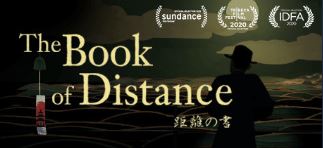
The Book of Distance
The Book
of Distance
A 30-minute room-scale VR documentary by Randall Okita, tracing his grandfather's journey from Hiroshima to Canada in 1935 — and the loss of everything during the internment of Japanese Canadians in WWII.
Steam • Viveport • Oculus
The Book of Distance is a room-scale VR documentary made by Canadian artist and filmmaker Randall Okita for the National Film Board of Canada. It premiered at the 2020 Sundance Film Festival's New Frontier programme, where The Verge named it the best narrative experience of the festival and Filmmaker Magazine called it "a standout — lyrical, personal and moving." Short of the Week declared it "the best interactive VR story told yet." It subsequently screened at Venice, SIGGRAPH, Tribeca/Cannes XR, and the Vancouver International Film Festival, where it won the Best of Animation Award at VIFF Immersed.
The experience, approximately 30 minutes long, follows Yonezo Okita — Randall's grandfather — from his home in Hiroshima, Japan, where he was born, through his emigration to Canada in 1935, his years building a strawberry farm in British Columbia, and then the devastating events of the Second World War: as a person of Japanese descent living in Canada, Yonezo was classified as an enemy alien, interned, and had his farm confiscated. Three generations later, Randall attempts to recover what was lost.
The experience is available free in English, French, and Japanese on Steam, Viveport, and the Oculus Store. It is produced by David Oppenheim and executive produced by Anita Lee for the NFB's Ontario Studio in Toronto. The Japanese language version is particularly notable given the subject matter — audiences in Japan encountering this story of Japanese emigration and wartime treatment can experience it in their first language.
The internment of Japanese Canadians during the Second World War is one of Canada's most significant episodes of government-sanctioned racism. Following Japan's attack on Pearl Harbor in December 1941, the Canadian government under the War Measures Act ordered the removal of all persons of Japanese descent from a 100-mile security zone along the Pacific coast, regardless of citizenship status. Approximately 22,000 Japanese Canadians were affected. Their property was confiscated and sold. Many were sent to internment camps; others to forced labour in road construction or sugar beet farming. The policy continued after the war ended: Japanese Canadians were not allowed to return to the coast until 1949.
In 1988, the Canadian government under Prime Minister Brian Mulroney issued a formal apology and paid reparations to survivors. The Japanese Canadian internment is directly comparable to the internment of Japanese Americans in the United States during the same period, covered by the Civil Liberties Act of 1988.
- Free on Steam, Viveport, and Oculus Store
- Universally acclaimed: Sundance, Venice, Tribeca, VIFF
- Three languages: English, French, Japanese
- ~30 minutes: fits within a lesson period
- NFB production: exceptional artistic and cultural credibility
- Room-scale, interactive: participants pick up artefacts and trigger events
- Japanese Canadian internment is an underrepresented WWII history topic
- Strong cross-subject hooks: History, PSHE, RS, English, MFL
- Suitable for KS4 and above; emotional but not distressing
- PC VR headset required for full room-scale experience
- Emotionally affecting: some students may find the internment sequences difficult
- Canadian context requires some teacher-supplied background for UK audiences
- Subject is 20th-century North American history, not always on UK syllabi directly
- Director
- Randall Okita
- Producer
- National Film Board of Canada (NFB)
- Price
- Free
- Platforms
- SteamVR • Viveport • Oculus Store (PC VR)
- Runtime
- ~30 minutes
- Languages
- English, French, Japanese
- Age Rating
- Everyone (KS4+ recommended)
- Subject
- Japanese Canadian internment, WWII, family memory
- Festival Debut
- Sundance 2020 New Frontier
- Type
- Interactive VR documentary