
Astronomy

Go For Launch: Mercury

The XR SchoolScienceAstronomy › Go For Launch: Mercury
GO
$9.99 Free demo on Steam Solo developer • First Time Games PC VR only • Not Meta Quest standalone
Joe Chisholm • First Time Games • Released Jul 2021 • Steam: Very Positive 81% (59) • Scott Manley endorsed • VRLO 2017 finalist • Free demo

Go For Launch:
Mercury

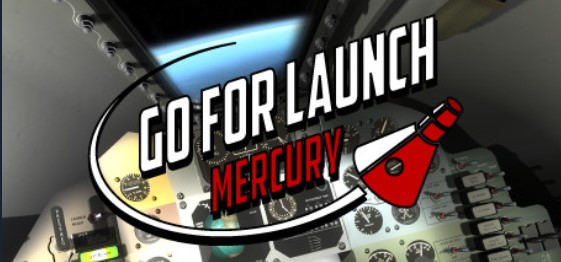
Climb into Freedom 7 and become Alan Shepard. Pull the switches, run the pre-launch checklist, and feel the Redstone rocket ignite beneath you as you become the first American in space. Go For Launch: Mercury is a meticulous, historically accurate simulation of NASA's Project Mercury programme — every spacecraft interior individually crafted, every mission reconstructed from the historical record, and a full-scale recreation of Earth from low orbit waiting at the top.

Developer: Joe Chisholm • First Time Games
Price: $9.99 • Free demo on Steam
Platform: PC VR (SteamVR / Oculus PC)
Steam: Very Positive • 81% of 59 reviews
Platform note: PC VR required. Go For Launch: Mercury runs on PC VR headsets via SteamVR or the Oculus PC app — it is not available as a Meta Quest standalone app. Schools will need a VR-capable PC connected to a compatible headset (such as a Quest used via Link cable or Air Link, or a Valve Index / HTC Vive). It can also be played on a standard monitor without a headset, which extends its classroom accessibility beyond schools with PC VR setups.
7.5
/10
XR School Score
Recommended
Finest historically accurate Project Mercury simulation in VR • $9.99 • Free demo • 81% Very Positive (Steam) • Scott Manley endorsed • PC VR required • Solo developer scale
Steam: Very Positive 81% of 59 reviews
"Doesn't it look really rather good!" — Scott Manley
Overview

Go For Launch: Mercury is a solo passion project by developer Joe Chisholm, published under the First Time Games label, and it shows every hallmark of what a dedicated individual with deep subject knowledge and genuine craft can produce. Released into Early Access in October 2017 after a successful Kickstarter and indie showcase run — including a finalist position at the VRLO 2017 Most Promising New Indie Developer award — it reached full release on Steam in July 2021. The goal, stated plainly on the Steam page, is to be as authentic and accurate as possible: not a dramatisation or a stylised approximation, but a genuine simulation of what it felt like to sit inside a Mercury capsule on top of a Redstone or Atlas rocket in the early 1960s.

Every spacecraft interior has been individually researched and modelled. The switches, instruments, and layout of Freedom 7 are not generic cockpit assets; they are the specific configuration Alan Shepard encountered on May 5, 1961. The same care has been applied to each subsequent Mercury mission, tracking the design changes and loadout differences between vehicles as the programme evolved through six crewed flights. Players work through the pre-launch checklist, experience the vibration and roar of ignition, and ascend through the atmosphere to a full-scale recreation of Earth from low orbit. The experience is explicitly educational — the Steam description flags it as suitable for schools and colleges to teach astronomy, spaceflight, and history.

The Scott Manley Endorsement: What It Signals Scott Manley is a Scottish astronomer, science communicator, and arguably the most respected voice in the spaceflight simulation community, with millions of YouTube subscribers and deep professional credibility in the field. His pull quote — "Doesn't it look really rather good!" — appears prominently on the Steam store page and is not a paid promotional placement. For a solo indie developer making a historically accurate spaceflight simulation, having Manley's attention and approval is a meaningful signal of both authenticity and community standing. It also indicates the game has been reviewed by someone with the knowledge to catch inaccuracies and did not find them disqualifying.
The Mercury Missions
MR-3 • Freedom 7
Alan Shepard
America's first crewed spaceflight. A 15-minute suborbital trajectory on a Redstone rocket. The beginning of human spaceflight in the United States, arriving 23 days after Yuri Gagarin's orbital flight.
May 5, 1961
MR-4 • Liberty Bell 7
Gus Grissom
The second American in space. Suborbital flight with the infamous hatch malfunction on splashdown, which nearly cost Grissom his life and sank Liberty Bell 7 to the ocean floor.
July 21, 1961
MA-6 • Friendship 7
John Glenn
The first American to orbit the Earth, completing three orbits on an Atlas rocket. A landmark moment in the Space Race, widely regarded as the most significant flight of the Mercury programme.
February 20, 1962
MA-7 to MA-9
Carpenter, Schirra, Cooper
The final three Mercury orbital missions. Scott Carpenter (Aurora 7), Wally Schirra (Sigma 7), and Gordon Cooper (Faith 7) completing the programme's science and endurance objectives.
1962–1963
Why Project Mercury Belongs in the Classroom Project Mercury sits at the intersection of Cold War history, the physics of spaceflight, the science of human endurance in space, and the engineering ingenuity of the early 1960s. It is the origin point of American human spaceflight and the direct precursor to Gemini and Apollo. Yet it is often taught as a footnote to Apollo — a brief preamble before the Moon landing captures all the attention. Go For Launch: Mercury makes the case that Mercury deserves its own time and attention, by placing students inside the actual capsules and asking them to confront the claustrophobia, the technical complexity, and the physical courage of what those seven astronauts agreed to do. A student who has sat in Freedom 7 in VR will approach a Cold War History lesson with a fundamentally different frame of reference than one who has only read about it.
What Users Say
Steam reviewer • Very Positive
"This is a fantastic piece of software. The attention to detail in recreating the Mercury capsule interiors is extraordinary. As someone who has read extensively about the programme, I was impressed by how accurately the developer has captured the feel of the era. The Redstone launch sequence is genuinely thrilling."
Steam reviewer • Very Positive
"Incredible historical accuracy. You really feel like you are inside the capsule. The Earth recreation from orbit is beautiful. Worth every penny at the asking price for space history enthusiasts."
Steam reviewer • Mixed
"Ambitious and clearly the work of someone who knows the subject deeply. Some rough edges around the controls and tutorial that might frustrate newcomers, but the core simulation is the real thing."

With 59 Steam reviews at 81% positive, the community is small but consistent: historical accuracy, capsule detail, and the launch sequence are the most praised elements. The main criticism from negative reviews is the learning curve without a thorough tutorial, which is worth flagging to teachers planning sessions with students who have no prior spaceflight context.

Curriculum Links
🌎
Astronomy / Space Science
Orbital mechanics, re-entry physics, the engineering of life support in vacuum, and the scale of low Earth orbit. A full-scale Earth recreation provides genuine spatial understanding of altitude and trajectory.
📚
History • Cold War
The Space Race as geopolitical competition, the Mercury Seven as symbols of American technological ambition, and the political context of Sputnik, Gagarin, and Kennedy's Moon speech. First-person immersion in the defining technology of the era.
Physics / Engineering
Rocket propulsion, thrust-to-weight ratio, escape velocity, orbital insertion, and re-entry heating. The Mercury programme solved each of these engineering problems for the first time under extreme time pressure.
🧠
PSHE • Courage & Risk
The Mercury Seven volunteered for missions whose survival probability was genuinely uncertain. A discussion of calculated risk, institutional trust, and the nature of courage in the context of the Space Race.
Assessment
Historical accuracy
9.6
Immersion / presence
8.8
Value for money
9.0
Curriculum depth (History/Science)
8.6
Tutorial / newcomer onboarding
5.2
School deployment accessibility
4.8
Strengths and Considerations
Strengths
  • Finest historically accurate Mercury programme simulation in VR
  • Every capsule interior individually researched and modelled
  • $9.99 • Free demo on Steam — try before purchasing
  • Full-scale Earth recreation from low orbit
  • Covers all six crewed Mercury missions
  • Scott Manley endorsed — community spaceflight credibility
  • Playable on a standard monitor without VR headset
  • Explicitly designed for school and college educational use
  • Cold War History / Astronomy / Physics curriculum value
  • Solo developer passion project: exceptional subject depth
Considerations
  • PC VR only — not available on Meta Quest standalone
  • Schools need a VR-capable PC or Quest with Link cable
  • Tutorial is thin — teacher prep essential for student sessions
  • Solo developer: update pace and long-term support less certain than studio products
  • Small Steam review pool (59) — community validation limited
  • Controls complexity may require orientation session before student use
Teacher Preparation Recommendation The most common criticism in Steam reviews is the absence of a thorough tutorial for newcomers. For classroom use, teachers should run through the experience themselves first — the free demo is the obvious starting point — and prepare a brief orientation for students covering the pre-launch checklist and basic controls before handing over headsets. A printed or projected mission timeline showing where the VR experience sits within the broader Mercury programme history will significantly enhance the educational value of each session. The monitor mode (no VR headset required) also makes whole-class demonstration viable with a single PC and a projected display.
$9.99
Steam • PC VR (SteamVR / Oculus PC) • Also playable on standard monitor without headset • Free demo available
Get on Steam → Download free demo →
Quick Facts
Developer
Joe Chisholm • First Time Games
Price
$9.99 • Free demo on Steam
Platform
PC VR only (SteamVR / Oculus PC)
Monitor mode
Yes — playable without headset
Steam rating
Very Positive • 81% of 59 reviews
Missions
All 6 crewed Mercury flights
Rockets
Redstone • Atlas (detailed models)
Endorsed by
Scott Manley • VRLO 2017 finalist
Best for
History, Astronomy, Physics (KS4+)
Headset needed
PC VR or Quest via Link cable
Verdict
Go For Launch: Mercury is the work of a solo developer who clearly knows and loves Project Mercury in a way that no licensed product could replicate. The historical accuracy, capsule detail, and launch sequence are exceptional for an indie title at $9.99, and the free demo removes any purchasing risk. The PC VR requirement is the limiting factor for most schools — Meta Quest standalone users will need a Link cable and PC. Teachers should prepare students with a mission context overview and their own run-through of the demo before classroom sessions, as the tutorial is thin. For History departments teaching the Cold War, Astronomy departments covering human spaceflight, or Physics teachers exploring rocket propulsion, there is nothing else quite like it.