Overview
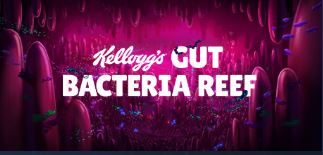
Kellogg's Gut Bacteria Reef is a free VR experience created by advertising agency TBWA\Eleven Sydney and game developer Nakatomi for Kellogg's Australia. It was developed to explain, in accessible and engaging terms, how dietary fibre promotes the growth of healthy gut bacteria. The brief came directly from Kellogg's nutrition team: to communicate that fibre from grain cereals promotes bifidobacteria and lactobacillus growth, which supports a positive shift in intestinal microbiota. Rather than making a standard advertising film, the team spent two years developing a genuine VR game.
The experience places players in a virtual submarine inside the human gut. A dive instructor narrates the journey, explaining how the gut ecosystem functions, why balance between bacterial species matters, and how fibre feeds the good bacteria. Players then actively participate: loading the submarine's fibre feeder with food sources and shooting fibre at good bacteria to help them multiply and overwhelm the bad bacteria. The experience lasts approximately seven minutes and ends with the food completing its journey through the digestive system.
CSIRO-Backed Science
The scientific basis of the experience reflects findings from the CSIRO (Commonwealth Scientific and Industrial Research Organisation of Australia), which conducted research showing that despite half of Australians experiencing gut health issues annually, two-thirds are not meeting recommended daily fibre intake. The microbiome content — gut flora diversity, the role of bifidobacteria and lactobacillus, the impact of fibre on bacterial growth — is scientifically accurate, even if the delivery mechanism is a branded cereal product.
The experience was first deployed at SEA LIFE Sydney Aquarium as part of their Great Barrier Reef exhibit, with QR codes on Kellogg's cereal boxes (Sultana Bran, Special K, All Bran, Guardian) in Australia linking to the Steam download. It was also playable on YouTube as a 360-degree video for non-VR users. The Steam version with full VR interactivity has 50 reviews at 84% positive, making it "Very Positive."
The Gut Journey: What Happens
🛶
Descent: Enter the Gut in a Submarine
Players board a virtual submarine and travel down into the human digestive tract. The gut environment is visualised as a vibrant, reef-like ecosystem, with villi lining the walls and an array of microorganisms drifting past. A dive instructor narrates the ecology of the gut microbiome throughout.
🧬
Exploration: Gut Bacteria Reef
Players explore the microbial ecosystem, learning to distinguish good bacteria (bifidobacteria, lactobacillus) from bad bacteria. The ecosystem is framed like a coral reef: diverse, interdependent, and sensitive to imbalance. The commentary explains how a rise in one species can disrupt the whole ecosystem.
🏹
Action: Feed the Fibre, Fight the Bacteria
The active gameplay phase: players load the fibre feeder with food sources (which are represented by Kellogg's cereal products) and use them to nourish the good bacteria, helping them multiply and overwhelm the bad bacteria. This is the branded element of the experience: Kellogg's products function as the ammunition for gut health.
🚫
Exit: The Natural Conclusion
The experience ends as food naturally exits the digestive system. The developers at Nakatomi described "very grown-up conversations about animating sphincters" in creating this ending. It is handled with appropriate scientific matter-of-factness.
The Science: Gut Microbiome Curriculum
🧹
Bifidobacterium
A key genus of beneficial gut bacteria. Ferments dietary fibre, produces short-chain fatty acids that nourish the gut lining, and supports immune function. Numbers are increased by dietary fibre intake.
🧺
Lactobacillus
Another genus of probiotic bacteria found in the gut. Produces lactic acid, inhibiting pathogen growth. Associated with improved digestion and immune modulation. Fibre supports its proliferation.
⚠️
Bad Bacteria (Pathogens)
Opportunistic pathogenic species that can dominate when gut diversity is disrupted. A low-fibre diet reduces diversity, allowing harmful species to proliferate and cause digestive symptoms.
🌿
Dietary Fibre's Role
Non-digestible plant carbohydrates that pass to the large intestine, where they are fermented by gut bacteria. Act as prebiotics, selectively feeding beneficial species and supporting a diverse, healthy microbiome.
Curriculum Connection
The gut microbiome content in this experience maps to GCSE and A Level Biology topics covering the digestive system, mutualistic microorganisms, and the role of diet in health. The concepts of ecosystem balance, species diversity, and the effect of diet on microbial communities also connect to ecology themes. Combined with a discussion of the experience as branded content, this could support an effective media literacy discussion at any key stage.
Using This in the Classroom: Transparency is Essential
The most educationally responsible approach is to name the commercial framing explicitly. Students who understand they are interacting with a marketing campaign — and can discuss how the science is used to sell a product — will develop more critical thinking skills than students who encounter it uncritically. The science is solid. The brand is omnipresent. Both facts are worth teaching.
Curriculum Fit
GCSE Biology (Digestion)
7.8
PSHE / Health Education
8.2
Media Literacy (KS3/4)
8.5
Engagement / Fun factor
8.4
What Players Say
Steam Reviewer
Positive
"Surprisingly fun and educational. Yes it's Kellogg's marketing but the science is actually explained well and the submarine gut environment is really imaginative. Kids will love it. Adults too."
Steam Reviewer
Positive
"Probably the most creative advertising I've ever seen. It's a real VR game, it teaches you something, and it's free. I genuinely enjoyed it more than some paid experiences. Kellogg's deserves credit for this."
Russ Tucker, ECD TBWA\Eleven (Developer)
LBBOnline
"We had very grown-up conversations about animating sphincters. The complexity of designing the game was certainly more involved than a sit back and watch viewing experience."
Steam: Very Positive, 84% of 50 reviews. Average player session: 7 minutes. Originally deployed at SEA LIFE Sydney Aquarium during school holidays.
Strengths and Limitations
Strengths
- Free on SteamVR
- Very Positive Steam rating (84% of 50 reviews)
- Scientifically accurate gut microbiome content (CSIRO-backed)
- Genuinely interactive gameplay, not passive viewing
- Strong engagement — average 7-minute session for a 7-minute experience
- Serves as a media literacy case study as well as biology content
- Subject matter (gut microbiome) directly on GCSE Biology specifications
- Fun, memorable, well-designed by a professional studio
Considerations
- Created as advertising: Kellogg's products are the gameplay mechanic
- PC VR headset required; not on standalone Meta Quest
- Teachers must explicitly address the branded content framing
- Very short: the full experience is approximately 7 minutes
- Australian-origin marketing; references Australian-market cereals
- No depth of narration beyond the gut health / fibre message