
Freehistory

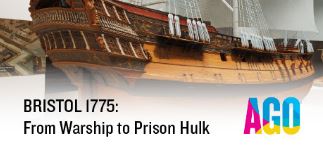
AGO BRISTOL 1775: From Warship to Prison Hulk

Home Humanities History Free AGO Bristol 1775
🚢
⚓ VR Museum · History · FREE · Steam · Napoleonic Wars · Prison Hulk
🏛️ Art Gallery of Ontario · Priam Givord Studio · CT scan + photogrammetry · World-first live-guided multiplayer museum VR

AGO Bristol 1775

From Warship to Prison Hulk

Step aboard the HMS Bristol — a Royal Navy warship that sailed the Atlantic during the American Revolution, then the Caribbean and Indian Ocean, before ending its life as a floating prison for captured soldiers of the Napoleonic Wars. A joint production between the Art Gallery of Ontario and Priam Givord Studio, this free VR experience rebuilds the Bristol from CT scans and photogrammetry of a 1774 museum artefact — and opens it to the world for the first time, with a live AGO guide and up to six visitors simultaneously, from anywhere on Earth.

FREE Steam PC VR Art Gallery of Ontario ✓ Three decks to explore ✓ Free + narrative modes ✓ Live-guided multiplayer ✓ All ages
Get Free on Steam AGO Research
🌍 World-First: Live-Guided Multiplayer Museum VR — Up to 6 Visitors, From Anywhere on Earth

AGO Bristol 1775 is described by its creators as the first-in-the-world multiplayer VR museum visit system with a live guide from the actual museum. Up to six visitors from anywhere in the world can explore the Bristol simultaneously in the same VR environment, accompanied by a real AGO curator or interpretive guide. This is qualitatively different from any recorded audio tour or self-guided VR experience — it is a live, synchronous, expert-led museum visit in virtual reality, from any location on Earth, completely free.

XR Rating
4.2
⭐⭐⭐⭐
Platform: Steam PC VR  ·  Price: FREE  ·  Developer: Priam Givord Studio / Art Gallery of Ontario  ·  Released: November 2023
About the Experience

What is AGO Bristol 1775?

AGO Bristol 1775: From Warship to Prison Hulk is a free VR museum experience co-produced by Priam Givord Studio and the Art Gallery of Ontario — one of Canada's most distinguished art museums. It was two and a half years in the making, drawing on AGO curatorial research, expert consultation with the National Maritime Museum in Greenwich, England, and state-of-the-art CT scanning and photogrammetric reconstruction of a remarkable physical artefact: George Stockwell's 1774 scale model of the HMS Bristol, now part of the Thomson Collection at the AGO.

The Thomson Collection of Ship Models at the AGO contains over 130 miniaturised ships spanning hundreds of years of maritime history — unique in Canada and one of the finest ship model collections in the world. The Bristol model — made at 1:48 scale in wood, ivory/bone, copper alloy and glass at the same Sheerness Dockyard in Kent where the real ship was being built — is one of its most significant pieces. Hidden inside the model, discovered in 1992 by National Maritime Museum curator Simon Stephens, was a handwritten note identifying George Stockwell as the maker and the date of construction.

AGO Interpretive Planner Gillian McIntyre, who led the project, explains the concept: "VR made a tiny, hard-to-comprehend thing enormous, permeable, and explorable. We embarked on animating the Bristol ship model to reveal the stories it holds." The AGO team and Priam Givord Studio spent two and a half years collaborating to produce the experience — with the AGO providing all historical research and Priam Givord Studio creating all design and interactive elements, built in Unreal Engine.

The technical foundation of the VR reconstruction is unusually rigorous: the AGO studied the physical Bristol model using microscopy, X-rays, CT scans and photogrammetry before partnering with Priam Givord Studio to digitally reassemble it. CT scanning — the same technology used in medical imaging — reveals the interior structure of the model, allowing the VR reconstruction to include internal spaces and structural details impossible to see from the model's exterior. The result is a full-scale digital ship that visitors can explore from the inside, at the scale of a real vessel rather than a 41cm model.

Historical Context

The Story of the HMS Bristol

The HMS Bristol was a 50-gun fourth-rate ship of the line — a significant warship of the Royal Navy, designed in 1768 and completed in 1775 at Sheerness Dockyard in Kent. Its career spanned three decades and three ocean theatres:

🌊
Atlantic Ocean
American Revolution — suppressing colonial independence
🌴
Caribbean
Anglo-French War, 1778-83 — rival colonial empires
🌏
Indian Ocean
Anglo-French War — global contest for empire

By the turn of the 19th century, the Bristol was no longer seaworthy. Rather than being scrapped, it was repurposed as a prison hulk — a decommissioned ship moored in harbour, used to house prisoners of war captured during the Napoleonic Wars (1793-1815). Prison hulks were a notorious feature of the era: overcrowded, disease-ridden, and deeply unpleasant, they held thousands of French, Spanish and other enemy prisoners in conditions that historians have documented as often appalling. The AGO Bristol 1775 VR experience focuses on this final chapter — life aboard the Bristol as a floating prison.

George Stockwell made his 1774 model at the very same Sheerness Dockyard where the real Bristol was being built simultaneously — crafting a 1:48 scale replica of a ship taking shape around him. In 1992, National Maritime Museum curator Simon Stephens discovered a handwritten note hidden inside the model, identifying Stockwell as the maker. That hidden note, still inside the model today, is one of the most poignant details of the entire story: a craftsman's quiet signature, sealed inside his work for over two centuries.
Features

The VR Experience

🚢
Three Decks — Built from CT Scans & Photogrammetry
The Bristol is reconstructed across three explorable decks, built from the AGO's CT scan and photogrammetric data from the 1774 Stockwell model. CT scanning — normally used in medical imaging — reveals the interior structural detail of the model that cannot be seen from outside, while photogrammetry captures the exterior surface geometry precisely. Together they allow the VR reconstruction to include structural details and internal spaces of the ship at full scale — transforming a 41cm museum model into a full-size vessel you can walk through. The Gun Deck, where the ship's cannon were mounted, is one of the key spaces — placing visitors in the heart of an 18th-century warship in a way no physical museum visit could achieve.
📖
Free Exploration & Narrative Mode — Life as a Prison Hulk
Two experience modes are available. Free exploration allows visitors to move through the Bristol at their own pace, examining spaces and details independently. Narrative mode follows the story of life aboard the Bristol during its time as a prison hulk — placing visitors within the human experience of the Napoleonic Wars prisoners who lived in these cramped decks. The historical content for the narrative was produced entirely by the AGO's curatorial and interpretive team, based on primary research. For History students studying the Napoleonic Wars, prison conditions, or the experiences of ordinary people caught in 18th-century warfare, this first-person narrative immersion is an unusually powerful primary source supplement.
👥
World-First Live-Guided Multiplayer Museum Visit
The most technically innovative feature: up to six visitors from anywhere in the world can enter the Bristol simultaneously, guided live by an AGO curator or interpretive specialist. This is not a recorded audio tour — it is a synchronous, real-time guided museum visit in VR with an actual museum professional leading the session. For schools unable to visit Toronto (or Canada), this provides access to AGO curatorial expertise and a world-class artefact collection at zero cost. Sessions would need to be booked with the AGO directly to access the live-guide component.
🔬
CT Scanning & Photogrammetry — Conservation Meets VR
The AGO studied the Stockwell model using multiple imaging techniques before VR reconstruction: microscopy, X-rays, CT scans and photogrammetry. This multi-modal conservation science is itself curriculum content — it is exactly the kind of scientific methodology discussed in Art & Design (conservation), Science (imaging techniques), and History (how historians use physical evidence). The decision to reconstruct the model at full ship scale — rather than at its 1:48 miniature size — is a deliberate pedagogical choice: it transforms an object "a tiny, hard-to-comprehend thing" into something "enormous, permeable, and explorable", in McIntyre's words.
School Value

Curriculum & Educational Fit

Narrative quality
92%
History — 18th–19th century
88%
Value for money (FREE)
99%
Age appropriateness
98%
Art & museum studies
80%
Curriculum specificity (UK)
45%

AGO Bristol 1775 is most powerful as a History immersion tool for the late 18th and early 19th century — specifically the Napoleonic Wars era, British naval history, and the lived experience of prisoners of war. The prison hulk context is genuinely unusual: few students will have encountered this specific aspect of British history, and experiencing life in a floating prison — the cramped decks, the maritime setting, the historical narrative — creates an emotional and spatial understanding of the period that no textbook can replicate. The app is strongest as an enrichment or extension resource rather than a primary curriculum tool, as the specific topic of HMS Bristol does not appear on standard UK GCSE History specifications.

For History KS3–4, the most direct curriculum links are to the Napoleonic Wars, British naval power, the Atlantic world in the 18th century (American Revolution, Caribbean colonial conflict) and the conditions experienced by prisoners of war. For Art & Design / Museum Studies, the conservation methodology — CT scanning, photogrammetry, microscopy, X-rays applied to a museum artefact — is directly curriculum-relevant: this is how professional conservators study objects, and the connection between scientific imaging and VR reconstruction is itself a cross-curricular teaching point. For Geography, the Bristol's three-ocean career — Atlantic, Caribbean, Indian Ocean — maps directly onto the geography of British imperial expansion in the 18th century. For PSHE, the conditions of Napoleonic prisoners opens discussions of human rights, the treatment of enemies in wartime, and the ethics of confinement. The live-guided multiplayer feature gives this app a unique quality: a real museum curator from the AGO can lead a class session from Toronto — making it one of the most direct connections to professional expertise available in any educational VR application.

Best use in school: KS3–4 History — Napoleonic Wars era · British naval history · Life of prisoners of war · 18th-century British Empire · Art & Design — conservation techniques, CT scanning, photogrammetry · Museum Studies · PSHE — prisoners of war, human rights in conflict · History enrichment and extension · Virtual museum visit — contact AGO directly for live-guided sessions.
XR School Verdict
Value for money (FREE)10/10
Historical authenticity9/10
Narrative quality8/10
Age appropriateness9/10
UK curriculum specificity4/10
Platform accessibility5/10
Bottom line: A genuinely extraordinary free VR experience — built on two and a half years of AGO curatorial research, CT scanning and photogrammetry of an 1774 museum artefact, and currently the world's only live-guided multiplayer museum VR. The topic (HMS Bristol as a Napoleonic Wars prison hulk) is niche but rich in curriculum potential for History, Art and PSHE. The platform limitation (Steam PC VR only) reduces classroom accessibility, but at zero cost and with the AGO providing live expert guides, this is one of the most intellectually serious VR history tools available.
Pros & Cons
✓ Completely FREE
✓ Real AGO curatorial research
✓ CT scan + photogrammetry reconstruction
✓ World-first live-guided museum VR
✓ Up to 6 visitors globally, simultaneously
✓ Three explorable decks
✓ Free exploration + narrative modes
✓ 2.5 years of development · museum quality
✓ National Maritime Museum, Greenwich input
✓ All ages · historically respectful content
✗ Steam PC VR only (not standalone Quest)
✗ Very niche topic — not on most UK specs
✗ Live guide needs AGO session booking
✗ Very few user reviews
Quick Info
PlatformSteam PC VR
PriceFREE
DeveloperPriam Givord Studio / AGO
ReleasedNovember 2023
MuseumArt Gallery of Ontario, Toronto
ArtefactStockwell 1774 model · Thomson Collection
TechnologyCT scan + photogrammetry
Multiplayer✓ Up to 6 · live AGO guide
ModesFree exploration · Narrative
Age✓ All ages
Best forHistory · Art & Design · Museum Studies
⚓ HMS Bristol Timeline
1768 — Designed for the Royal Navy
1774 — Stockwell builds the model at Sheerness
1775 — Ship completed; American Revolution
1778-83 — Caribbean and Indian Ocean service
c.1800 — No longer seaworthy; converted to hulk
1793-1815 — Prison hulk · Napoleonic Wars
1992 — Hidden note discovered in the model
2023 — VR experience launched
Get Free on Steam
AGO Bristol 1775 · Free · PC VR
🏛️
AGO Research & Live Guide Info
ago.ca — book live-guided sessions
© The XR School · VR & AR Apps for Education