
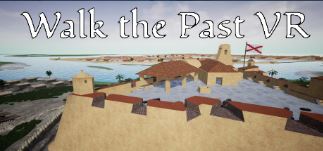
Walk the Past VR
Walk the Past VR
A narrated VR journey to the Battle of Cartagena de Indias, 1741 — one of the most dramatic and least-taught episodes of British colonial history. Walk through meticulous 3D reconstructions of Caribbean fortifications, listen to a fully voice-acted retelling of the battle from two narrators, read the beautifully written journals of fallen soldiers, and explore at your own pace in a world that blurs the line between museum and living history.
"You've come a long way, traveller. Crossed vast oceans, sailing against the tides of time. Welcome to the Battle of Cartagena de Indias, 1741. Come with me. I will show you the beaches and the forests, the Castles and the forts, our first staggering steps in the sand and our final desperate climb. So — would you care to come to shore?"
What is Walk the Past VR?
Walk the Past VR is a narrative historical VR experience developed by Balandra Studios and written by Sam Gohra. It is not a game in the conventional sense — there is no combat, no puzzles to solve, no score to achieve. It is closer to a living history museum or an audio-guided heritage site, translated into immersive virtual reality. You are placed inside a 3D reconstruction of Cartagena de Indias in 1741, during one of the most dramatic and least-known battles of British colonial history, and invited to explore it at your own pace with a narrator as your guide.
The experience centres on the Battle of Cartagena de Indias — a British attempt to capture the heavily fortified Spanish colonial port city in what is now Colombia, during the War of Jenkins' Ear. It was one of the largest amphibious military operations in history up to that point, involving approximately 186 British ships and over 23,000 troops under Admiral Edward Vernon, facing roughly 3,000 Spanish defenders commanded by the formidable Admiral Blas de Lezo. Despite an overwhelming numerical advantage, the British suffered a catastrophic defeat — losing as many as 18,000 men to battle, disease and tropical conditions. It remains one of Britain's worst colonial military failures and one of Spain's greatest defensive victories.
Balandra Studios grew out of their existing work on a strategy game called Field of Arms, for which they had already invested significantly in 3D modelling of 18th-century fortifications and environments. Walk the Past VR repurposes that work into a VR walking experience — the benefit being that the architectural and environmental reconstruction has unusually high fidelity for an indie project. The environments include beaches, forests, castles and Spanish colonial fortifications, all reconstructed with care and attention to period accuracy.
What's Inside
The Battle of Cartagena de Indias, 1741
The Battle of Cartagena de Indias (March–May 1741) was fought during the War of Jenkins' Ear — a conflict between Britain and Spain arising from commercial tensions in the Caribbean and South America. The name derives from a British merchant captain, Robert Jenkins, who claimed to have had his ear severed by a Spanish coast guard officer in 1731 and produced what he said was the preserved ear before the House of Commons in 1738, inflaming public sentiment for war.
Admiral Edward Vernon, fresh from an early success capturing the port of Porto Bello (with just six ships — an action so celebrated that a London street is named after it), led a massive fleet of 186 ships and 23,600 troops against Cartagena. Contemporary British confidence was extraordinary: commemorative medals were struck in London before the battle showing Vernon receiving Cartagena's surrender. The British initially made progress, destroying the chain barrier across the Boca Chica channel and capturing Fort San Luis.
The defeat was so catastrophic that the British government suppressed news of it to avoid public panic, while Spain celebrated Blas de Lezo as a national hero. In Colombian history the battle is remembered as the "Heroic City's" finest hour. Among the ordinary British soldiers who survived was Lawrence Washington — the older half-brother of George Washington, who named his Virginia plantation "Mount Vernon" after the admiral. This tiny detail connects one of the least-known British defeats to one of the most famous Americans in history.
Curriculum & Educational Fit
Walk the Past VR is most valuable for schools as a historical empathy and narrative quality experience — a demonstration of how immersive storytelling can make a distant historical event feel present and human. The experience is most immediately relevant to KS3 History units covering Britain and the wider world in the 18th century, the British Empire, and colonial conflict. However, the Battle of Cartagena de Indias does not appear explicitly on most UK GCSE History specifications, which means its curriculum fit depends significantly on how a teacher frames it.
For History, its greatest value is thematic: it illustrates British colonial ambition and overreach, the limits of military power, the experience of people on the receiving end of British expansion, and the complexity of historical narrative — a famous British "victory" (Porto Bello) followed by a catastrophic hidden defeat. It is an exceptional stimulus for discussions about whose history gets taught — why Cartagena barely features in British history textbooks while it is celebrated in Colombia and Spain. For English, the soldier journals model historical fiction writing in the voice of an ordinary person caught up in large events — directly applicable to historical narrative writing tasks. For PSHE and Citizenship, the Spanish perspective — defenders of their city against an invading colonial force — opens discussions about power, perspective and the ethics of empire that are central to post-colonial critical literacy. Suitable from Year 7 upwards; the battle involves death and combat but in a respectful, literary context — no graphic violence, no distressing content.
| Platform | Meta Quest · Steam · itch.io |
| Price | $9.99 |
| Developer | Balandra Studios |
| Writer | Sam Gohra |
| Subject | Battle of Cartagena de Indias, 1741 |
| Context | War of Jenkins' Ear · Spain vs Britain |
| Narrators | ✓ 2 · fully voice-acted |
| Journals | ✓ Fallen soldiers · in-world |
| Non-VR mode | ✓ Available |
| Age rating | ✓ All ages (Year 7+) |
| Best for | History · English · PSHE |
Among the British soldiers who survived the Battle of Cartagena was Lawrence Washington — the older half-brother of George Washington. He served under Admiral Vernon and, on returning to Virginia, named his plantation "Mount Vernon" in the Admiral's honour.
George Washington inherited Mount Vernon after Lawrence's death — and the rest is history. One of the least-taught British defeats is quietly connected to one of the most famous names in American history.