Overview
What Is It?
Edda Physics 1 is a VR physics education platform developed by a Swedish team, originating from a university research project conducted in collaboration with cognitive scientists and educators. It contains six fully interactive physics laboratories covering topics from classical mechanics to nuclear physics and the theory of relativity, with each lab designed to fill a standard class period of 30–45 minutes.
It comes in two distinct editions. The consumer edition ($29.99 on Meta Quest and Steam) is designed for individuals, home learners, and enthusiasts. The school edition (€99 licence) adds a teacher dashboard with progress tracking, comprehensive lesson plans with learning objectives and assessment tools, a 4-character code system for real-time screen sharing via any web browser, professional development sessions, and ongoing pedagogical support.
The platform supports all Meta Quest headsets, PICO devices, HTC Vive, Steam, and any OpenXR-compatible headset — one of the broadest platform footprints in the Physics category. Early studies conducted during development suggest that students learning through Edda Physics 1 outperformed equivalent groups taught via traditional lab methods, though the full research is not yet widely published.
Content
The Six Physics Labs
The selection of six topics is thoughtful — spanning classical and modern physics, and chosen specifically because they are topics where three-dimensional, interactive simulation offers advantages that a textbook diagram or classroom demonstration cannot easily replicate.
🚢
Archimedes' Principle
Explore buoyancy and fluid dynamics by manipulating objects of different densities in virtual fluids. Feel the forces of upthrust at work and uncover the conditions that govern floating and sinking. A topic that students often find counterintuitive when approached mathematically; the physical sensation of buoyancy in VR makes it visceral.
GCSE Physics
Fluid dynamics
Upthrust & density
🎯
Newton's Laws of Motion
Test inertia, acceleration, and force by applying and modifying physical interactions in a VR environment. Newton's Laws are foundational to all of classical mechanics and a staple of GCSE and A-level Physics — and the ability to directly manipulate mass, force, and acceleration variables with immediate visual feedback is more informative than any worked example.
GCSE & A-Level Physics
Mechanics
Inertia & acceleration
☢️
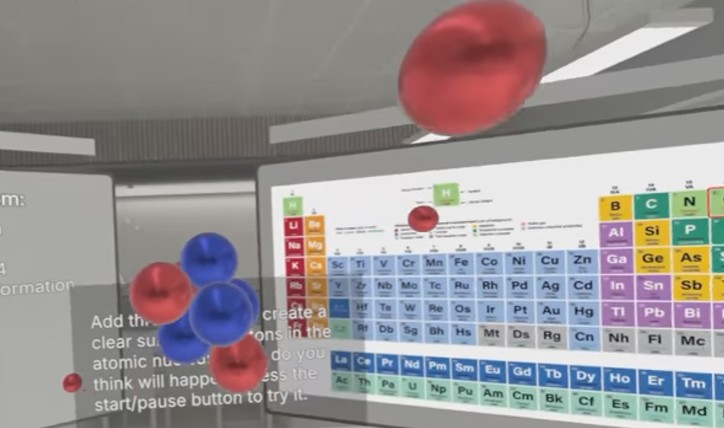
Nuclear Physics
Step inside the nucleus and witness atomic energy at human scale. Nuclear physics is one of the most abstract topics in secondary education — students are asked to understand forces and reactions at scales incomprehensibly smaller than anything they can observe directly. VR provides the scale shift that makes the nuclear world tangible.
A-Level Physics
Nuclear forces
Fission & fusion
🌀
The Theory of Relativity
Bend space and time as you explore the concepts underlying special and general relativity. Relativity is notoriously difficult to convey from first principles because it requires intuitions about space and time that are genuinely alien to everyday experience. VR can simulate relativistic effects — time dilation, length contraction, spacetime curvature — in ways that make the concepts experientially graspable rather than purely mathematical.
A-Level Physics
Special relativity
Spacetime
🌍
The Coriolis Effect
Watch as the invisible rotational force of the Earth shapes weather systems, ocean currents, and atmospheric circulation. The Coriolis effect is an excellent example of a phenomenon that is invisible in everyday life but has massive global consequences — seeing it demonstrated at planetary scale in VR brings geography and physics into direct contact.
A-Level Physics / Geography
Rotational dynamics
Global weather patterns
⚡
Coulomb's Law
Get hands-on with electric charges and witness the forces of attraction and repulsion between charged particles at a scale you can feel and manipulate. Coulomb's Law is the electrostatic equivalent of Newton's gravitational law — and seeing the force field geometry in three dimensions, with charges you can physically move and observe, makes the inverse-square relationship intuitive rather than abstract.
A-Level Physics
Electrostatics
Electric fields
Why these six?
The topic selection is deliberate. All six are concepts that students regularly find abstract, counterintuitive, or impossible to observe directly at human scale. VR is uniquely suited to physics education precisely because it can simulate conditions — extreme scales, invisible forces, relativistic effects — that no physical lab can demonstrate. Edda Physics 1 has identified the topics where VR adds the most value and built around them.
School Edition
What Schools Get
The school licence (€99) is meaningfully different from the consumer edition — it's built as an institutional product with the infrastructure that teachers actually need:
📊
Teacher Dashboard & Progress Tracking
Monitor which students have completed which labs, view progress across the class, and identify where students are spending the most time or encountering difficulty.
📋
Comprehensive Lesson Plans & Assessment
Each lab comes with lesson plans, detailed laboratory instructions, clear learning objectives, and assessment tools. Teachers don't need to create their own curriculum wrapper — the materials are included.
🖥️
Browser-Based Screen Sharing
Students receive a 4-character code inside the app that other students — or the teacher — can use to mirror the VR screen through any web browser. This elegant solution bypasses vendor-specific casting issues and works on any device with a browser, including classroom displays.
🎓
Professional Development & Pedagogical Support
The school licence includes professional development sessions and ongoing support to help teachers integrate VR effectively into their teaching — addressing one of the most common barriers to adoption in schools.
🖥️ The screen sharing solution is worth noting.
Screen casting from VR headsets to classroom displays is one of the most practically frustrating aspects of deploying VR in schools. Edda's 4-character browser code system — which works on any device, bypassing Meta Casting, Miracast, and other vendor-specific tools — is a genuinely thoughtful solution to a real problem that teachers encounter every lesson.
Research Foundation
University Origins & Cognitive Science Design
Edda Physics 1 grew out of a university project in Sweden, developed in collaboration with cognitive scientists and educators. This academic origin shapes the app's approach in a meaningful way: rather than being designed primarily as a VR showcase, it was designed around pedagogical principles — how people actually learn physics, and what specific properties of VR can help with which specific types of conceptual difficulty.
Early comparative studies suggest students learning through Edda Physics 1 performed better than equivalent groups using traditional lab methods. The full research has not yet been widely published at the time of this review, but the trajectory mirrors findings from other VR physics education tools — immersive, interactive simulation supports both engagement and retention, particularly for abstract or difficult-to-visualise concepts.
📐 Proven pedagogic methods.
The developer explicitly states the app is "built on proven pedagogic methods." For a 2024 launch product with limited public review volume, the university origin and cognitive science collaboration provide meaningful credibility — this isn't a VR novelty dressed up as education, but a product designed from the start around how learning works.
User Feedback
What the First Reviewer Found
Edda Physics 1 launched in late 2024 and, at the time of this review, has a single detailed Steam review — by a player who experienced it on Meta Quest 3 via PC VR. It is one of the most detailed and honest single reviews available for any app in this physics series, and worth reading carefully.
★
Steam Reviewer
Meta Quest 3 · November 2024
Positive
✅
"Top notch content for learning physics in VR. This may be the future of learning. I wish I had learned about these topics in VR versus the dull old teacher's slides."
✅
Estimates around one hour of content in the consumer edition. "It is a premium price given the content" — honest assessment of the $30 price point relative to content volume.
✅
Comfortable to play seated. Interactions involve button presses, sliders, and grabbing objects. "A little more than standing room is recommended to reach all interactions without issue."
⚠️
One practical frustration: it is easy to accidentally press the home button and exit to the main menu. A minor but genuine usability issue worth knowing about before classroom deployment.
📊 Context on the review count.
One detailed Steam review is a genuinely limited basis for evaluation. Edda Physics 1 is a new product (late 2024 launch) and the school edition is primarily sold via direct licensing rather than consumer storefronts, so the review count understates actual usage. The reviewer's impressions are consistent with the developer's stated design goals — which is reassuring — but prospective buyers should factor in the early-stage review landscape.
Honest View
What to Be Aware Of
⚠️
$29.99 is a premium consumer price for ~1 hour of content. The one reviewer noted this directly: excellent quality, but the content-to-price ratio requires consideration. The school licence (€99) is better value for classroom contexts where 30+ students will use it, amortising the cost across many sessions and including curriculum materials.
⚠️
Very new product with minimal public reviews. Launched in late 2024, one detailed Steam review at the time of writing. The product has credible foundations (university origin, cognitive science design, academic preliminary studies) but independent corroboration from the broader user community is still building.
⚠️
Accidental home button exits. The single reviewer flagged this as a practical frustration — accidentally pressing the headset's home button exits back to the main menu, losing progress within a lab. Worth briefing students on before their first session.
✅
The broadest platform support of any physics app in this series. Meta Quest 2/3/3S, PICO 4, HTC Vive, Windows Mixed Reality, Steam, and any OpenXR headset. Edda Physics 1 will run on whatever VR hardware a school has deployed.
✅
Topic selection is pedagogically justified, not arbitrary. Archimedes, Newton, Nuclear Physics, Relativity, Coriolis, Coulomb — these aren't six easy topics picked for novelty. They are all genuinely difficult to teach because they involve invisible forces, extreme scales, or counterintuitive geometry. VR is the right medium for precisely this content.
✅
The browser screen sharing solution is practically excellent. The 4-character code that mirrors VR content to any browser — bypassing vendor-specific casting problems — solves a genuine classroom pain point. This alone separates Edda from most competitor products that require school-specific AV setups.
Our Verdict
XR School Scores
Educational Value
8 / 10
University-developed, cognitive science-informed, with preliminary evidence of learning gains. Six well-chosen topics where VR is the right tool. Held below the top mark by very limited independent review data at this stage.
Topic Selection & VR Fit
10 / 10
Every one of the six topics is genuinely hard to teach from static diagrams and benefits specifically from interactive 3D simulation. This is the best topic selection of any physics VR app reviewed here.
Classroom Infrastructure
9 / 10
School licence: teacher dashboard, lesson plans, assessment tools, browser-based screen sharing, professional development, pedagogical support. Excellent deployment infrastructure for a 2024 launch product.
Platform Coverage
10 / 10
All Meta Quest, PICO, HTC Vive, WMR, Steam, and any OpenXR headset. No other physics VR app reviewed here supports this breadth of hardware.
Value for Money (school)
8 / 10
The €99 school licence with lesson plans, assessment, teacher dashboard, screen sharing, and professional development is strong institutional value. The consumer $29.99 for ~1 hour is honest value at a premium price point.
Bottom Line
Edda Physics 1 is a thoughtfully designed, university-developed VR physics platform with the best topic selection of any physics app reviewed on this site. Every one of its six labs — Archimedes, Newton, Nuclear Physics, Relativity, Coriolis, Coulomb — covers content that is genuinely hard to teach and specifically benefits from interactive 3D simulation. The school edition adds teacher dashboard, lesson plans, assessment tools, and a browser-based screen sharing solution that elegantly solves one of classroom VR's most practical frustrations. It launched in late 2024, has limited public reviews, and the consumer price of $29.99 is premium for roughly an hour of individual content. But the academic foundation is credible, the infrastructure is serious, and the one detailed reviewer called it "top notch content for learning physics in VR" and "possibly the future of learning." For physics departments investing in VR, Edda Physics 1 deserves to be at the top of the evaluation list.