Overview
What Is It?
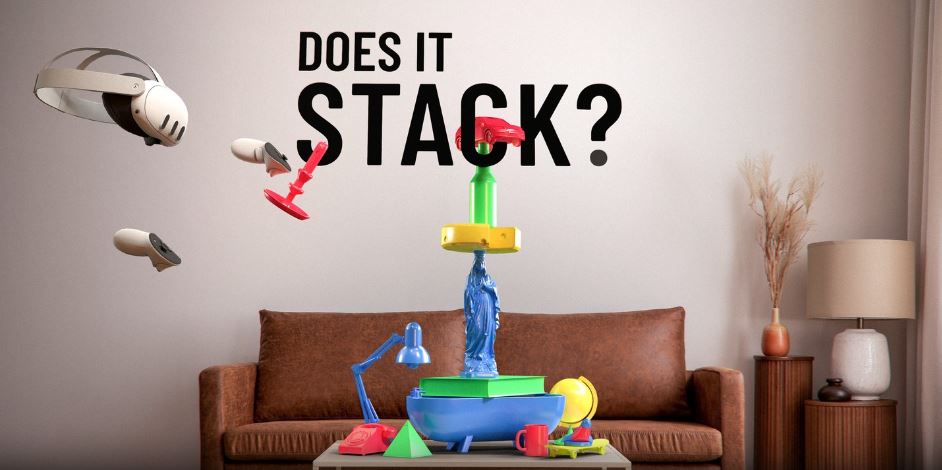
Does It Stack? is a physics-based tower-building puzzle game from Belgian studio Cybernetic Walrus, developed in collaboration with Meta and released for Meta Quest 2 and 3 in October 2024. The premise is exactly as absurd as it sounds: stack increasingly ridiculous objects on top of each other to build the tallest, most precariously balanced tower you can manage.
The twist — and the strategic core — is that no two objects of the same colour can touch each other. If they do, they explode. This transforms what could be a simple stacking toy into a spatial planning puzzle: you need to think ahead about both the physical balance of your tower and the colour sequence of the objects you're placing.
Does It Stack? is the first in Cybernetic Walrus's new "Does It?" series — a family of XR games built around a single playful verb and a physics simulation. The studio, previously known for racing game *Antigraviator*, made a deliberate pivot to "fun and quirky XR games" with this release.
Mechanic
Stack It. Don't Match It. Don't Drop It.
Does It Stack? sits in the same family as Jenga and Tumble VR — tower-building games where the physics engine is the primary challenge. But the colour constraint adds a layer of puzzle logic that elevates it beyond a pure dexterity test.
🏗️
Stack ridiculous objects
Toy cars, bicycles, bowling balls, fish, forks in toasters — 150 unlockable objects with wildly different shapes, weights, and surface properties. Every object behaves differently under the physics simulation. A bicycle is long and unstable; a bowling ball rounds off corners; a fish is an irregular shape that slides and tilts.
💥
Same colour = BOOM
If any two objects of the same colour come into contact, they explode — and potentially take half your tower with them. This constraint forces players to plan ahead: you need to think about both the physical stability of each placement AND the colour sequence of the objects in your available pool.
🎯
Level challenges escalate
Each of the 60 levels includes three challenges of escalating difficulty. Early challenges are simply about building height. Harder challenges introduce specific objectives — top the tower with a cheese wheel, ensure the last placed object is blue, reach a specific height with a limited set of objects. These require forward planning as well as physical skill.
UploadVR (pre-release impressions):
"It's reminiscent of Supermassive Games' Tumble VR... There's an immediately relatable premise that's straightforward to learn... a straightforward premise that works well in mixed reality."
Source: UploadVR hands-on impressions, October 2024
Features
Everything In the Box
🎮
60 levels · 3 challenges each
180 total challenge targets across the campaign. Early challenges build height; later ones introduce specific end-state requirements.
🎒
150 unlockable objects
Progress unlocks a widening catalogue of objects — each with different shapes, mass, and surface friction that make placement feel distinct.
🌐
VR + Mixed Reality modes
Play fully immersed in VR or use Quest passthrough to build towers in your actual room. MR mode is a standout feature — stacking objects on your real desk or floor.
👥
Local co-op
Two people can stack together in the same physical space — one of the modes that makes Does It Stack? well suited to short shared classroom activities.
🏆
Daily challenges + leaderboards
A fresh daily challenge keeps regular users engaged. Online leaderboards let students compare heights against each other and the broader community.
🏖️
Sandbox mode
Free build with all unlocked objects and no objectives — pure creative stacking. Ideal for unstructured play and exploring which object combinations make the most stable (or spectacularly unstable) towers.
🌐 Mixed Reality is a highlight.
Building towers in your actual physical space using Quest passthrough — balancing a bicycle on your real desk, watching a bowling ball roll across your actual floor before tipping off a virtual shelf — is one of the most effective demonstrations of mixed reality's potential for a general audience. For schools with Quest 3 headsets, the MR mode is a natural conversation starter about augmented vs virtual reality as technologies.
Education
What Students Learn — Without Knowing It
Does It Stack? is not a curriculum tool and makes no pretence of being one. But like the best physics-adjacent puzzle games, it builds genuine intuitions through repeated interaction with a physics simulation — intuitions that support and enrich formal learning.
⚖️ Centre of mass & stability
Every stacking decision is an implicit test of centre of mass reasoning. Students who spend time in Does It Stack? develop the intuition for when a tower is about to tip — the same understanding tested formally in GCSE Physics.
📐 Spatial reasoning
Planning multi-object colour sequences while managing three-dimensional physical balance requires sustained spatial reasoning — one of the most transferable cognitive skills in STEM.
🔬 Experimental iteration
Towers fall. Students identify what went wrong, adjust their approach, try again. This is informal experimental method in its purest form — hypothesis, test, observe, revise.
🎲 Constraint-based logic
The colour-matching rule introduces a logic constraint — students must plan sequences to avoid explosions while still achieving the physical tower goal. This is combinatorial thinking in disguise.
🏫 Best classroom use.
Does It Stack? is an excellent end-of-lesson reward, a break-time enrichment activity, or a paired introductory VR session for students who haven't used headsets before. The co-op mode makes it a natural social activity. The daily challenge creates a low-stakes recurring engagement point. For teachers covering forces and stability in KS3 or GCSE Physics, a 15-minute session followed by a discussion about what made towers stable or unstable connects play to curriculum.
Honest View
What to Be Aware Of
⚠️
Not a curriculum science tool. Does It Stack? is a fun puzzle game with light physics. It builds physical intuition and spatial reasoning through play, but has no curriculum alignment, no lesson plans, and no assessment. Its value in a science context requires teacher framing to make the connection explicit.
⚠️
Limited content depth. 60 levels with 3 challenges each is solid but finite. Regular players will work through the campaign and reach the daily challenges as the ongoing engagement loop. Sandbox mode extends replayability but lacks objectives to sustain long-term engagement.
✅
Instantly accessible to any age. No prior VR experience needed. No tutorials to sit through. Pick up an object, put it on the tower. The premise is understood within seconds. This makes Does It Stack? one of the best introductory VR experiences for students trying headsets for the first time.
✅
Mixed Reality mode is a genuine showcase feature. Building towers in your actual physical room via Quest passthrough is one of the most accessible and impressive demonstrations of MR technology for a general audience. For schools introducing students to VR/MR technology, Does It Stack? is an ideal first experience.
✅
Local co-op and daily challenges suit classroom rhythms. Pair students for co-op sessions; use daily challenges as a recurring hook for headset time. These features map well to a school deployment model where headsets are shared and sessions are time-limited.
✅
Developed in collaboration with Meta — strong quality signal. Cybernetic Walrus worked with Meta directly on this release. The involvement of Meta's platform team in development typically means tight integration with Quest platform features (MR, voice, leaderboards) and a well-optimised experience on Quest hardware.
Our Verdict
XR School Scores
Fun & Accessibility
9 / 10
Instantly comprehensible to any age. Absurd objects are charming. Physics feedback is satisfying. Co-op adds social play. Daily challenges sustain engagement. One of the most immediately accessible VR puzzle games reviewed here.
Mixed Reality Implementation
9 / 10
Building towers in your actual room is one of the best consumer MR experiences available on Quest. Developed in collaboration with Meta — the integration is polished and the MR experience is genuinely impressive.
Physics / Spatial Reasoning Value
7 / 10
Builds centre of mass intuition, spatial reasoning, and constraint-based logic through play. Needs teacher framing to connect to curriculum. Genuine but indirect educational value.
Content Depth
7 / 10
60 levels × 3 challenges = solid campaign. Daily challenges and sandbox add ongoing engagement. 150 unlockable objects provides variety. Not an endless content pool, but well-sized for the price.
Value for Money
8 / 10
$14.99 for 60 levels, sandbox, MR mode, co-op, leaderboards, and daily challenges. Solid value for a well-polished, professionally developed VR puzzle game from a studio working directly with Meta.
Bottom Line
Does It Stack? is a cheerful, polished, instantly accessible physics puzzle game that earns its place on school Quest headsets through sheer approachability and its excellent mixed reality mode. Balancing bicycles on bowling balls while watching the colour of each object to avoid explosions is genuinely fun — and genuinely physics. It builds spatial reasoning and centre of mass intuition through play, and the co-op mode and daily challenges map naturally to classroom deployment rhythms. It is not a science curriculum tool, and teachers looking for GCSE-aligned optics experiments or Newtonian mechanics simulations should look elsewhere in this series. But as an introductory VR experience for students trying headsets for the first time, a social end-of-lesson activity, or a reliable enrichment game for free periods, Does It Stack? is one of the best options on the Quest platform at its price point.