
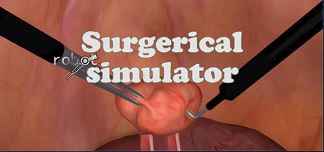
Surgical Robot Simulator
Surgical Robot Simulator
A professional-grade VR training tool for robotic-assisted surgery — built by practising robotic surgeons, featuring haptic feedback, precision suturing tasks, and a companion expert-led online course.
What Is It?
Marion Surgical Robot Simulator is a professional VR surgical training application for the Meta Quest 3 and 3S, built by Marion Surgical — a company staffed and led by practising robotic surgeons. It is designed to help trainee and qualified surgeons, medical students, and healthcare professionals develop the fine motor skills and procedural familiarity needed to operate robotic surgical systems.
The simulator focuses on the key technical competencies of robotic surgery: instrument handling, precision suturing, electrocoagulation, tissue dissection, and procedural sequencing. Haptic feedback through the Quest controllers simulates tissue resistance, making the experience significantly more realistic than a purely visual simulation. 3D anatomical models are used throughout, and real-time performance metrics track accuracy, efficiency and completion time.
Uniquely, the app is paired with an expert-led online course available via Udemy, developed by robotic surgery pioneers, that provides guided instruction and contextual learning alongside the practical VR sessions. The two together represent a more complete training package than most consumer-facing medical VR apps offer.
Why Robotic Surgery Training Matters
Robotic-assisted surgery (RAS) — systems like the da Vinci — now accounts for a significant and growing proportion of surgical procedures worldwide. Unlike traditional open or laparoscopic surgery, RAS requires surgeons to learn an entirely new motor vocabulary: operating from a console, viewing through a camera, manipulating tissue via articulated robotic arms with no direct tactile link to the patient.
The learning curve is steep, and access to practice time on actual robotic systems is severely limited by cost and theatre availability. A single da Vinci surgical robot costs over £1 million — simulator access on dedicated hardware runs to tens of thousands of pounds per unit. VR training on a consumer headset at £50 represents a genuinely disruptive cost reduction, and the research literature supports XR-based training as effective preparation for real robotic procedures.
What It Covers
Who Is This For?
This is not a school classroom app in the way the Dissection Lab or UW Virtual Brain Project are. It is a professional and near-professional training tool with a specific, narrow target audience. Being honest about that makes it easier to decide whether it belongs in your context.
What to Be Aware Of
XR School Scores
Marion Surgical Robot Simulator is a serious, clinician-built training tool that makes professional-grade robotic surgery simulation accessible for the first time at consumer headset prices. For medical students, surgical trainees, and higher education institutions with Quest 3 hardware, it represents exceptional value. For secondary schools, it is more a powerful careers and enrichment experience than a curriculum tool — particularly compelling for sixth-form students with interests in medicine or engineering. It is not for Quest 2 users, and the companion Udemy course is an additional purchase to account for.
A 2024 systematic review & meta-analysis confirms XR simulators produce measurably better robotic surgery performance in novices — comparable to conventional physical simulators. The academic case for VR surgical training is established.
Read the review (PMC) →This app is incompatible with Quest 2. If your school fleet runs Quest 2 headsets, this app is not currently an option. Check the Meta Store listing for any future compatibility updates.