
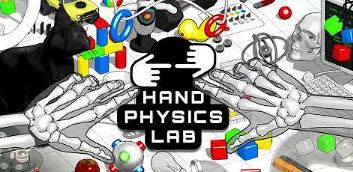
Hand Physics Lab
Hand Physics Lab
Put down the controllers. Use your actual hands. 85 physics puzzles — stacking blocks, casting magnets, operating machines, petting a virtual cat — experienced entirely through bare-hand tracking in one of VR's most innovative physics sandboxes.
What Is It?
Hand Physics Lab is a physics-based puzzle and sandbox game for Meta Quest, created by solo developer Dennys Kuhnert at Holonautic Studio. It is one of the earliest — and still one of the most creative — explorations of what becomes possible when you give VR users their bare hands instead of controllers, built right after Oculus released experimental hand tracking on the original Quest in early 2020.
The premise is simple: 85 puzzles and experiences, plus a sandbox mode, all driven entirely by your physical hands interacting with a physics engine. No buttons to press, no triggers to squeeze — you reach out, grab, stack, push, flick, pinch, poke, and gesture, and the virtual world responds. The visual style is deliberately minimalistic — clean, cartoon-like geometry that keeps the focus on what matters: the physical interaction.
The experience oscillates between moments of genuine magic — when your hand does exactly what you intended and the physics responds perfectly — and moments of frustration when hand tracking loses fidelity. Both are part of the experience, and the best players learn to work with the tracking system rather than fight it.
A Weekend Prototype That Became a Game
The Holonautic press kit describes the origin with appealing directness: it started in January 2020 as a weekend experimental prototype, created very shortly after Oculus released the experimental hand tracking features on Quest. Dennys Kuhnert saw the opportunity to jump on the hand tracking interaction system and explore what was genuinely possible — experimenting, building puzzles, sharing with the community, and iterating.
What grew from that weekend became a game with 85 puzzles, a sandbox mode, and a following of players who appreciated the spirit of genuine experimentation it represented. The design influences — Portal and Crazy Machines — are visible in the minimalistic level design and the physics-first puzzle approach. The decision to embrace a simple cartoon visual style was both a practical response to mobile VR performance constraints and a deliberate choice to keep attention on the physics interaction.
85 Puzzles Across Multiple Playgrounds
The puzzle collection spans a wide range of physics interactions and experiences — from the simple (stacking blocks with your hands) to the technically inventive (operating a remote control car with finger gestures) to the surreally charming (petting a virtual cat). Completing puzzles unlocks playgrounds — themed spaces with greater freedom to explore and create.
You operate a remote control car by pinching your fingers to accelerate and wagging a finger to steer. The moment you realise it works is genuinely magical — a "whoa!" moment that VR rarely delivers. Then the puzzle asks you to drive the car over ramps to your right and left. You turn your head to watch where the car is going — which moves the headset's cameras away from your hands — and the tracking dissolves, taking your remote control with it. This is Hand Physics Lab in miniature: the delight and the frustration are both real, both connected to the same fundamental property of hand tracking technology.
Physics Through Play
Hand Physics Lab is not a physics curriculum tool — it doesn't teach Newton's Laws, doesn't cover specific syllabus points, and has no lesson structure. What it does, which is both more subtle and genuinely valuable, is provide extended, engaging, hands-on experience of physics as a felt, embodied phenomenon.
Building a tower of blocks with your actual hands — feeling the constraint that if you stack too high it topples, that lighter blocks balance on heavier ones more easily, that an off-centre placement causes immediate instability — is a different kind of learning from calculating the centre of mass of a uniform rod. Both are useful. The physical intuition built in Hand Physics Lab is the kind that makes the mathematical abstractions make sense.
What to Be Aware Of
XR School Scores
Hand Physics Lab is a solo developer's love letter to what hand tracking in VR can feel like when it works — and at $9.99 for 85 physics puzzles and an open sandbox, it remains one of the most inventive physics play experiences on Meta Quest. The "wow" moments — picking up a block with your actual hands, operating a tiny car with finger gestures, watching a magnetic chain reaction — are genuinely extraordinary and unlike anything available with controllers. The "frustration" moments, when tracking loses fidelity in challenging lighting or look-away situations, are also real and need classroom preparation to manage. Test the lighting, brief students, use Touch controllers as fallback, and frame the sandbox mode around explicit physics observations. Do all that and Hand Physics Lab delivers an experience that no formal physics curriculum tool can — the visceral sensation of being a physicist using your own hands.