Overview
What Is It?
Gravity Lab is a physics-and-electronics puzzle game developed by solo developer Mark Schramm, set in an abandoned lunar testing facility. It is one of VR's longest-running active puzzle games — first arriving on PC VR in October 2016, arriving on Meta Quest in August 2020, and still receiving free content updates in 2021. Over its lifetime it has accumulated more than 16,000 players and 230,000 solved levels across all platforms.
The simplest description is UploadVR's: "Lemmings by way of a physics class." Each level presents an orb launcher and a destination bucket. Your job is to place gravity-bending appliances — ramps, gravity inverters, fans, portals, electronic components — in the three-dimensional space between launch and goal to guide the orbs to safety. The puzzle is not finding where to place things on a flat surface; it is reasoning about trajectories, gravitational effects, and force directions in three-dimensional VR space.
Mark Schramm is an Australian developer with genuine VR credentials — he worked on the Quest port of Superhot VR, one of the most acclaimed early Quest games. Gravity Lab is his personal project, developed over nearly a decade with consistent free updates and active community engagement. The developer's own note captures it well: "The VR immersion is almost secondary to the mental immersion in eking out the best solutions to the problems."
Mechanic
How It Works
The game is set on a lunar testing facility where gravity is only loosely respected. Each level has a machine that fires orbs and a goal zone where they need to land. Between the two, you place a toolkit of gravity-influencing appliances to create a path.
📐
Ramps & platforms
The basic tools — redirect the orb's trajectory with angled surfaces placed anywhere in three-dimensional space.
🔄
Gravity inverters
Pass an orb through a gravity inverter and it falls upward. The defining mechanic — opens paths that would be impossible under normal gravity.
💨
Fans
Direct airflow to push and steer orbs. Useful for fine trajectory adjustments and for reaching goal zones that ramps alone can't access.
⚡
Electronics
Later additions add electronic triggers and components — gates that activate when an orb passes, switches that control other appliances, adding a logic layer to the physics puzzles.
🌀
Time portals
The Time Travel update adds portals between past and present. Items age when moved through time; objects placed in the future don't exist in the past. Causality becomes a puzzle element.
🗂️
Level editor
Build and share your own levels. The community has contributed to those 230,000+ solved levels across all platforms — the puzzle content extends far beyond what Schramm built himself.
UploadVR on the Quest version (2020)
"It's Lemmings by way of a physics class — you might say, fire orbs halfway across a room, where they'll land on floating ramps that peddle them in a specific direction, down through a gate to invert their gravity, then watch them float into the goal zone."
UploadVR · Gravity Lab review · August 2020 · Rating: Good
Design Lineage
The Lemmings Lineage in VR
The "Lemmings" comparison is apt and worth unpacking for teachers. Lemmings — the 1991 DMA Design puzzle game — presented players with small creatures walking in a fixed direction toward danger, and tasked them with placing tools at strategic points along the path to redirect them to safety. The puzzle was not controlling the lemmings directly, but reasoning about trajectories and timing.
Gravity Lab applies the same conceptual structure in three-dimensional VR space, replacing flat-screen 2D lemmings with physical orbs in a volumetric environment. The VR dimension changes the nature of the puzzle fundamentally: paths can go in any direction, gravity can be inverted, and the solver must reason spatially in three dimensions rather than laterally in two. The mental model required is genuinely more sophisticated — and more physically rich — than any flat-screen incarnation of the concept.
🎮 Also inspired by: The Incredible Machine.
The physics-machine-building genre — where players assemble Rube Goldberg-style devices to solve physical problems — is a direct ancestor. The Incredible Machine, Crazy Machines, and Gravity Lab all share this heritage. In VR, the machine you're building exists in the same physical space as your body, making the construction and observation experience qualitatively different from screen-based versions.
Updates
Nearly a Decade of Free Updates
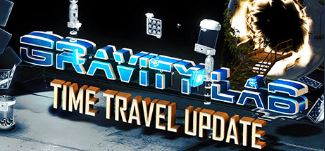
Gravity Lab arrived on PC VR in October 2016. Most puzzle games released in 2016 are long abandoned. Schramm has kept the game active — porting to Quest in 2020, adding Valve Index support, releasing the free Microstar update, and in August 2021 delivering the Time Travel update just before the game's fifth anniversary on Quest.
The Time Travel update is the most ambitious content addition. It introduces portals between present and past states of the level — stepping through changes what exists and what doesn't. Objects age when moved through time. An item placed in the future doesn't exist in the past; bring the future version of an item back, delete the original, and the future version vanishes too. Causality itself becomes a puzzle mechanic.
📅 Still going at five years old.
When UploadVR wrote about the Time Travel update in 2021, they noted: "It's pretty remarkable to see the game getting yet more updates this far in." That commitment to a single product over many years — entirely free additions, no paid DLC — says something about Schramm's relationship with Gravity Lab. This is not a project that was shipped and forgotten.
Education
Educational Value
Gravity Lab is a puzzle game that has genuine educational value, but its value is in physics intuition building rather than curriculum delivery. There are no lesson plans, no curriculum objectives, no assessment tools. What it does is immerse students in a three-dimensional environment where the physics of gravity, trajectory, force, and momentum govern every interaction — and where success requires accurate reasoning about those forces.
🌍 Gravity & trajectories
Every level is a practical exercise in predicting how objects move under gravity. Students develop intuition for parabolic trajectories, the effect of gravity on falling objects, and how changing direction changes outcomes.
🔄 Forces & momentum
Fans, gravity inverters, and ramps all apply forces to orbs. Students learn to reason about how forces change direction and magnitude of motion — qualitative physics reasoning that supports formal GCSE concepts.
🧠 3D spatial reasoning
Constructing solutions in three-dimensional VR space — planning paths that go up, down, sideways, through gravity fields — is one of the most demanding spatial reasoning exercises in this physics series.
🔬 Systematic problem-solving
Iterating on a gravity puzzle — placing a component, running the simulation, observing where it fails, adjusting — is informal experimental method. Try, observe, adjust, repeat.
🏫 Best classroom use.
Gravity Lab works best as a 20–30 minute enrichment activity during or after a unit on forces, gravity, or motion. The level editor could also be a creative extension task: challenge students to design a level that requires another student to apply a specific physical principle to solve it. The Time Travel levels are outstanding for stimulating discussion about causality — a genuinely cross-curricular conversation that reaches into philosophy and physics at once.
Honest View
What to Be Aware Of
⚠️
Shows its 2016 origins. Gravity Lab was built in 2016. UploadVR's 2020 Quest review noted that while it holds up well, "it doesn't feel as groundbreaking as it might have used to." The visual design and interaction model are clean and functional, but modest compared to 2023-era VR productions. This is a solved problem for the right audience — players who come for the puzzles won't notice; those expecting modern polish may.
⚠️
Not curriculum-aligned. No lesson plans, no learning objectives, no assessment tools. Educational value depends on the teacher providing framing and context. As a standalone session without curriculum connection it is an engaging puzzle game; with direction it becomes something more.
⚠️
Difficulty ramps steeply. Early levels are gently approachable. Later levels — and the Time Travel puzzles particularly — are genuinely difficult and require sustained, systematic thinking. Some younger or less patient students may find the harder levels frustrating. The built-in level editor means teachers can create simpler custom levels if needed.
✅
Genuinely unique 3D gravity puzzle experience. No other app in this physics series puts students in a three-dimensional space where gravity is the primary puzzle element — where inverting gravity, redirecting trajectories, and applying forces in all directions is the core mechanic. This is a one-of-a-kind experience in the educational VR landscape reviewed here.
✅
16,000+ players over eight years. The community and longevity data speaks for itself. Gravity Lab has retained an engaged player base for nearly a decade with consistent free updates. 230,000+ solved levels represents genuine, sustained engagement, not a novelty spike.
✅
Multiple comfort options including seated play. Teleport, joystick locomotion, and miniature mode (seated, reduced scale) make Gravity Lab accessible for players who need static or seated VR experiences — an important practical flexibility for classroom deployment.
✅
The Time Travel update is genuinely extraordinary. Causality as a puzzle mechanic — where actions in the future affect the present, and paradoxes are something to be designed around rather than avoided — is a conceptually rich experience that no other physics VR app reviewed here approaches.
Our Verdict
XR School Scores
Puzzle Design & Depth
9 / 10
Well-designed progressive puzzles, gravity inverter mechanic, electronics integration, and a causality-based Time Travel update. Eight years of puzzle development, including community levels, provides extraordinary content depth.
Physics Intuition Value
8 / 10
Gravity, trajectory, forces, and spatial reasoning all develop through extended play. No curriculum alignment, but strong physics intuition development for students who engage seriously with the puzzles.
Longevity & Community
10 / 10
Eight years. Three major free content updates. 16,000+ players. 230,000+ solved levels. Level editor with community content. This is the physics series' most enduring VR puzzle game by a significant margin.
Curriculum Alignment
4 / 10
Not curriculum-aligned. No lesson plans, objectives, or assessment. Best as forces and motion enrichment when framed by a teacher. The Time Travel puzzles are particularly good for stimulating discussion about causality.
Value for Money
9 / 10
$14.99 for a puzzle game with eight years of free updates, a level editor, community content, and 230,000+ solved levels of content breadth. Outstanding value for what is delivered.
Bottom Line
Gravity Lab is one of VR's most enduring puzzle games — a solo developer's eight-year project that has grown from a 2016 PC VR release into a content-rich, community-supported physics puzzle experience. "Lemmings by way of a physics class" is still the best single-sentence description: place gravity-bending appliances in three-dimensional space to guide orbs to their destinations. The core is simple; the depth is genuine. Free updates including the Time Travel puzzles — where causality itself becomes a mechanic — extend the content well beyond the original release. The 2016 production values are honest and undistracting. For teachers building physics intuition around gravity, forces, and trajectories, Gravity Lab at $14.99 is an exceptional value enrichment tool. The level editor adds the possibility of creative student extension work. And the developer's own summary is worth adopting: the VR immersion is almost secondary to the mental immersion in eking out the best solutions to the problems.