
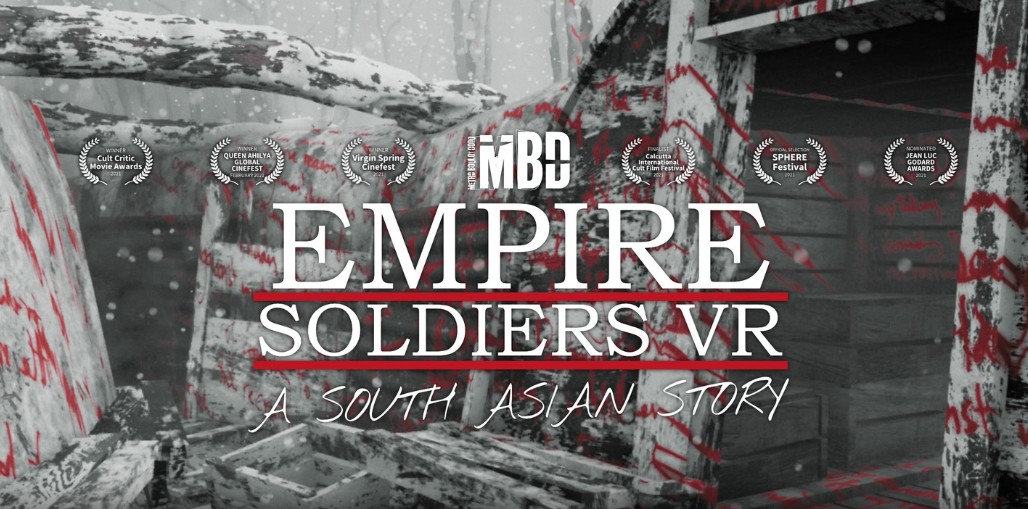
Empire soldiers a south asian story
Empire Soldiers:
A South Asian Story
A VR film honouring the overlooked contribution of South Asian soldiers in World War I. Experience the battlefield from the perspective of a returning soldier, then reflect on a century of migration. Originally created as a UK touring exhibition for the WWI centenary.
Touring WWI Centenary
Empire Soldiers: A South Asian Story is a free VR film produced by MBD, a UK-based arts organisation led by Creative Director Paul Long, whose multi-award-winning immersive experiences have been shown across the world. The film was originally commissioned as a touring virtual reality exhibition, shown across the UK in 2018 to mark the centenary of the end of the First World War.
The experience places you alongside a returning South Asian soldier as he shares first-hand accounts of the battlefield. The journey then shifts to the present day, reflecting on a century of change and the lasting impact of migration. It is approximately 12 minutes long and available free on Oculus Rift, Oculus Go, and Viveport. Empire Soldiers: A South Asian Story is part of a planned series of short VR films dedicated to preserving the stories of soldiers from across the former British Empire, including a companion Caribbean Story.
The film uses the perspective of migration and return to connect the WWI experience to the present day — making explicit the link between the sacrifice of South Asian soldiers in British service and the postwar migration that shaped modern multicultural Britain. This makes it relevant not only to History but to Citizenship, PSHE, and RS lessons about identity, belonging, and national belonging.
When Britain declared war in August 1914, it declared war on behalf of the entire British Empire. This meant that soldiers from India, the Caribbean, Africa, and other territories were drawn into a European conflict they had no say in initiating. For soldiers from the Indian subcontinent, service was complex: it could represent loyalty to the Crown, opportunity for advancement, economic necessity, or family tradition in military service.
Indian soldiers were among the first non-European troops to arrive on the Western Front in significant numbers, playing a critical role at the First Battle of Ypres in October and November 1914. The Indian Corps fought extensively through the winter of 1914-1915 in conditions for which they were poorly equipped, particularly regarding winter clothing. Casualties were severe.
- Free on Oculus and Viveport platforms
- Addresses a genuine gap in WWI history teaching
- Made by a UK multi-award-winning arts organisation (MBD)
- ~12 minutes: fits within a lesson activity
- Connects WWI service to migration — rich cross-curriculum relevance
- Part of a planned series (Caribbean Story also available)
- Originally UK touring exhibition with broad public reach
- PC VR headset required (Oculus Rift or compatible); no Meta Quest standalone version
- App dates from 2018; platform compatibility has changed — check before planning
- No public review score available
- Primarily a passive 360°/animated film rather than interactive VR
- Developer
- MBD (UK arts organisation)
- Creative Director
- Paul Long
- Price
- Free
- Platforms
- Oculus Rift • Oculus Go • Viveport
- Duration
- ~12 minutes
- Format
- 360° / VR animated film (passive)
- Original Context
- UK touring exhibition, WWI centenary 2018
- Companion
- Empire Soldiers: A Caribbean Story (also free)
- Age Rating
- KS3+ (war themes)