
Freehistory

Angels of Amsterdam

The XR SchoolHumanitiesHistory › Angels of Amsterdam
Free History Art & Cinema 🌟 Venice Biennale Mature — 16+ PC VR Only

Angels of
Amsterdam

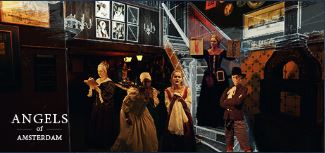
A 30-minute volumetric VR experience set in a 17th-century Amsterdam café, following four real women who lived in the shadows of the Dutch Golden Age. Venice Biennale world premiere. Free on SteamVR.

Creators: Anna Abrahams & Avinash Changa (WeMakeVR)
Price: Free
Runtime: ~30 minutes
Platform: SteamVR (PC VR only)
⚠ Mature Content Advisory — Recommended for ages 16 and above Angels of Amsterdam deals with sex work, poverty, and gender-based exploitation in 17th-century Amsterdam. It contains one brief moment of female nudity, included by the creators for its artistic and thematic purpose. The content is presented with care and historical context. Teachers should preview before classroom use and consider the appropriate age group carefully. Not recommended for under-16 students.
8.0
/10
XR School Score
Recommended (16+)
Award-winning VR filmmaking that brings a marginalised chapter of history to life with extraordinary realism
🌟 Venice Biennale 78th International Film Festival
First Dutch VR in official competition
Overview

Angels of Amsterdam is a free, 30-minute volumetric VR experience that places you inside a meticulously recreated 17th-century Amsterdam café, where four women — Maritgen Jans, Juliana, Elsje Christiaens, and Pussy Sweet — share episodes from their lives through song, dance, and direct address. The characters respond to your eye contact. You are their audience, their witness, and implicitly their judge.

The work was created by Anna Abrahams, filmmaker and VR programmer at the EYE Film Museum and teacher at the Royal Academy of Art in Amsterdam, and Avinash Changa, founder of WeMakeVR. It had its world premiere in the VR Expanded section of the 78th Venice International Film Festival in 2021, becoming the first Dutch VR work ever selected for Venice's official competition. The Steam release followed in December 2022.

The Historical Source The starting point for Angels of Amsterdam was a book called "Amsterdam Whoredom," written in the 17th century for a male audience as a guide to Amsterdam's sex trade. Abrahams and Changa retell these stories entirely from the women's perspectives, giving voice and agency to figures who were historically either invisible or defined entirely by their role in the male gaze. The four women are drawn from real historical records; their stories are documented, not invented.

The experience is not comfortable viewing, and it is not meant to be. The Dutch Golden Age — the era of Rembrandt, Vermeer, and the VOC trade empire — rested on the labour of thousands of women like Maritgen and Juliana, whose poverty, marginalisation and exploitation made the wealth of the city possible. Angels of Amsterdam makes this visible with a directness that no textbook achieves.

The Four Angels
🎻
Maritgen Jans
A woman navigating the economy of Amsterdam's port district in the 1600s. Her story opens questions about consent, survival, and the relationship between poverty and exploitation in early capitalist society.
💃
Juliana
A figure whose story explores the experience of a woman navigating social hierarchies in the city. Juliana's tale is central to the work's exploration of race, status, and gender intersecting in colonial-era Amsterdam.
⚖️
Elsje Christiaens
A real historical figure whose story is documented in period records. Elsje was executed in Amsterdam in 1664 and her body displayed on a scaffold for months. Rembrandt sketched her. Her presence in the work connects to canonical Dutch art history.
💋
Pussy Sweet
A woman whose story is told through musical performance, examining the performance of identity and desire in a society that reduced women to commodities. Her tale connects the 17th century directly to contemporary debates about gender and power.
The Elsje Christiaens Connection

One of the four women, Elsje Christiaens, offers an unusual bridge between this VR experience and canonical Dutch art history. Elsje was a young Danish servant girl executed in Amsterdam in January 1664 for the murder of her landlady. After her execution, her body was displayed on a scaffold at the city gates as a deterrent, where it remained for several months.

Rembrandt van Rijn made two pen-and-ink drawings of Elsje's executed body during this period. The sketches are now held in museum collections in New York and Paris. They are among the very few instances where Rembrandt documented a specific named woman outside of commissioned portraiture — and the subject is a executed criminal displayed as a public spectacle.

Art History Curriculum Hook For teachers covering Dutch Golden Age art, the Elsje Christiaens connection offers a rare opportunity to discuss Rembrandt's documentary practice and the ethics of depicting marginalised figures. The VR experience and the Rembrandt sketches together make a powerful paired study: one restoring voice, the other recording a moment of state violence. This is the kind of cross-disciplinary connection that makes an art history lesson genuinely memorable.
Volumetric Capture: A New Form of VR Cinema
📷 What Makes Angels of Amsterdam Technically Distinctive
Angels of Amsterdam uses volumetric capture — a technique that combines 3D scanning with high-resolution camera imagery to produce photorealistic human figures that exist as full three-dimensional objects in virtual space. This is fundamentally different from standard VR animation or 360-degree video. The performers were captured in three dimensions, allowing you to move around them, observe them from different angles, and experience their presence as genuinely spatial rather than flat or screened. The creators describe their goal as making "the separation between the real and the virtual invisible." Professional reviewers have credited the result as "one of the most stunningly realistic historical recreation stories in VR to date." The café environment was built from photogrammetry scans of real Amsterdam interiors, and the attention to period detail extends to the objects, textures, and ambient sound of the space.
Hardware Note The volumetric capture technology demands significant GPU power. The minimum specification is an RTX 2080ti; the recommended is an RTX 3080. This is one of the most demanding free VR experiences available on Steam. Schools will need to confirm their hardware meets spec before planning a session.
Curriculum Fit
History (Dutch Golden Age)
8.8
Women's History
9.2
Art History (Dutch)
8.0
Media & Film Studies
8.5
PSHE / Gender Studies
7.8
Suitability KS3/4
2.0
Critical Reception
Scatter (volumetric filmmaking specialists) Industry
"One of the most stunningly realistic historical recreation stories in VR to date."
Dutch Culture Cultural press
"You can almost smell the ripe plums that are laid out on the 17th-century bar, almost feel the sea breeze brushing through your hair. The virtual reality experience is so lifelike, that all your senses are involved."
Steam Reviewer Negative
"Technically impressive but requires very high-end hardware. My RTX 2070 struggled. The experience itself is powerful but short for the download size."
Steam Reviewer Positive
"Genuinely unlike anything else in VR. These women feel real, present, and their stories matter. The eye-contact mechanic is quietly unsettling in exactly the right way. Essential viewing."
Steam: Mixed rating, 60% positive (20 reviews, 12 positive, 8 negative). The negative reviews almost exclusively concern hardware performance requirements rather than the experience's quality. The critical and festival reception from specialist outlets is strongly positive.
Strengths and Limitations
Strengths
  • Venice Biennale world premiere — first Dutch VR in official competition
  • Free on SteamVR
  • Volumetric capture makes characters feel genuinely present
  • 30-minute runtime fits within a lesson period
  • Rare: gives voice to marginalised women in Dutch Golden Age history
  • Elsje Christiaens connects to Rembrandt and Dutch art history curriculum
  • Created with EYE Film Museum and Royal Academy of Art involvement
  • Mature, serious work that treats students as capable of difficult material
Considerations
  • Mature content: brief nudity, themes of sex work and exploitation — 16+ only
  • Minimum RTX 2080ti GPU — very demanding hardware requirement
  • PC VR only: no standalone Meta Quest version
  • Mixed Steam rating (60%) driven by hardware performance issues
  • Teachers must preview and obtain parental consent before classroom use
  • Not suitable for mainstream classroom use below Sixth Form
FREE
SteamVR • 16+ content advisory
Get on Steam →
⚠ Requires RTX 2080ti minimum. PC VR headset required. Mature content: teacher preview and parental consent recommended before classroom use.
Quick Facts
Creators
Anna Abrahams & Avinash Changa
Studio
WeMakeVR / Rongwrong Foundation
Price
Free
Platform
SteamVR (PC VR only)
Min. GPU
RTX 2080ti (very demanding)
Runtime
~30 minutes
Released
December 2022 (Steam)
Festival
78th Venice Biennale (World Premiere, 2021)
Steam Rating
Mixed • 60% positive (20 reviews)
Age Guidance
16+ (mature themes, brief nudity)
Language
English full audio
Verdict
One of the most artistically serious and technically impressive free VR experiences available. The Venice Biennale recognition is deserved: Angels of Amsterdam does something genuinely new with the medium, and its historical and feminist content is valuable precisely because it treats its subjects with dignity and complexity rather than simplification. The Mixed Steam rating is misleading — it reflects hardware frustrations, not quality. For A Level History, Art History, or Film Studies at Sixth Form, this is exceptional material. The hardware demands, mature content, and PC VR requirement are real constraints. Teachers who can clear those hurdles will find this among the most memorable VR experiences available for secondary education.