
Chemistry

Abelana’s Atom Maker

Home Science Chemistry Abelana's Atom Maker
⚛️
🔬
⚛️ Chemistry · Physics · Atomic Structure · PC VR · Steam

Abelana's Atom Maker

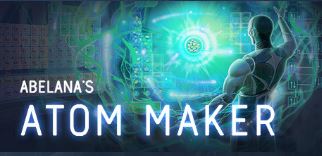
Assemble every element in the Periodic Table atom by atom in three-dimensional VR — visualising s, p, d and f orbitals, navigating energy levels, and building an intuitive understanding of electron configuration that no textbook diagram can replicate.

💲 $9.99 on Steam 🏢 Abelana VR 💻 PC VR — Steam & Oculus PC 🎓 Grades 7–12 & beyond 👥 Classroom multiplayer available
💻 PC VR Only — Not a standalone Meta Quest app — Abelana's Atom Maker runs on Windows PC via Steam (SteamVR) or through the Oculus PC app (Rift, Rift S). It is not available as a standalone Quest application. Schools with Quest fleets will need a tethered PC connection to use the VR mode.
Overview

What Is It?

Abelana's Atom Maker is an educational VR experience by Abelana VR, first released in February 2020. It is a single-player consumer version of an acclaimed multiplayer experience that has already been used in schools and location-based VR venues — built into a self-paced, step-by-step guided format for individual students, enthusiasts, and academics to use at home or in class.

The central experience is simple and powerful: you assemble atoms in three-dimensional virtual reality space. Protons, neutrons, and electrons are physical objects you can place and manipulate — building up the nucleus and populating the electron shells and orbitals around it. Every element in the Periodic Table is available to build, from hydrogen to oganesson.

What makes this more than a novelty is the depth of the atomic physics it covers. Rather than a simplified Bohr model with circular orbits, Abelana's Atom Maker visualises the actual quantum mechanical orbital shapes — s, p, d, and f orbitals — in three dimensions, at the correct energy levels. Students don't just place electrons; they see where those electrons actually exist, in the shapes predicted by quantum mechanics.

Developer

Who Made It & Why It Matters

Abelana VR is a VR software development company with a track record that goes beyond this single product. The studio was selected to develop Visceral Science in partnership with Columbia University physicist Professor Brian Greene and Verizon, as part of the Verizon 5G EdTech Challenge. Visceral Science — a multiplayer VR astronomy experience where students form stars, planets and black holes — was deployed at Liberty Science Center and in under-resourced middle schools, with Greene specifically designing it to bring cutting-edge science visualisation to students who wouldn't otherwise have access.

That pedigree matters for Atom Maker: Abelana VR is not a casual educational publisher. The studio has worked with one of the world's most prominent science communicators on a research-informed deployment at scale. The same attention to visualising genuinely difficult physics concepts runs through Atom Maker.

🔭 Abelana VR & Brian Greene. Abelana VR developed Visceral Science for the Verizon 5G EdTech Challenge in partnership with Professor Brian Greene (Columbia University). The experience was used at Liberty Science Center and deployed to under-resourced schools. The same studio built Atom Maker.
Content

What It Teaches

Atom Maker covers a significant sweep of atomic physics — from basic atomic structure at KS3 level through to A-level and beyond content on electron configuration, orbital theory, and quantum principles. This is unusual depth for a single focused VR experience.

Atomic structure (protons, neutrons, electrons) Bohr diagram (enhanced) Energy levels / electron shells s, p, d and f orbital shapes (3D) Aufbau principle Pauli exclusion principle Electron configuration notation Exceptions & special cases (noble gases, incomplete orbitals) All 118 elements Periodic Table groupings History of element discovery
⚛️ The s, p, d, f orbitals in 3D

This is the headline feature. Electron orbitals — the probability regions where electrons exist — have specific three-dimensional shapes that are almost impossible to convey through a 2D textbook diagram. The s orbital is a sphere; p orbitals are dumbbells; d and f orbitals have complex multi-lobed shapes. In Atom Maker, students see these shapes at human scale in three dimensions and watch how electrons populate them according to the Aufbau principle. For A-level students in particular, this visual understanding of orbital shapes is one of the most enduring things VR can provide that a textbook simply cannot.

📘 Designed for Grades 7–12. The developer describes the target range as Grades 7–12 (roughly UK KS3 through A-level), with deeper content available for college-level and academic users. Younger students will benefit most from the orbital visualisation and basic atomic structure; older students can engage with electron configuration notation, exceptions, and the Aufbau and Pauli principles in depth.
Versions

Single-Player & Classroom Multiplayer

The Steam and Oculus PC versions reviewed here are the single-player consumer editions — self-paced, with a built-in step-by-step guide. But Abelana VR also offers a separate multiplayer classroom version designed for instructor-led use in schools and VR arcades.

👤
Single-Player (Steam / Oculus PC)
Self-paced with built-in step-by-step guide. $9.99 on Steam. Available to any student or enthusiast with a PC VR headset. Suitable for home study or supervised classroom use.
👥
Classroom Multiplayer
Instructor-led version used in schools and location-based VR venues. Already deployed in classrooms. Available by contacting Abelana VR directly. Designed for teacher-facilitated group sessions.
Honest View

What to Be Aware Of

⚠️
PC VR only — not standalone Quest. Like Abelana's other products, this app requires a connected Windows PC and either SteamVR or the Oculus PC app. Schools running standalone Quest fleets cannot use this app without additional hardware.
⚠️
Very small review sample. Just 3 Steam reviews at the time of writing, all positive — giving a "Very Positive" label but from a statistically insignificant base. Community feedback from the Oculus store is similarly limited. The app has an all-time peak of 1 concurrent player on Steam. It is a niche product with a small but enthusiastic user base.
🔬
A physicist's note on the electrons. A physics researcher left detailed Steam community feedback pointing out that the electrons in the simulation are shown with classical paths — moving visibly from point A to point B like marbles — rather than as quantum mechanical standing waves or probability distributions. This is a genuine scientific simplification. For KS3–GCSE level students, the classical path model is the curriculum-standard Bohr model and is entirely appropriate. For A-level and beyond, teachers should note this caveat and use it as a discussion point about the limits of classical models.
Orbital shapes are accurately rendered. Despite the electron path simplification, the 3D shapes of the orbitals themselves — the probability regions — are correctly visualised. The dumbbell shape of p orbitals, the cloverleaf shape of d orbitals: these are accurate. This is the most educationally valuable feature and it is well done.
Genuine classroom pedigree. The multiplayer version has been used in schools and VR venues. This is not purely a consumer curiosity — it has a track record in educational settings, which the Steam single-player version extends to individuals.
$9.99 for the full Periodic Table. All 118 elements, every orbital type, step-by-step guide, Aufbau and Pauli principles, electron configuration notation — at under $10 this is generous content for the price, particularly for A-level and university-level students seeking to deepen their understanding of atomic theory.
Our Verdict

XR School Scores

Educational Value 8 / 10
Covers atomic structure from Bohr model basics all the way to Aufbau principle, Pauli exclusion, and full electron configuration notation. Orbital shape visualisation in 3D is genuinely outstanding for A-level learners. Slight caveat on the classical electron path model at advanced level.
Visualisation Quality 9 / 10
Seeing s, p, d, and f orbital shapes in three dimensions at human scale is one of the best uses of VR for chemistry education. The orbital geometry is accurately rendered. This is the killer feature.
Ease of Use 8 / 10
Self-paced with a built-in step-by-step guide. Designed for individual learners without teacher supervision. The physical atom assembly mechanic is intuitive — picking up and placing particles in 3D space.
Classroom Fit (Quest schools) 3 / 10
PC VR only. Not compatible with standalone Quest headsets without a connected Windows PC. Schools wanting a Quest-native atomic structure tool should look at Tablecraft's isotope mechanics for a partial equivalent. The classroom multiplayer version requires separate licensing.
Value for Money 9 / 10
$9.99 for all 118 elements, four orbital types, electron configuration notation, Aufbau/Pauli content, and a self-paced guided experience. Exceptional for students, tutors, and science enthusiasts.
Bottom Line

Abelana's Atom Maker is one of the most focused and educationally rigorous atomic structure visualisers available in VR. Seeing p, d, and f orbital shapes in true three-dimensional space is genuinely transformative for students who have only ever seen them as flat diagrams — and at $9.99 it is remarkable value, particularly for A-level and university-level learners. The PC VR requirement is the key practical barrier for Quest schools, and the electron path model is a legitimate scientific caveat at advanced level that teachers should be aware of. For students who have PC VR access, or for the classroom multiplayer version available directly from Abelana VR, this is a highly recommended experience for anyone tackling electron configuration and orbital theory.

Quick Facts
Price $9.99 (Steam)
Developer Abelana VR
Platforms PC VR (SteamVR / Oculus PC)
Release February 2020
Steam rating Very Positive (3 reviews)
Target age Grades 7–12 & beyond
Elements All 118
Orbitals s, p, d, f (3D)
Classroom version Yes (contact Abelana VR)
Meta Quest Not standalone
Curriculum Fit
KS3 Chemistry / Science ★★★★☆
GCSE Chemistry ★★★★★
A-Level Chemistry ★★★★★
University Chemistry ★★★★☆
Primary / KS2 ★★☆☆☆
🔭 Developer Pedigree

Abelana VR partnered with Prof. Brian Greene (Columbia University) and Verizon to build Visceral Science — a multiplayer VR astronomy experience for under-resourced schools. The same studio built Atom Maker.

Get Atom Maker
🎮 Steam ($9.99) → 🥽 Oculus PC App →
Requires Windows PC + VR headset
🏫 Classroom Multiplayer

An instructor-led multiplayer version for schools and VR arcades exists separately. Contact Abelana VR directly to enquire about licensing and deployment.

Contact Abelana VR →
Review by The XR School · Chemistry · Science