🎓 University-Developed · Peer-Reviewed Research · Erasmus KA2
Neotrie VR is not a commercial product made by a games studio — it is a research-backed educational tool developed by mathematicians at the University of Almería, Spain, specifically for mathematics classrooms. Research on its classroom effects has been published in Frontiers in Education (2024), and it was supported by an Erasmus KA2 project ("Geometrician's Views") and a UAL-FEDER research grant. This level of academic grounding — peer-reviewed evidence from real classrooms — is essentially unique among VR mathematics tools on the Meta Quest platform. One reviewer puts it simply: "If you are interested in VR tools for teaching math at any level, you have to install Neotrie."
Platform: Meta Quest 2/3/3S/Pro · Steam ·
Price: ~$14.99 ·
Developer: Virtual Dor / University of Almería ·
Level: KS3 to university
About the App
What is Neotrie VR?
Neotrie VR is a dynamic 3D geometry software built in Unity by Virtual Dor — the commercialisation spin-off of the University of Almería, Spain. It was developed by Professor José L. Rodríguez of the UAL Mathematics Department and Diego Cangas, and first released in October 2018 on Steam. The Quest version followed later, making the software accessible on standalone headsets for the first time — a significant development given that the high cost of PC VR rigs had previously prevented many schools from adopting it.
The core concept is a 3D geometry sandbox where students can physically build and manipulate geometric objects rather than observe them on a flat screen. Instead of looking at a diagram of a dodecahedron in a textbook, you hold it, rotate it, pull it apart, pass through its faces and explore it from inside. Instead of reading about a Möbius band, you walk along one. Instead of memorising the properties of a torus, you stand inside it and look up through its hole. The spatial understanding that comes from this embodied interaction is qualitatively different from anything a 2D representation can provide.
From Frontiers in Education (2024), peer-reviewed: "Virtual reality enables the creation of immersive and interactive learning environments for students and teachers... Neotrie is a virtual reality software that enables users to create, interact, and manipulate geometrical objects. The available tools allow teachers to deal with many Geometry topics, especially three-dimensional ones, at educational levels ranging from primary school to first years of university."
Neotrie is used at UAL in degree-level Mathematics courses — linear geometry, algebraic topology — as well as in secondary school Mathematics and in teacher training. Master's students studying to become secondary school teachers have used Neotrie to design their own lesson sequences, which they then deliver in schools. This is one of the few VR tools with an established teacher professional development pathway built directly into its academic ecosystem.
Features
What's Inside
🔷
Polyhedra — Every Type, Buildable & Manipulable
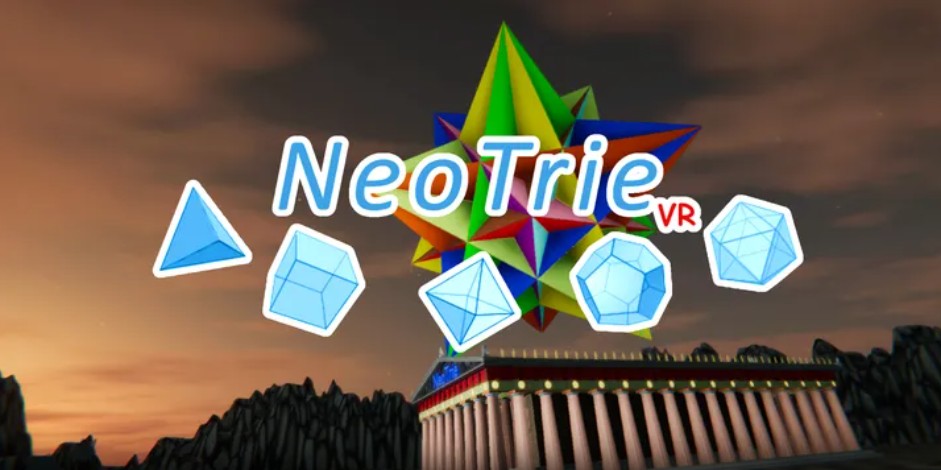
Neotrie covers the full range of polyhedral geometry: Platonic solids (tetrahedron, cube, octahedron, dodecahedron, icosahedron), Archimedean solids (truncated tetrahedron, cuboctahedron, snub cube, etc.), Johnson solids, Kepler-Poinsot polyhedra (star polyhedra), pyramids, prisms and antiprisms — plus geodesic spheres and cupolas. Students don't just observe these — they physically construct them face by face, vertex by vertex, exploring properties as they build. Basic operations on polyhedra include duality, truncation, rectification and extension. In 3D VR, students can shrink a polyhedron until it fits in their palm or expand it until they stand inside it — impossible in any other geometry classroom tool.
🌀
Torus, Möbius Band, Fractals & Surfaces
Neotrie includes topology and curved surface content that goes beyond standard school geometry into territory traditionally reserved for undergraduate mathematics — but made immediately accessible through physical exploration. Walk over a Möbius band and discover it has only one side. Stand inside a torus and look through its central hole. Build fractal structures and observe self-similarity at different scales. The 3D graphic calculator allows parametric curves and surfaces to be visualised and manipulated in real time — functions that a Maths teacher could use to explore graphs and surfaces in three dimensions. Crystalline lattice structures demonstrate the regular geometry underlying material science.
📊
Graph Theory — Königsberg, Hamiltonian Graphs & Four Colours
Neotrie includes a substantial graph theory section that brings some of mathematics' most famous problems into physical VR space: the Seven Bridges of Königsberg (Euler's graph traversal problem — can you cross every bridge exactly once?), Hamiltonian graphs (the Travelling Salesman problem — find the shortest route visiting every node), and graph colouring based on the Four Colour Theorem. These are problems that appear in GCSE and A-level Mathematics and Further Mathematics contexts, and being able to physically manipulate the graphs in 3D space — connecting nodes, colouring regions, tracing paths — makes the abstract concrete in a way diagrams on paper cannot.
👩🏫
Teacher Scene Creator & Classroom Multiplayer
Teachers can design custom VR scenes — pre-building geometric objects, adding text instructions, photos, videos and audio cues, and saving them as activities for students to load. The gallery of hundreds of pre-designed figures provides a ready-made library. Multiplayer mode allows a teacher and multiple students to share the same VR environment simultaneously, building collaboratively, demonstrating to the class, or competing in geometry challenges. The developer's website provides a user guide and activity templates. Scenes can be saved and loaded, and STL files can be exported for 3D printing — allowing virtual constructions to become physical objects. GeoGebra import is in development.
📐
Tessellations, Symmetry & Plane Geometry in 3D
Tessellations — the tiling of a plane — are built and explored in 3D space, with Neotrie supporting mosaics and repeating patterns across both 2D and 3D surfaces. Spatial symmetries (translations, rotations, reflections, dilations) are applied to 3D figures and observed in real time. Multiview projection planes allow students to study cross-sections of complex 3D shapes — projecting from the third dimension onto 2D planes in a way that directly addresses one of the most consistently challenging areas of school geometry. Parallels, perpendiculars, angles, lengths, areas and volumes are all measurable within the VR environment.
School Value
Curriculum & Educational Fit
GCSE / A-level Maths fit88%
Research evidence base96%
Teacher scene creation88%
Ease of use / onboarding48%
Neotrie VR is the most curriculum-aligned geometry VR tool available on Meta Quest — and the only one with peer-reviewed evidence of its effectiveness in real classrooms. Its greatest strength is in areas where school geometry consistently struggles: 3D spatial reasoning. Students who cannot visualise the cross-section of a cone, cannot mentally rotate a polyhedron to count its faces, or cannot understand why a Möbius band has only one side — these are exactly the students who benefit most from physical interaction in VR. Research shows that students who struggle most with 3D visualisation on paper show the greatest gains from immersive geometry environments.
For KS3 Maths, polyhedra, tessellations, symmetry and 3D shapes are directly on the curriculum — Neotrie provides the most powerful available supplement to these topics. For GCSE Maths, graph theory (Königsberg bridges), 3D coordinate geometry, cross-sections and transformations are all covered. For A-level and Further Maths, parametric surfaces, graph theory (Hamiltonian paths, Four Colour theorem) and topological structures go well beyond standard school content but are directly accessible to curious students. For Art & Design / STEAM, tessellation design, the geometry of Islamic art, geodesic architecture and crystalline structure all draw on Neotrie's content. The 3D printer export is a direct STEAM link — virtual constructions become physical artefacts.
Best use in school: KS3–GCSE 3D geometry and shapes · Polyhedra construction and properties · Spatial reasoning development · A-level / Further Maths graph theory and topology · STEAM project work · 3D printing integration · teacher-designed activity sequences · Maths enrichment clubs.
Honest note on learning curve: Neotrie has a steeper initial learning curve than most VR apps — navigation uses joystick + hand direction for flying, which some users initially find unintuitive. The developers acknowledge this and provide a user guide on their website. Plan a 20-minute introductory session for students before using it for curriculum activities — the investment pays back quickly once students are comfortable with the tools.
XR School Verdict
3D geometry depth10/10
Research evidence base10/10
Curriculum range9/10
Teacher tools8/10
Ease of use / onboarding5/10
Polish & UX5/10
Bottom line: The most powerful 3D geometry tool available on standalone VR — and the only one with genuine peer-reviewed evidence from real classrooms. Two 10/10 scores: geometry depth and research backing. The learning curve is real and the UI is academic rather than polished, but for any school serious about using VR for Maths, Neotrie is indispensable. No other app lets students walk inside a torus, build a Kepler-Poinsot star polyhedron, or physically traverse a Möbius band.
Pros & Cons
✓ University-developed · mathematicians
✓ Peer-reviewed classroom research
✓ Every major 3D geometry topic
✓ Torus · Möbius · fractals · parametric
✓ Graph theory — Königsberg, Four Colours
✓ Teacher scene creator · custom activities
✓ Multiplayer classroom mode
✓ 3D printer export (STL)
✓ Hundreds of pre-built figures
✓ KS3 to university level
✓ Quest + Steam · Erasmus backed
✓ All ages · pure Maths content
✗ Steep learning curve — needs onboarding
✗ Navigation unintuitive at first
✗ UI is functional rather than polished
✗ Occasional bugs (acknowledged by developers)
Quick Info
| Platform | Quest 2/3/3S/Pro · Steam |
| Price | ~$14.99 |
| Developer | Virtual Dor / Univ. Almería |
| Research | Frontiers in Education (2024) |
| Funding | Erasmus KA2 · UAL-FEDER |
| Level | KS3 → University |
| Multiplayer | ✓ Classroom mode |
| Teacher tools | ✓ Scene creator · gallery |
| 3D print export | ✓ STL export |
| Age | ✓ All ages · pure Maths |
| Best for | Maths · STEAM · Geometry |
📐 Topics Covered
🔷 Platonic, Archimedean, Kepler polyhedra
🌀 Torus · Möbius band · geodesic spheres
❄️ Tessellations · mosaics · symmetry
🌿 Fractals · parametric surfaces
📊 Graph theory (Euler · Hamiltonian)
🎨 Four Colour theorem
🔬 Crystalline networks
📏 3D symmetries · transformations
📐 Multiview projection · cross-sections
📈 3D graphic calculator
📐
Get on Meta Store
Neotrie VR · ~$14.99