
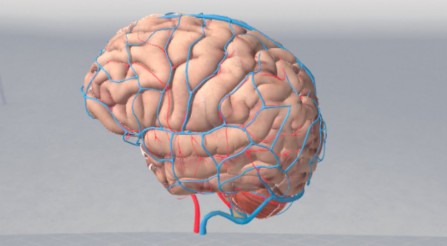
Brain VR
Brain VR
Hold a human brain in your hands and take it apart. Touch the cerebrum, cerebellum and brain stem individually. Use your index and middle fingers to trigger the disassembly — watching the brain separate into its component structures in 3D space around you. Then follow a guided lesson that walks you through what each region does. Brain VR is a dedicated brain anatomy learning app for Meta Quest, designed for students, educators and medical professionals who want to understand the most complex organ in the human body.
The brain — its major regions, their functions, and how the nervous system coordinates responses — is an explicit requirement in GCSE Biology (AQA, Edexcel, OCR). Students must be able to identify the cerebrum, cerebellum, medulla oblongata and other structures, describe their functions, and understand the nervous system's role in coordination and control. Brain VR is currently the only dedicated Meta Quest app that focuses specifically on the brain — making it a uniquely targeted tool for this specification area.
What is Brain VR?
Brain VR is a Virtual Reality brain anatomy learning application for Meta Quest, released in May 2025. It places a detailed 3D model of the human brain directly in your hands in VR — allowing you to hold it, rotate it, examine it from any angle, and trigger an interactive disassembly that separates the brain into its component regions. The app is designed for students, educators and medical professionals who want to develop a genuine three-dimensional understanding of brain anatomy that diagrams in textbooks simply cannot provide.
The fundamental value of Brain VR is spatial: the human brain is a three-dimensional object whose structures have specific positional relationships to each other that are extremely difficult to convey in a 2D diagram. The cerebellum sits at the posterior inferior aspect of the brain. The brain stem extends inferiorly from the diencephalon. The corpus callosum connects the two cerebral hemispheres at the midline. In a textbook, these descriptions require students to build mental models from flat images. In VR, they are immediately apparent because you can physically rotate the brain, view it from below, separate it into left and right hemispheres, or pick up and examine individual lobes.
Two modes are available. Free exploration allows students to move through the brain model at their own pace — examining structures, rotating views and triggering disassembly independently. Guided Learning Mode leads students through a structured lesson based on a real-life brain viewing session — the kind of guided tour that would previously require access to a real cadaver specimen or an expensive physical model. The guided mode makes Brain VR accessible to students who need structure and scaffolding, while the free mode serves independent learners and revision sessions.
What's Inside
Curriculum & Educational Fit
Brain VR is most immediately valuable for GCSE Biology students covering the nervous system — specifically the topic of brain structure, which is explicitly on all major UK GCSE Biology specifications. AQA Biology requires students to know the functions of the cerebral cortex, the cerebellum and the medulla, and to understand how scientists study the brain (including MRI scanning and the effects of brain damage). Brain VR provides a three-dimensional spatial reference for this content that no textbook diagram can match: once a student has physically held and disassembled a brain in VR, the positional relationships between regions — the cerebellum behind and below the cerebrum, the brain stem extending downward from the diencephalon — are retained far more effectively than from a labelled diagram.
For A-level Biology, the nervous system is a substantial topic covering the central and peripheral nervous systems, neurotransmission, the roles of different brain regions in behaviour and reflex arcs. Brain VR provides a spatial foundation for this more detailed study. For A-level Psychology, brain structure is foundational to the biological approach — the localisation of function, lateralisation, split-brain research and neuroimaging are all topics where knowing the physical layout of the brain is a prerequisite. For KS3 Science, the brain as part of the nervous system appears in the KS3 curriculum, and Brain VR provides accessible, visual introduction to a topic students consistently find abstract. For PSHE and Health Education, understanding the brain supports discussions of mental health, addiction, concussion and neurological conditions. Suitable for all ages — anatomical content with no distressing elements.
| Platform | Meta Quest |
| Price | Free / low cost |
| Released | May 2025 |
| Focus | Brain anatomy only |
| Regions | Cerebrum · cerebellum · brain stem |
| Interaction | ✓ Touch · rotate · disassemble |
| Hand tracking | ✓ Finger gesture disassembly |
| Guided mode | ✓ Structured brain lesson |
| Age | ✓ All ages |
| Best for | GCSE Biology · A-level · Psychology |
Consciousness · intelligence · language · memory
Coordinates muscular movement · balance
Unconscious activities: breathing · heart rate
Textbook brain diagrams show one view — usually a lateral or medial cross-section. The brain's 3D structure means many important spatial relationships are invisible from any single flat view.
In VR, students can look at the brain from below to see the cranial nerve exits, rotate to the posterior to see the cerebellum's true position, or pull the hemispheres apart to expose the corpus callosum. These views simply cannot be obtained from a textbook image.