Overview
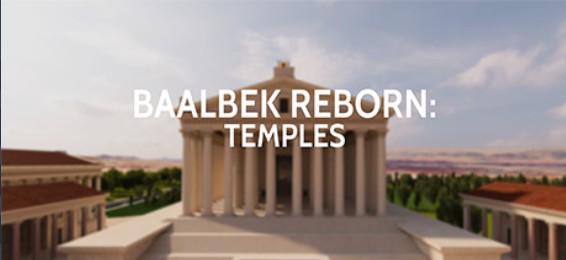
Baalbek Reborn: Temples is a free virtual tour of the Roman temple complex at Baalbek, a UNESCO World Heritage Site in the Bekaa Valley of Lebanon. It was created by virtual tour company Flyover Zone in collaboration with the German Archaeological Institute, whose researchers have been studying Baalbek since 1997, and the Lebanese Ministry of Culture's General Directorate of Antiquities. The tour is offered free of charge to the world thanks to the generosity of donor Bassam Alghanim, who funded it in memory of his parents.
The experience spans 39 carefully curated stops through the sanctuary complex, combining 360-degree photography of the ruins as they stand today with digitally reconstructed views of how the same spaces appeared in the 3rd century AD, when the sanctuary was at the height of its Roman imperial grandeur. The Time Warp feature allows visitors to toggle between past and present at each stop, experiencing the contrast between the surviving ancient stones and the fully reconstructed temple in one seamless movement.
Scholarly Credentials
The audio commentary was prepared entirely by experts from the German Archaeological Institute, drawing on over two decades of archaeological research at Baalbek. This is not a general-purpose tourist audio guide but genuine specialist narration from the archaeologists who know the site best. At each stop, they explain what you are seeing, what has been lost, what has been reconstructed, and what the site's stones reveal about Roman imperial ambition, engineering, and religious practice.
A guided tour mode introduces the highlights in approximately 38 to 45 minutes. The experience is available in four languages: English, French, German, and Arabic, making it genuinely accessible to a multilingual classroom. It can be experienced in full VR on SteamVR or via the free flat-screen version on Yorescape, or on the Meta Quest store (listed as available via PCVR Link connection).
The Temples: What You Visit
🏛
Temple of Jupiter Heliopolitanus
The largest Roman temple ever built, dedicated to Jupiter in his local Heliopolitan form. Only six of its original 54 Corinthian columns still stand, but their scale is extraordinary at over 20 metres tall. The digital reconstruction reveals the full peristyle and the colossal platform built on the three largest stones ever moved by any human civilisation, each weighing over 1,000 tonnes. The Time Warp feature here is particularly powerful.
🏗
Temple of Bacchus
One of the best-preserved Roman temples in the world, and arguably the most impressive intact Roman religious structure surviving anywhere outside Rome itself. Despite its name (given by 19th-century travellers), it was probably dedicated to Venus or another deity. The detailed Corinthian capitals, carved entablature, and coffered ceiling survive to an extraordinary degree.
🍃
Temple of Venus
A smaller, unusual circular temple nearby with concave recesses in its facade, a distinctive feature rarely seen in Roman architecture. Its curved bays set it apart visually from the massive rectangular temples of the main complex.
🎵
Temple of the Muses
An adjacent temple explored in the tour, with its own archaeological narrative. The nearby area also features the propylaea (monumental gateway) and the great court, whose scale once rivalled the imperial fora of Rome.
Baalbek: Historical Context
📍
Location
Bekaa Valley, Lebanon. Ancient name Heliopolis ("City of the Sun") under the Romans. Population of over 80,000 in modern times.
📅
Construction Period
Main temple complex built over two centuries (c. 1st–3rd century AD). The Jupiter platform took so long some historians believe it may have been deliberately prolonged to provide stable employment.
⛏
The Trilithon Stones
Three stones in the temple platform each weigh over 1,000 tonnes. They remain the largest stones ever cut and moved by human hands anywhere on earth. How the Romans moved them remains a subject of active study.
🪧
Building Materials
Rose granite columns were transported from Aswan in southern Egypt, over 2,500 km away, demonstrating the logistical reach of the Roman empire at its height.
🌎
UNESCO Status
World Heritage Site since 1984. Also a site of active ongoing archaeological excavation, with new finds continuing to emerge.
🇦🇫
Access Today
Baalbek is open to tourists, but Lebanon's complex political and economic context makes independent travel difficult for most British school groups. This VR tour genuinely substitutes for a trip that most students will never make.
Why This Subject Matters for UK Schools
Roman history is on the KS3 History curriculum and features in GCSE and A Level Classical Civilisation. Baalbek is rarely taught because it sits outside the usual Rome/Britain axis, yet it offers extraordinary evidence of Roman imperial ambition at a scale that surpasses anything in Rome itself. The Egyptian granite columns, the impossibly large platform stones, and the dedication to a syncretised Roman-Syrian deity all illuminate how the Roman Empire functioned beyond the textbook examples. Languages teachers covering Latin or Classical Greek also find the site curriculum-relevant.
Curriculum Fit
Classical Civilisation
9.2
Art History (Architecture)
8.2
Heritage / Archaeology
8.5
VR Immersion Note
This experience uses 360-degree photography at fixed viewpoints rather than full 3D spatial VR. You cannot walk freely around the site, and the image resolution has been noted as variable by some reviewers. The educational value comes from the narration and reconstructions, not from spatial exploration. It is more like a richly narrated slide tour than an open-world walk. Manage student expectations accordingly.
What Visitors Say
v1rl.com (VR review specialist)
Industry review
"Baalbek Reborn: Temples presents an engaging 45-minute tour crafted by the German Archaeological Institute. Good coverage of the site with many locations. Engaging in-depth audio narration."
Steam Reviewer
Positive
"Not only is it free, it is also one of the most in-depth virtual tours I've seen in VR so far. The narration is by actual archaeologists who have spent decades there. This is a rare thing."
Steam Reviewer
Critical
"Great content but limited VR functionality. It's mostly static panoramas, not real 3D. Some images are low resolution. More of a podcast with visuals than a true VR experience. The narration saves it."
archaeology-travel.com
Specialist review
"The 3D reconstructions show what Baalbek's ruins looked like in the 3rd century AD. The central 'tablet' navigates between 38 points of interest, starting a multi-language guide at each one. The guided tour is a 38-minute introduction to the highlights."
Steam: Very Positive, 81% of 64 reviews. Common theme: exceptional narration and content depth praised; static panorama format and variable image quality noted as limitations. Available in English, French, German, and Arabic.
Strengths and Limitations
Strengths
- Completely free on Steam and Meta Quest store
- Very Positive Steam rating (81% of 64 reviews)
- Commentary prepared by German Archaeological Institute experts
- Time Warp feature toggling ruins vs. 3rd-century reconstruction
- 39 stops across the full sanctuary complex
- Four languages: English, French, German, Arabic
- UNESCO World Heritage Site rarely covered in school VR
- Funded by donation; genuinely free to the world permanently
- Flat-screen version also available (Yorescape; no headset needed)
Considerations
- 360-degree panoramas at fixed viewpoints, not full 3D VR exploration
- Some images noted as lower resolution
- No locomotion or spatial freedom
- PC VR for full VR mode; Meta Quest requires Link connection
- Narration-heavy: students need to listen carefully to get value
- 45-minute duration: plan for a structured session, not a quick demo