
Energy Encyclopedia VR
Energy Encyclopedia VR
A free virtual science museum of power generation — over 20 animated, cross-sectioned 3D models and 8 life-size walk-through power plant environments spanning nuclear fission, nuclear fusion, solar, hydropower, and wind. The most technically accurate free energy VR experience available.
What Is It?
Energy Encyclopedia VR is the virtual reality extension of EnergyEncyclopedia.com — an international educational platform dedicated to explaining how electricity is generated. It is, in the most direct sense, a virtual science museum of energy: a free, explorable collection of technically accurate, animated, cross-sectioned 3D models of power generation facilities, with eight of them reconstructed at true life-size scale so you can walk through them as if you were actually there.
The app spans five energy sectors — Nuclear Fission, Nuclear Fusion, Solar Power, Hydropower, and Wind Energy — and includes over 20 scaled-down models and 8 full-size walk-through environments. A robot guide named Robbie accompanies visitors, explaining the components and operating principles of each facility. The app has been updated following feedback from the World Nuclear Exhibition 2025 in Paris, with a revised control scheme designed to be accessible even to users with no prior VR experience.
One reviewer on Meta Quest described it as "the coolest science museum ever" and praised its clarity, its respect for engineering work, and its quality. The 4.9/5 rating from 10 Meta Quest ratings makes it one of the highest-rated free educational VR apps in this series. And it is free.
Two Ways to Explore
The app is structured around two complementary modes of exploration that together span both the conceptual and the experiential dimensions of energy infrastructure.
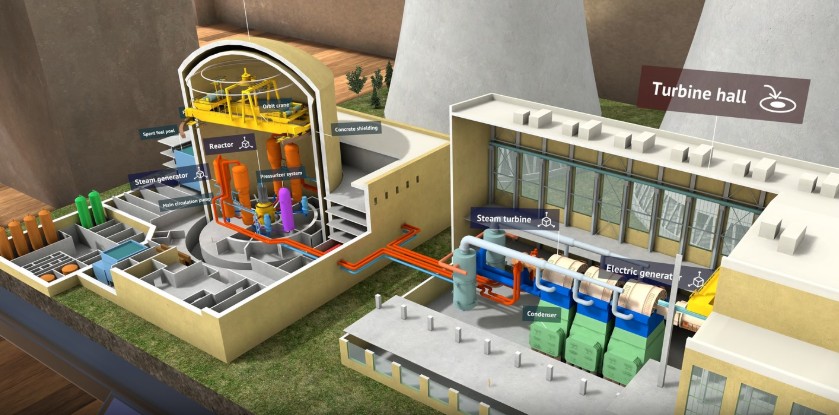
Animated, cross-sectioned models that reveal the internal workings of each power plant type. Turbines spin, coolant loops animate, reactors expose their fuel assemblies. Cross-sections that would be physically impossible to achieve in a real facility become routine in VR.
Full-scale reconstructions of power plant interiors — turbine halls, reactor buildings, the ITER Tokamak facility — that you can walk through at true human scale. The ITER Tokamak alone is a once-in-a-generation engineering project; stepping inside a full-size model of it while it is still under construction is genuinely extraordinary.
Five Energy Sectors in Depth
The most technically detailed section of the app, covering three distinct reactor designs across five model units. The breadth here is exceptional — most energy VR apps cover nuclear as a single generic "reactor." Energy Encyclopedia VR distinguishes between PWR, BWR, and SMR designs and explains each.
Coverage of the two leading fusion confinement approaches — the Tokamak (represented by ITER, the €20 billion international fusion project in France) and the Stellarator (an alternative magnetic confinement geometry). These are among the most significant engineering projects in human history, and no student currently in school will see ITER produce power during their education. VR is uniquely positioned to bring the inside of the ITER facility to students who will never visit Cadarache.
Four turbine and facility types covering the range of hydroelectric generation, from large-scale pumped storage to three distinct turbine designs. The distinction between Kaplan, Francis, and Banki-Mitchell turbines — which students rarely encounter explicitly — reflects engineering-level precision rather than simplified overview content.
Three distinct solar generation technologies — including two that students rarely encounter in school despite their industrial importance. The distinction between photovoltaic (solar panels) and concentrating solar power (CSP) technologies is significant and often skipped in curriculum coverage.
Wind turbine model showing the complete power plant — from rotor blades and nacelle through gearbox to generator. The sheer physical scale of a wind turbine becomes immediately apparent when walking through a life-size model; the nacelle is roughly the size of a double-decker bus.
Why the Nuclear Fusion Content is Exceptional
Of all the content in Energy Encyclopedia VR, the nuclear fusion section stands out as uniquely valuable for the simple reason that no other free VR application reviewed on this site covers it at all — and the real-world technology itself is inaccessible to virtually everyone.
ITER is a €20 billion, 35-country fusion experiment under construction in Cadarache, southern France. It will be the world's largest magnetic confinement plasma physics experiment when complete. Its first plasma operations are planned for the mid-2030s — meaning students currently in school will graduate before it produces fusion power. A student's only realistic prospect of encountering the inside of the ITER Tokamak facility in any form is virtual.
The SMR coverage is similarly timely — Small Modular Reactors are one of the most actively discussed topics in UK energy policy, and the model in Energy Encyclopedia VR gives students a concrete understanding of what an SMR is and how it differs from a conventional PWR or BWR plant.
4.9 Stars — What Users Say
"The coolest science museum ever. Exceptional clarity of information and genuine respect for the work of engineers. Particularly impressive for learning about nuclear and wind power systems."
"Free and high-quality design — a strong example of VR used well for learning. Minor note: the robot guide Robbie's voice can sometimes come from behind, making it harder to hear."
How to Use It in Teaching
Energy Encyclopedia VR is an interactive museum rather than a structured lesson — there are no built-in quizzes, curriculum maps, or teacher resources. Like Materials VR, it is a tool whose educational value depends entirely on the teacher supplying the context and questions. Used well, it is exceptional; dropped into a class cold, it is just a very impressive gallery.
What to Be Aware Of
XR School Scores
Energy Encyclopedia VR is a free, engineering-accurate virtual science museum of power generation — and one of the most impressive free educational VR applications available on Meta Quest. It covers five energy sectors across 20+ animated 3D models and 8 life-size walk-through environments, with technical depth that distinguishes between PWR, BWR, and SMR reactor designs, covers both the ITER Tokamak and the Stellarator in nuclear fusion, and includes three distinct hydroelectric turbine types. The nuclear fusion content alone — a full-scale ITER Tokamak facility you can walk through, updated for accuracy after the World Nuclear Exhibition 2025 — is irreplaceable and available nowhere else for free. There are no built-in lessons or curriculum resources, so teacher framing is essential. But as a virtual field trip to the energy infrastructure of the 21st century, framed as a visit rather than a worksheet, it earns a place on every secondary school Physics department's headsets.
Energy Encyclopedia VR is the VR extension of EnergyEncyclopedia.com — a comprehensive web-based reference for energy systems. The website provides additional technical depth and diagrams to supplement VR sessions.