Overview
What Is It?
VIRTUE — Virtual Interactive Reality Toolkit for Understanding the EIC — is a free, standalone particle physics event display application built by Sean Preins, a PhD student in the Department of Physics and Astronomy at the University of California, Riverside, under the supervision of Prof. Miguel Arratia. Released on Steam on Christmas Day 2023, it was specifically designed to make the science of the future Electron-Ion Collider visible and accessible — first to physicists and researchers, then to students and the public.
The Electron-Ion Collider (EIC) is a major nuclear physics research facility being planned and built at Brookhaven National Laboratory on Long Island, New York. When complete in the early 2030s, it will accelerate electrons and ions to near the speed of light and collide them to probe the internal structure of atomic nuclei — specifically studying the mysterious strong force that holds protons and neutrons together. The EIC is one of the largest investments in fundamental nuclear physics research in a generation.
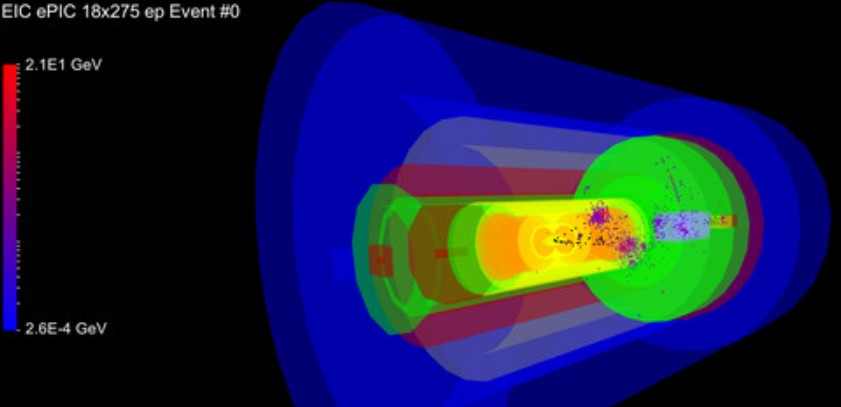
VIRTUE lets you step inside the ePIC detector — the experiment that will detect the results of those collisions — before it has been built, and watch simulated electron-proton collision events unfold in three dimensions around you. Videos made with VIRTUE have already been used by Brookhaven National Laboratory to draw public attention to the EIC project.
Science Context
The EIC and Why It Matters
The Electron-Ion Collider is not a general-purpose particle accelerator. It is designed to answer specific questions about the structure of matter at the most fundamental level — and to probe physics that the Large Hadron Collider at CERN is not designed to address.
⚛️
The Strong Force
The strong nuclear force is one of the four fundamental forces of nature. It is responsible for binding quarks together into protons and neutrons, and then binding protons and neutrons together into atomic nuclei. Without it, all matter would fly apart. The EIC will probe how the strong force operates inside nuclear matter — questions that remain open in fundamental physics.
💥
Electron-Ion Collisions
The EIC accelerates electrons and ions (atomic nuclei stripped of their electrons) to near the speed of light in a circular storage ring, then brings them into collision. The products of those collisions — a spray of particles detected by the surrounding ePIC detector — carry information about the internal structure of the nucleons involved.
🔭
The ePIC Detector
The ePIC (electron-Proton/Ion Collider) detector is the experiment that will surround the collision point and record the particles produced. It is a multi-layered cylindrical detector many metres in diameter — a common architecture in high-energy physics, but distinguished by its specific design for the EIC's electron-ion programme. VIRTUE lets you explore its internal engineering and X-ray views in detail.
Prof. Miguel Arratia, UC Riverside:
"VR technology will enable a completely new way to explore particle and nuclear physics data in both space and time. I anticipate this tool will be immensely beneficial for researchers, aiding them in gaining intuition that can translate into insights during data analysis."
Source: UCR News / BNL Newsroom, December 2023
Features
What You Can Do
🔬
Explore the ePIC Detector
Navigate freely through the ePIC detector in X-ray and engineering views. The X-ray mode reveals the internal layer structure; the engineering view shows the mechanical design. Walk through the detector at human scale — from the small tracking layers near the beam pipe to the large outer calorimeter systems.
💥
Watch Simulated Collisions
Pre-loaded simulated electron-proton collision events — generated by the ePIC Collaboration using physics simulation codes — play out inside the detector in three dimensions. The "spray of hits" that physicists see in data readouts becomes a visible, spatial event you can move through and examine from any angle.
📐
Customise Detector Geometries
For researchers and advanced students: load custom detector geometries and collision data using JSON and FBX files. The ePIC detector is the default, but VIRTUE can be adapted to visualise other collider experiments entirely. An FBX file of the ePIC detector with a school bus placed next to it for scale is included — giving an immediate sense of the detector's size.
🎬
Animation & Presentation Mode
Set the camera and collision animator on a smooth loop for professional-quality presentation recordings. This is how Brookhaven National Laboratory has used VIRTUE — creating outreach videos that show the EIC to a general audience. Teachers can use the same capability to create demonstration material.
🖥️
Desktop Mode — No Headset Required
The full application runs in desktop mode on any Windows PC without any VR hardware. All features available in VR are available on the desktop. This removes the hardware barrier entirely for schools with Windows PCs but no VR headsets.
🚌 Scale reference.
The developer added an FBX file of the ePIC detector with a standard school bus parked next to it for scale. This is a telling detail: the team knows that students (and researchers) struggle to grasp the physical size of particle detectors, and this practical addition makes the scale immediately, viscerally clear.
Developer
Who Built It & Why
Sean Preins is a doctoral student in the Department of Physics and Astronomy at UC Riverside, researching under Prof. Miguel Arratia. The ePIC detector simulations and designs that VIRTUE visualises were provided by the ePIC Collaboration — the international team of physicists designing the actual EIC experiment.
VIRTUE grew from a practical research problem: how do physicists — let alone students and the public — develop intuition for what particle collision data looks like when it happens inside a complex three-dimensional detector? Traditional event display software shows 2D projections on a screen. VR allows you to be inside the collision as it happens.
Brookhaven National Laboratory — the US Department of Energy laboratory responsible for the EIC project — has formally featured VIRTUE in its newsroom and used videos made with it for public outreach. The institutional endorsement from one of the world's leading nuclear physics laboratories gives VIRTUE a credibility that a PhD student's personal project alone wouldn't carry.
🎄 Released on Christmas Day.
Sean Preins released VIRTUE on Steam on December 25, 2023 — a deliberate choice. Asked about the release date in a UCR interview, it's understood as both a personal milestone and an acknowledgement of the gift character of free science education software. It's now available to anyone, any day.
Audience
Who Is VIRTUE For?
✅
Particle physics researchers & postgraduates
The primary audience for whom the tool was originally built. VIRTUE helps physicists develop spatial intuition for detector geometry and collision topology — understanding that translates into better data analysis and algorithm design.
✅
University physics students (undergraduate projects)
The developer explicitly notes VIRTUE offers "an excellent opportunity for undergraduate-level projects, allowing students to adapt it to explore and understand new experiments." The JSON/FBX customisation makes it a genuine research and project tool at this level.
✅
A-level Physics students (enrichment)
Advanced A-level students who have studied particle physics and fundamental forces can encounter what a real particle detector looks like inside, and experience what collision event data looks like in three dimensions. This is the kind of experience that shapes career choices.
🟡
General public & GCSE students
VIRTUE was designed partly as a public outreach tool. Younger students and general visitors can explore the detector environment and watch collision animations without needing to understand the underlying physics in detail — the visual impact of a particle physics experiment at human scale is powerful in its own right.
Honest View
What to Be Aware Of
⚠️
Very specialised content. VIRTUE covers one specific future particle physics experiment at one specific laboratory. Students who have not studied particle physics, fundamental forces, or nuclear physics at some level will find the context opaque. This is not a gentle introduction to physics — it is a window into frontier research for those who already know something of the field.
⚠️
No guided lesson structure. VIRTUE is a visualisation and exploration tool — not a lesson. There are no explanations of the physics for non-specialists, no curriculum-aligned content, no quizzes. Teachers must supply all educational context.
⚠️
PC-only — not standalone Quest. Requires a Windows PC. VR mode needs a Quest (or other headset) connected via PC Link. Desktop mode runs on any Windows PC without a headset.
✅
Endorsed and used by Brookhaven National Laboratory. This is not a hobbyist project. VIRTUE has been formally featured by one of the world's leading nuclear and particle physics research laboratories, and its videos are used in Brookhaven's own public outreach. That institutional validation is significant.
✅
Desktop mode removes all hardware barriers. Any student with a Windows PC can explore a particle detector used in frontier physics research, for free, without any VR equipment. The accessibility argument here is as strong as it gets.
✅
The EIC is the future of nuclear physics. Students currently in A-level or undergraduate physics will be graduating into a world where the EIC is taking first data. Getting familiar with the facility, the detector, and the physics programme now is not idle curiosity — for students considering careers in particle or nuclear physics, it is relevant professional context.
Our Verdict
XR School Scores
Scientific Authenticity
10 / 10
Real detector geometry from the ePIC Collaboration. Real physics simulations from the EIC programme. Endorsed and used by Brookhaven National Laboratory. Built by a UC Riverside PhD student under faculty supervision.
Uniqueness
10 / 10
No other app in this physics series lets students step inside a future particle physics collider detector and watch simulated collision events in three dimensions. VIRTUE is entirely without parallel in the educational VR landscape reviewed here.
Accessibility for School Use
5 / 10
PC-only, no standalone Quest, no lesson structure, highly specialised content. Desktop mode helps significantly. Best suited to A-level Physics enrichment and university-level contexts; less appropriate as classroom curriculum.
Research & University Value
10 / 10
Customisable with JSON/FBX, suitable for undergraduate projects, used by physicists to develop spatial intuition for detector data. Endorsed by Brookhaven. A genuine research and outreach tool.
Value for Money
10 / 10
Free. Forever. On any Windows PC. Including a desktop mode. There is no financial barrier at all.
Bottom Line
VIRTUE is a free research-grade particle physics event display built by a UC Riverside PhD student, endorsed by Brookhaven National Laboratory, and used for public outreach by one of the world's leading nuclear physics research facilities. It lets you step inside the ePIC detector at the future Electron-Ion Collider and watch simulated electron-proton collision events in three-dimensional space. It is genuinely unique — no other educational VR app reviewed on this site comes close to this territory. It is also genuinely niche: it is best suited to A-level students studying particle physics who want to encounter the reality of the discipline, to university-level physics students working on projects, and to researchers. For GCSE and younger students it is an impressive but contextually opaque experience. At zero cost on any Windows PC, there is no reason not to install it — but the teacher who frames it well, and connects it to the particle physics curriculum, will extract dramatically more from it than the one who simply hands students a headset and steps back.