
Astronomy

Apollo 11 Quest

The XR SchoolScienceAstronomy › Apollo 11
XI
Meta Quest standalone • All models Original NASA archive audio & video $9.99 • ~1 hour ENGAGE XR (fmr. Immersive VR Education)
ENGAGE XR • Formerly Immersive VR Education • London Stock Exchange • Also made: Shuttle Commander • Viveport Developer Award 2017: Explore 1st Place

Apollo 11

Climb aboard the Saturn V, ride the fire into orbit, navigate the three-day transit to the Moon, land Eagle on the Sea of Tranquility, and take humanity's most famous first steps. Apollo 11 for Meta Quest is a one-hour VR journey through the greatest adventure in human history, woven from original NASA archive audio and video, recreated spacecraft interiors, and interactive mission elements that put the controls in your hands.

Developer: ENGAGE XR (formerly Immersive VR Education PLC)
Price: $9.99
Platform: Meta Quest (all models) • Standalone
Duration: ~1 hour • v2.3 • 1.78 GB
8.5
/10
XR School Score
Highly Recommended
Original NASA archive audio • Full mission arc: launch → Moon → return • Interactive: CM dock • LM land • Lunar EVA • Experiments • Cinematic mode too • $9.99 • Meta Quest standalone • ~1 hour
Meta Quest standalone $9.99 • ~1 hour
Original NASA archive audio
Overview

Apollo 11 for Meta Quest is the standalone Quest rebuild of what began as a 2016 Oculus Rift launch title by Immersive VR Education — now trading as ENGAGE XR, a company listed on the London Stock Exchange. The same studio made Shuttle Commander, also reviewed in this Astronomy section. The Quest version (released May 2019, currently v2.3) was rebuilt with entirely new assets, textures, animation, lighting, and audio to take advantage of the Quest's standalone capabilities, removing the PC dependency of the original and its HD successor.

The experience covers the complete Apollo 11 mission chronology across approximately one hour: the Saturn V launch from Kennedy Space Centre on July 16, 1969; the three-day transit to the Moon; the separation of the Lunar Module from the Command Module; the powered descent to Tranquility Base; Neil Armstrong and Buzz Aldrin's surface EVA; the scientific experiments deployed on the surface; the ascent, rendezvous, and docking; and the return to Earth. Throughout, original NASA archive audio and mission footage are woven into the recreated environments, so what students hear is what the actual crew heard, including Mission Control, Armstrong's famous words at touchdown, and the communications traffic of the undocking sequence.

📻
Why Original Archive Audio Changes Everything The defining quality of Apollo 11 as an educational experience is not its interactive elements or its visual recreation of the spacecraft, but its use of the actual voices. When students hear the crackle of the S-band radio carrying Armstrong's words from the lunar surface, they are hearing the same transmission that came to Mission Control 57 years ago. The controlled calm of the astronauts, the clipped professionalism of the CAPCOM, the quiet urgency of the powered descent, and the explosive celebration when Eagle lands are not performances — they are a primary historical record. No dramatisation, however well-produced, achieves the same effect as hearing the original. This is what positions Apollo 11 VR above any scripted lunar simulation: it is a documentary as much as it is an experience.
Mission Phases
🚀
Saturn V Launch
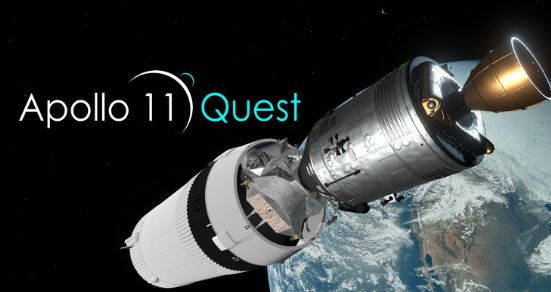
Sit inside Columbia as the Saturn V ignites 7.5 million pounds of thrust beneath you and lifts the crew into orbit. The scale of the rocket and the force of the ascent are among the most viscerally impressive moments in the experience.
Cinematic
🌕
Translunar Coast
The three-day journey to the Moon, with Earth receding behind and the Moon growing ahead. The scale of the cislunar void — a place no human now alive has visited — is communicated in a way no image can.
Cinematic
Command Module Docking
Take manual control of the Command Module and dock with the Lunar Module. The docking sequence is one of the most technically demanding manoeuvres of the mission and one of the most engaging interactive elements in the experience.
Interactive
🛸
Lunar Module Landing
Take the controls of Eagle through the powered descent to Tranquility Base. The original 1202 alarm audio plays as it did in 1969. Landing is challenging — as it should be. Students who succeed feel a proportionate sense of achievement.
Interactive
👣
Lunar Surface EVA
Descend Eagle's ladder and take humanity's most famous steps. Explore the surface at Tranquility Base, visit the LM, and experience the Moon's reduced gravity and the panoramic desolation of the landing site.
Interactive
🔭
Deploy Experiments
Set up the Apollo Lunar Surface Experiments Package (ALSEP): the seismometer, laser ranging retroreflector, and solar wind composition experiment that Armstrong and Aldrin deployed during their 2.5-hour surface EVA.
Interactive
Cinematic Mode: A Genuine Second Option Not every student will want to wrestle with the lunar module landing controls, and not every session has time for the full interactive sequence. Apollo 11 includes a cinematic passive mode that removes the interactive demands and lets students sit back and experience the mission as a guided documentary. This makes it significantly more flexible for classroom deployment: teachers can choose the level of interactivity appropriate to their time, their students, and the curriculum moment. A shortened cinematic session covering the launch and landing could fit within 20 minutes; the full interactive experience occupies the full hour.
The Three Versions: Which to Use
Version
Platform
Steam rating
Notes
Apollo 11 VR
PC VR (2016)
Very Positive 81% (563)
Original launch title
Apollo 11 VR HD
PC VR (2018)
Mostly Positive 78% (263)
Rebuilt assets, new audio
Apollo 11 (Quest)
Meta Quest standalone
Quest store ✓ recommended
No PC needed • This review

For schools using Meta Quest headsets, the Quest standalone version is the right choice: no PC required, no cable, all models supported. The HD Steam version is the option for schools with PC VR setups who want the highest visual fidelity. Both cover the same mission content.

Curriculum Links
📚
History • Cold War
Apollo 11 as the culmination of the Space Race, the geopolitical context of Sputnik, Kennedy's challenge, and the 400,000 people who made the Moon landing possible. Primary source audio as historical evidence.
🔮
Physics • Engineering
Rocket propulsion, orbital mechanics, rendezvous and docking, life support in vacuum, re-entry heating, and the engineering challenges solved under extreme time pressure between 1961 and 1969.
🌐
Astronomy • Space Science
The Moon's geology and surface conditions, the scale of cislunar space, the science experiments deployed at Tranquility Base, and what Apollo taught us about the Moon's formation and Earth's history.
🧠
PSHE • Human Achievement
The courage, teamwork, and institutional determination that made Apollo possible. The mission as a case study in what humans can achieve when a goal is clearly defined and collectively pursued.
Assessment
Emotional / historical impact
9.6
Archive audio authenticity
9.4
Quest deployment ease
9.0
Value for money
9.2
Scientific explanation depth
4.8
Interactive challenge balance
6.2
Strengths and Considerations
Strengths
  • Original NASA archive audio and video — primary historical source in VR
  • Complete mission arc: launch to splashdown in one hour
  • Interactive: CM docking • LM landing • Lunar EVA • Science experiments
  • Cinematic mode for sessions where full interactivity isn't needed
  • Meta Quest standalone — no PC, no cable
  • $9.99 — exceptional value for one hour of content
  • Strong Steam validation across versions (563 + 263 reviews)
  • Viveport Developer Award 2017: Explore 1st Place
  • Common Sense Media: highly recommended for educators
  • Same studio as Shuttle Commander (consistent quality track record)
Considerations
  • Cinematic focus — not designed to explain the underlying science
  • LM landing controls can frustrate without adequate preparation
  • Teacher framing essential to connect emotional experience to curriculum
  • No structured assessment or learning check built into the experience
Common Sense Media's Teacher Assessment: Accurate and Worth Sharing Common Sense Media's educator review describes Apollo 11 VR as "a powerful cinematic experience, light on in-your-face teaching" and concludes: "If infused with good teaching, this cinematic experience can provide a rich, unforgettable adventure." This is exactly the right frame. The experience does not pause to explain Newton's laws or walk students through the orbital mechanics of translunar injection. It trusts them to feel first and understand later. That is not a flaw — it is a deliberate design choice that positions it as the emotional foundation on which teaching can build, not as the teaching itself. A History teacher who uses it to open a Cold War lesson, or a Physics teacher who uses it before covering rocket propulsion, will find that students who have been inside the Saturn V ask fundamentally better questions than students who have only read about it.
$9.99
Meta Quest (all models) • Standalone • No PC required • ~1 hour • v2.3 • 1.78 GB
Get on Meta Quest → HD version on Steam (PC VR) →
Quick Facts
Developer
ENGAGE XR (formerly Immersive VR Education PLC)
Also made
Shuttle Commander • Titanic VR
Price
$9.99 (Meta Quest)
Platform
Meta Quest (all models) • Standalone
Duration
~1 hour (full) • Shorter in cinematic mode
Version
2.3 • 1.78 GB installed
Audio
Original NASA archive audio & video
Interactive
CM docking • LM landing • EVA • ALSEP
Passive mode
Yes • Cinematic option available
Award
Viveport Developer Award 2017: Explore 1st
Best for
History, Astronomy, Physics, PSHE
Verdict
Apollo 11 for Meta Quest is the most emotionally powerful history experience in this Astronomy section, and one of the most compelling pieces of educational VR available on any subject. The original NASA archive audio is what makes it irreplaceable: students do not watch a recreation of the Moon landing, they hear the actual voices of the people who lived it, in the environments where it happened. At $9.99 on Meta Quest standalone, it is the single most accessible and cost-effective deployment of first-person history available on Quest. It needs good teaching around it to fulfil its curriculum potential — it will not explain the physics or quiz the class — but as the emotional ground on which a lesson can grow, nothing on this site comes close.