
Languages

Librarium

The XR SchoolHumanitiesLanguages › Librarium
$9.99–$19.99 Kaplan partnership • MCAT decks Strong concept: spatial memory + active recall ⚠ Community reports abandoned 2024
Librarium Inc. • Duane Mathes, CEO • Patent-pending spatial memory tech • 100+ decks • Kaplan MCAT partnership • Community creation

Librarium

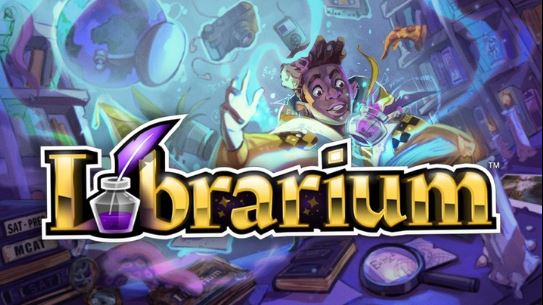
A VR flashcard platform built on the ancient method of loci: place study cards as physical objects inside a virtual library, and use your spatial memory to retrieve them. A genuinely compelling idea with strong scientific backing, a Kaplan partnership, and a thriving early community. As of 2024, multiple community sources describe the app as abandoned, with login and card creation broken and no updates issued.

Developer: Librarium Inc. (Eagle, ID) • CEO: Duane Mathes
Price: $9.99–$19.99 (+ premium Kaplan decks)
Platform: Meta Quest • SideQuest
Status: No updates confirmed • Community: "Abandoned"
⚠ Important notice before purchasing: Multiple community reviewers on SideQuest (2024) report that Librarium is no longer functional. Specific issues documented include: login box broken (text disappears on pressing enter), card creation broken, and no developer updates for an extended period. One reviewer who initially praised the app has edited their review to read simply: "Edit 2024: Abandoned." The SideQuest AI summary of reviews states "a significant portion of users report issues with the app's functionality and perceived unfinished state." The XR School does not recommend purchasing Librarium until the developer demonstrably resumes support and resolves these issues.
4.5
/10
XR School Score
Not Currently Recommended
Strong concept • Real science (method of loci, University of Maryland research) • Kaplan MCAT partnership • Community reports app abandoned 2024 • Login and card creation broken • No updates
Not currently recommended Community: "Abandoned" (2024)
Login & card creation broken
The Concept: Why This Idea Matters

Librarium was built on one of the oldest and most well-validated memory techniques in human history: the method of loci, also known as the memory palace. First documented in ancient Greek and Roman rhetorical training, the technique involves mentally placing items to be remembered at specific locations along a familiar imagined route or within a familiar imagined building, then mentally walking through that space to retrieve them. The spatial encoding of information alongside emotional and environmental context significantly improves recall compared to rote repetition.

Librarium's insight was that VR is ideally suited to this technique. Rather than imagining a memory palace, a VR user inhabits one. Flashcard content becomes a three-dimensional object placed at a specific physical location within the virtual library environment. The user walks to it, sees it, answers it, and the physical act of moving through a space and encountering objects at known locations engages the spatial memory systems that the method of loci exploits. Launched in September 2022 in partnership with Kaplan — the leading test preparation company — the app included over 100 curated flashcard decks covering environmental sciences, biology, philosophy, history, and other subjects, plus the option to create custom decks via a companion mobile app.

The Science Behind the Concept Is Real A University of Maryland study cited at launch found that users of a spatial memory environment in VR showed meaningfully better long-term recall than those using the same approach on a flat screen. The research used numbered face-matching tasks and found VR users were more likely to recall the correct pairing after a delay. A separate earlier study found that spatial memory methods on screens outperformed non-spatial methods by approximately 25%. The direction of the evidence supports Librarium's core claim: VR spatial encoding should produce better retention than flat flashcard apps. One note of honesty: the developer's marketing claim of "33% higher long-term memory retention" combines these two studies' figures in a way that is mathematically incorrect (adding rather than contextualising separate effects from separate experiments). The underlying research is valid; the specific marketing statistic is not.
The Learning Science: What Librarium Got Right
🏛
Method of Loci
One of the most studied memory enhancement techniques. Physical placement of flashcards as 3D objects in a navigable space engages spatial memory circuits not activated by list review.
🔁
Active Recall
Prompting the user to actively retrieve answers rather than passively re-read. Active recall produces significantly stronger long-term retention than passive review, supported by decades of cognitive science research.
🌎
Spaced Repetition Potential
The app's design was intended to support community deck creation and personalised progression — building toward a spaced repetition layer on top of the spatial memory foundation. This was never fully realised.
🌟
Gamification
Rewards, achievements, and the inherent engagement of physical movement through an environment were intended to sustain motivation across multiple study sessions — a real problem for flat-screen flashcard apps.
Current Status: What the Community Reports
Multiple Confirmed Issues as of 2024 — App Appears Abandoned The SideQuest community summary generated from user reviews states explicitly that "a significant portion of users report issues with the app's functionality and perceived unfinished state, leading to frustration. Many users mention that the app feels like an abandoned project or is not well-executed, despite its promising concept." Individual reviews confirm: login functionality broken (text disappears from the login box on pressing enter, making the app inaccessible); card creation, which is the app's core value for self-directed study, broken and not fixed. A reviewer who originally praised the app edited their review in 2024 to add a single word: "Abandoned." Another pays $9.99, describes being able only to "tour the library" with no functional content, and reports no updates or fixes across an entire year of ownership. The developer's Discord server, where community members sought support, is described as inactive or off-topic.
SideQuest reviewer (original praise)Early promise
"Of all the games I've tried out in VR, Librarium appears to carry the most practical value for autodidacts, so I'm hoping the game continues to be developed in the future."
Same reviewer, edited 2024Updated verdict
"Best of luck to the developers, but I don't recommend spending your money on this. Edit 2024: Abandoned."
SideQuest reviewer (2024)Broken login
"I have been trying to log in for over half an hour the text just keeps disappearing from the log in box when I press enter! I have even tried to create a new user log in but the same thing is happening. Useless app and a waste of money."
SideQuest reviewer (parent)No content accessible
"Bought this a year ago to help my kids study. The only thing we have been able to do is tour the library. So basically $9.99 to walk around an empty library. There have been no updates or fixes and it's been this way for the entire year."
SideQuest reviewer (early adopter)When it worked
"Librarium is a great way to study all kinds of subjects. There are card decks for everything! History, science, math, literature, medical terminology, languages, SAT, MCAT. This has so much potential for learning and wish I had something like this when I was in school."
Value Ratings
Concept quality
9.2
Scientific foundation
8.6
Current app reliability
1.0
Developer support (current)
0.8
Value for money (today)
1.2
Strengths and Limitations
Concept Strengths
  • Method of loci is one of the most rigorously validated memory techniques
  • VR is genuinely well-suited to spatial memory encoding
  • Active recall design improves on passive re-reading
  • 100+ curated decks across multiple subjects at launch
  • Kaplan MCAT partnership validated by serious test prep standards
  • Community deck creation (when functional) extended utility broadly
  • Gamification, rewards, and physical movement through space address flashcard fatigue
Current Reality
  • Login functionality broken for multiple users as of 2024
  • Card creation broken — core user feature non-functional
  • No developer updates in extended period — community: "Abandoned"
  • Some users report app inaccessible entirely after purchase
  • Discord support community inactive
  • Marketing "33% memory improvement" claim is mathematically incorrect
  • Do not purchase until developer demonstrates active support resumption
If the Developer Returns: What to Look For Before Reconsidering The concept underpinning Librarium is genuinely strong, and if active development resumes, it merits reassessment. Signals to watch: a public update on the Meta Quest store changelog, confirmation from the developer on Discord or social channels that login and card creation bugs are resolved, and a period of sustained support rather than a single patch. The early community's response to the app when it worked was consistently enthusiastic, describing it as the most practically valuable VR learning tool they had encountered. That audience still exists. The problem is entirely on the support and reliability side, not the concept.
$9.99–$19.99
⚠ Not recommended for purchase
App reported broken and abandoned (2024). Do not purchase until developer resumes active support and resolves login and card creation issues.
View on Meta Quest (check status) →
Quick Facts
Developer
Librarium Inc. (Eagle, ID) • CEO: Duane Mathes
Price
$9.99–$19.99 + premium Kaplan decks
Platform
Meta Quest • SideQuest
Content
100+ decks at launch • MCAT (Kaplan) • Community decks
Technique
Method of loci • Active recall • Spatial memory
Current status
Reported abandoned • Login broken • No updates
Recommendation
Do not purchase until issues resolved
Verdict
Librarium had one of the strongest conceptual foundations of any educational VR application launched on Meta Quest: the method of loci is a millennia-old memory technique that research consistently validates, and VR is a genuinely better medium for it than a flat screen. The Kaplan partnership, the community deck creation system, and the early user enthusiasm all pointed toward something that could have been one of the most useful study tools in this category. As of 2024, the app is broken for core functions — login and card creation — and the developer has not responded. The XR School cannot recommend purchasing Librarium in its current state. Monitor for signs of resumed development and revisit if those appear.