
Physics

4D Toys

Home Science Physics 4D Toys
🔮
W axis
Tesseract
🔮 4D Geometry · Maths · Physics · Meta Quest · Steam · iOS
⭐ Overwhelmingly Positive

4D Toys

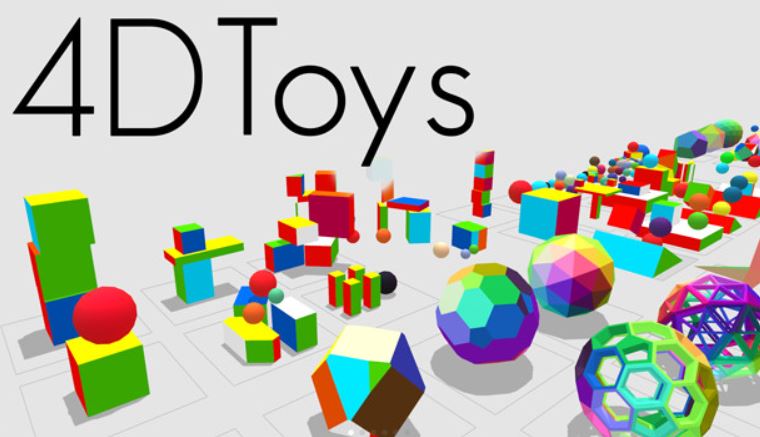
A box of toys from the fourth dimension. Roll a hypercube. Stack tesseracts. Watch cross-sections of 4D objects appear, morph, and vanish. Powered by the world's first 4D Physics Engine. Now on Meta Quest — sit on your living room floor and play with objects from another dimension.

★★★★★ Overwhelmingly Positive Steam
🎮 Marc ten Bosch (solo developer)
🥽 Meta Quest · Steam · iOS 🌐 4D Physics Engine (world's first) 📦 100+ scenes 🖥️ Also: Mouse & Keyboard
🆕 Now on Meta Quest — 4D Toys launched on Meta Quest in August 2025. Marc ten Bosch wrote: "It feels like the first true version of the game. You sit on your actual living room floor playing with strange objects from another dimension." Previously available only on Steam (PC/VR), iOS, and Android.
Overview

What Is It?

4D Toys is a physics-based toy box from the fourth spatial dimension, created by solo developer Marc ten Bosch. It began life as a side project to his long-in-development 4D puzzle platformer Miegakure, when Marc realised that the rules governing how objects bounce, slide, fall, spin, and roll can be generalised to any number of dimensions — and that this would make a fascinating standalone experience to explore.

The core concept is simple to describe and genuinely mind-bending to experience. 4D Toys places four-dimensional objects into a simulation world and lets you interact with them physically. Because we are three-dimensional beings, we see only a three-dimensional cross-section of these 4D objects at any moment — just as a two-dimensional being would see only a cross-section of a sphere as it passes through their plane (first nothing, then a growing circle, then a shrinking circle, then nothing again). The result is that 4D objects appear to morph, grow, shrink, and pass through each other in ways that look physically impossible but are geometrically correct.

After launching on iOS and Steam in 2017, 4D Toys arrived on Meta Quest as a standalone app in August 2025 — which Marc described as feeling like "the first true version of the game." The Quest's room-scale capability, where you are physically present in the space rather than seated at a desk, makes the spatial alienness of 4D geometry viscerally more affecting.

The Mathematics

The Flatland Analogy — and Why It Matters

The classic way to explain the fourth spatial dimension is the flatland analogy, and 4D Toys uses it directly. Imagine a two-dimensional being living on a flat surface — a "Flatlander." When a three-dimensional sphere passes through their world, they see it as a circle that appears from nothing, grows to a maximum, shrinks, and disappears. They cannot see the sphere whole — only its cross-sections in their plane.

We are in exactly the same position with respect to four-dimensional objects. When a four-dimensional object (a "hypersphere," a "tesseract," a "120-cell") passes through our three-dimensional space, we see its three-dimensional cross-sections — shapes that appear, morph, and vanish. This is not a visual glitch or a game effect: it is the correct mathematical description of what four-dimensional objects would look like to us.

4D Toys makes this experience tangible and playful. You can hold a hypercube and rotate it in four dimensions, watching it transform through cross-sections that make no intuitive sense in three dimensions. You can roll a hypersphere and watch it behave exactly like a sphere (it is a sphere — just in a higher dimension). You can witness a 120-cell — a 4D solid with 120 regular dodecahedral cells — rolling across a surface.

Marc ten Bosch on the mathematics

"It turns out the rules of how objects bounce, slide, fall, spin and roll around can be generalised to any number of dimensions, and this toy lets you experience what that would look like. My initial goal in making this was to have a ton of fun inventing the math for it. At first I was sceptical it was going to be possible at all, but in the end the mathematics fit together so well."

Source: marctenbosch.com, 2017
Content

100+ Scenes to Explore

4D Toys is not a game with levels to complete or a simulator with a specific goal — it is a toy box. The 100+ scenes are curated explorations of different aspects of 4D geometry and physics, each designed to reveal something specific about how four-dimensional space works.

4D Ball Pit
Hyperspheres bouncing and rolling — the fundamental experience of 4D physics. Like a ball pit, but every ball is a four-dimensional sphere whose 3D cross-section you can see and interact with.
🎲
4D Domino Rally
Toppling sequences of 4D objects — a familiar cascade dynamic applied to hypersurfaces, revealing how physical momentum and contact work in four dimensions.
🌀
4D Maze
Navigate a maze that has a fourth spatial dimension of passages — routes that are impassable in 3D are open in 4D. A direct spatial reasoning challenge.
🔮
Hypercubes & Tesseracts
The classic 4D shape — a cube of cubes. Hold one, rotate it in the W direction, and watch the cross-sections transform. Stack tesseracts on each other.
🔵
120-Cell
A perfectly symmetrical 4D polytope with 120 dodecahedral cells — the 4D equivalent of a die with 120 faces. In 4D, perfect symmetry permits this; in 3D it is impossible.
🌀
Double Rotations
In 4D, an object can rotate in two perpendicular planes simultaneously. Watching a tesseract undergo a double rotation — a phenomenon impossible in 3D — is one of the more genuinely vertiginous moments in the app.
📐
Flatland Levels
See the same scenes in 2D/3D split-screen to understand the dimensional analogy directly — how 2D beings would see 3D objects, illustrating how we see 4D objects.
🔷
Wireframe Projections
View 4D objects as wireframes — showing all the edges at once in projection. A different way to apprehend 4D structure, comparable to seeing a 3D cube drawn in 2D perspective.
🎲 A 600-sided die is possible in 4D. The 120-cell is a 4D analogue of a dodecahedron — a regular convex 4D polytope with 120 faces, 720 edges, and 600 vertices. In our 3D space, only 5 regular convex polyhedra (the Platonic solids) exist. In 4D, six regular convex 4-polytopes exist — including the 120-cell and the 600-cell. 4D Toys lets you hold and interact with all of them.
Why VR?

Why 4D Objects Are Uniquely Suited to VR

4D Toys has a unique relationship with VR — perhaps stronger than any other educational app reviewed on this site. The dimensional analogy that explains why 4D objects look the way they do is itself spatial: our inability to perceive 4D objects whole is analogous to a 2D being's inability to perceive 3D objects whole. We see 3D cross-sections of 4D objects, just as a Flatlander would see 2D cross-sections of 3D objects.

In a 2D diagram or a 3D computer screen, 4D Toys must project a 4D simulation into a flat image — adding one more layer of dimensional reduction. In VR, the simulation is projected into a full 3D environment — the maximum fidelity that is physically possible for a three-dimensional being experiencing four-dimensional objects. The cross-sections of the 4D objects exist in actual 3D space around you, not flattened onto a screen.

Road to VR reviewer: "This is the most intuitive VR interface I've ever used. It ironically confused me at first, because every other interface is confusing."
Source: roadtovr.com, 2017
Marc ten Bosch on Quest: "It feels like the first true version of the game. You sit on your actual living room floor playing with strange objects from another dimension."
Source: marctenbosch.com, August 2025
Developer

Marc ten Bosch

Marc ten Bosch is a Canadian solo game developer who has been working on Miegakure — a 4D puzzle-platformer where you can walk in the fourth dimension to navigate otherwise impossible puzzles — since 2009. 4D Toys was a side project that emerged from the 4D physics engine he was building for Miegakure, released in 2017 to share the physics research with a wider audience before the main game was complete.

The development of a genuine 4D physics engine — one that correctly simulates how four-dimensional objects would bounce, roll, slide, stack, and interact with each other under a consistent physics model — is a significant mathematical and software engineering achievement. Marc describes the experience of discovering that the mathematics "fit together so well" as one of the driving satisfactions of the project.

🎮 Miegakure. Marc's main project — a puzzle platformer where the fourth spatial dimension is used as a game mechanic — has been in development since 2009 and remains one of the most anticipated independent games in development. 4D Toys exists partly as a way of sharing the 4D physics research while Miegakure continues to be developed. Those interested in 4D geometry after experiencing 4D Toys may want to follow Miegakure's development.
Curriculum

Where It Fits Educationally

4D Toys is categorised under Physics by the XR School, but it is primarily a mathematics experience — specifically spatial geometry, topology, and dimensional analogy. The physics in the experience is correct and rigorous (real 4D physics, not approximation), but the conceptual content is mathematical rather than tied to a specific physics curriculum topic.

📐 A-Level/IB Maths (Further)
Higher-dimensional geometry, regular polytopes, and dimensional analogy are all topics in Further Mathematics. 4D Toys provides intuitions that complement rigorous algebraic treatment.
🔭 A-Level Physics (Dimensions)
The dimensional analogy is used in string theory, general relativity, and various areas of theoretical physics. Gaining spatial intuition for higher dimensions is a valuable foundation.
🧠 Spatial Reasoning
Extensive interaction with 4D Toys genuinely develops spatial reasoning — the ability to visualise and manipulate objects in space. This cross-cuts all STEM subjects.
✨ STEM Enrichment
One of the most effective STEM enrichment activities for mathematically curious students. The combination of accessible play and genuine mathematical depth makes it appropriate across a wide age range.
💡 A note on accessibility. No prior knowledge is required to enjoy 4D Toys. The flatland levels explain the dimensional analogy from first principles — a student who has never heard of a fourth spatial dimension can begin playing and develop genuine intuition for 4D geometry through interaction. At the same time, a university mathematician or physicist will find depths that reward extended exploration. It is genuinely accessible at multiple levels.
Honest View

What to Be Aware Of

⚠️
Not directly curriculum-mapped. 4D Toys does not align with any specific GCSE or A-level Physics or Mathematics topic in the way that Edda Physics 1 or Molecule Builder do. It is an experience and an enrichment tool, not a curriculum-aligned lesson. Teachers need to supply the curriculum connection themselves.
⚠️
Can be initially confusing. The dimensional analogy, while explained in the flatland levels, requires some cognitive work to internalise. Some students (and adults) find the morphing 3D cross-sections of 4D objects disorienting before the explanation clicks. This is a feature of the mathematics, not a failure of the app — but it means supervised introduction works better than cold deployment.
Overwhelmingly Positive on Steam — one of the highest-rated educational VR apps reviewed here. Hundreds of Steam reviews. This is not a niche product appealing only to mathematicians — it has a broad, enthusiastic audience that includes people who had never thought about the fourth dimension before playing it.
Now on Meta Quest — the experience Marc considers definitive. The August 2025 Quest launch makes this accessible to schools with standalone Quest headsets for the first time. The room-scale experience, where you sit on the floor and interact with 4D objects in your actual physical space, is qualitatively different from the screen-based versions.
The 4D Physics Engine is genuinely novel. Marc ten Bosch built the world's first 4D physics engine for this project. The 4D objects in 4D Toys behave according to correctly generalised physical laws — this is not approximation, not artistic interpretation, but actual mathematics. Students are interacting with real four-dimensional geometry.
Also plays on desktop and iOS — no headset required. Mouse/keyboard on PC (Windows, Mac, Linux), and multi-touch on iOS with accelerometer tilt. Accessible to any student without VR hardware.
Our Verdict

XR School Scores

Mathematical Depth & Accuracy 10 / 10
The world's first 4D physics engine, built from scratch for this project. Physics and geometry are correctly generalised from three to four dimensions. Interacting with 4D Toys means interacting with real mathematical objects under real physical laws, not an artistic simulation.
Engagement & Wonder 10 / 10
Overwhelmingly Positive on Steam from hundreds of reviews. Uniquely mind-bending for every person who experiences it, regardless of mathematical background. One of the most genuinely awe-inspiring experiences in the XR School's catalogue.
Curriculum Alignment 5 / 10
No specific GCSE or A-level topic alignment. Best understood as enrichment and spatial reasoning development rather than curriculum delivery. The Further Mathematics connection is the strongest curriculum hook for secondary students.
Accessibility 9 / 10
Meta Quest (standalone, August 2025), Steam (PC VR + mouse/keyboard), iOS (multi-touch). No prior knowledge required. Flatland levels explain the dimensional analogy from scratch. Age-appropriate for any student curious about mathematics.
Value for Money 9 / 10
Around $9.99 on Steam. Quest price to be confirmed but similar. 100+ scenes, desktop mode included. The depth of mathematical content, the quality of the physics engine, and the breadth of the scene library make this exceptional value for any mathematics department or curious individual.
Bottom Line

4D Toys is one of the most intellectually extraordinary experiences in the XR School's catalogue. Built on the world's first 4D physics engine by solo developer Marc ten Bosch, it lets you interact with geometrically and physically correct four-dimensional objects in VR — watching hypercubes morph as you rotate them through the W axis, rolling hyperspheres, stacking tesseracts, and encountering the 120-cell. The Meta Quest release in August 2025 makes it available as a standalone room-scale experience for the first time — which Marc himself describes as the definitive version. It holds an Overwhelmingly Positive rating on Steam from hundreds of reviews. It is not curriculum-mapped, and the dimensional analogy takes a moment to click — but for mathematically curious students at any level, and for anyone who wants their brain to feel genuinely stretched by an encounter with mathematics beyond everyday experience, 4D Toys is without peer.

Quick Facts
Price ~$9.99 (Steam)
Developer Marc ten Bosch (solo)
Platforms Quest · Steam · iOS · Android
Meta Quest Aug 2025 · Standalone
Steam launch June 2, 2017
Steam rating Overwhelmingly Positive
Scenes 100+
Physics engine World's first 4D engine
Desktop mode Yes — mouse & keyboard
Related game Miegakure (in development)
Curriculum Fit
STEM Enrichment (all ages) ★★★★★
Further Maths (higher dimensions) ★★★★★
Spatial Reasoning Development ★★★★★
A-Level / IB Physics ★★★☆☆
GCSE Maths / Science ★★☆☆☆
🔮 4D Objects in the Game
Hypercube (Tesseract) — cube of cubes
Hypersphere — sphere in 4D
120-cell — 120 dodecahedral faces
600-cell — 600 tetrahedral faces
Other regular 4-polytopes
Double-rotation objects
🎮 About Miegakure

Miegakure is Marc ten Bosch's 4D puzzle-platformer — a game where you can walk in the fourth spatial dimension to navigate otherwise impassable puzzles. In development since 2009. 4D Toys shares its 4D physics engine. Follow development at marctenbosch.com.

miegakure.com →
Review by The XR School · Physics · Mathematics · Geometry