
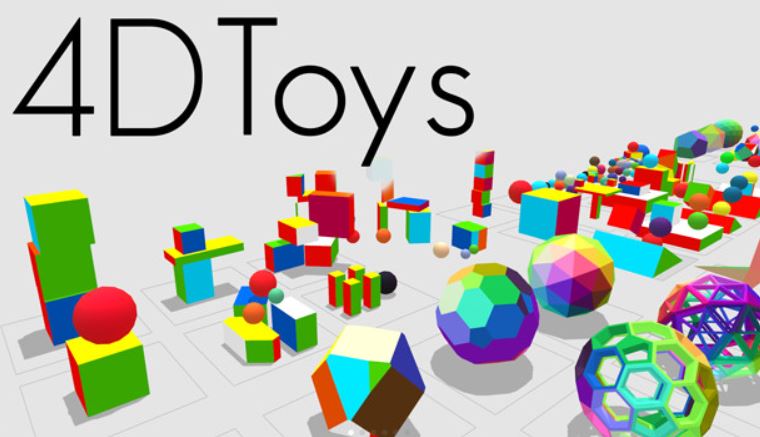
4D Toys
4D Toys
A box of toys from the fourth dimension. Roll a hypercube. Stack tesseracts. Watch cross-sections of 4D objects appear, morph, and vanish. Powered by the world's first 4D Physics Engine. Now on Meta Quest — sit on your living room floor and play with objects from another dimension.
What Is It?
4D Toys is a physics-based toy box from the fourth spatial dimension, created by solo developer Marc ten Bosch. It began life as a side project to his long-in-development 4D puzzle platformer Miegakure, when Marc realised that the rules governing how objects bounce, slide, fall, spin, and roll can be generalised to any number of dimensions — and that this would make a fascinating standalone experience to explore.
The core concept is simple to describe and genuinely mind-bending to experience. 4D Toys places four-dimensional objects into a simulation world and lets you interact with them physically. Because we are three-dimensional beings, we see only a three-dimensional cross-section of these 4D objects at any moment — just as a two-dimensional being would see only a cross-section of a sphere as it passes through their plane (first nothing, then a growing circle, then a shrinking circle, then nothing again). The result is that 4D objects appear to morph, grow, shrink, and pass through each other in ways that look physically impossible but are geometrically correct.
After launching on iOS and Steam in 2017, 4D Toys arrived on Meta Quest as a standalone app in August 2025 — which Marc described as feeling like "the first true version of the game." The Quest's room-scale capability, where you are physically present in the space rather than seated at a desk, makes the spatial alienness of 4D geometry viscerally more affecting.
The Flatland Analogy — and Why It Matters
The classic way to explain the fourth spatial dimension is the flatland analogy, and 4D Toys uses it directly. Imagine a two-dimensional being living on a flat surface — a "Flatlander." When a three-dimensional sphere passes through their world, they see it as a circle that appears from nothing, grows to a maximum, shrinks, and disappears. They cannot see the sphere whole — only its cross-sections in their plane.
We are in exactly the same position with respect to four-dimensional objects. When a four-dimensional object (a "hypersphere," a "tesseract," a "120-cell") passes through our three-dimensional space, we see its three-dimensional cross-sections — shapes that appear, morph, and vanish. This is not a visual glitch or a game effect: it is the correct mathematical description of what four-dimensional objects would look like to us.
4D Toys makes this experience tangible and playful. You can hold a hypercube and rotate it in four dimensions, watching it transform through cross-sections that make no intuitive sense in three dimensions. You can roll a hypersphere and watch it behave exactly like a sphere (it is a sphere — just in a higher dimension). You can witness a 120-cell — a 4D solid with 120 regular dodecahedral cells — rolling across a surface.
"It turns out the rules of how objects bounce, slide, fall, spin and roll around can be generalised to any number of dimensions, and this toy lets you experience what that would look like. My initial goal in making this was to have a ton of fun inventing the math for it. At first I was sceptical it was going to be possible at all, but in the end the mathematics fit together so well."
100+ Scenes to Explore
4D Toys is not a game with levels to complete or a simulator with a specific goal — it is a toy box. The 100+ scenes are curated explorations of different aspects of 4D geometry and physics, each designed to reveal something specific about how four-dimensional space works.
Why 4D Objects Are Uniquely Suited to VR
4D Toys has a unique relationship with VR — perhaps stronger than any other educational app reviewed on this site. The dimensional analogy that explains why 4D objects look the way they do is itself spatial: our inability to perceive 4D objects whole is analogous to a 2D being's inability to perceive 3D objects whole. We see 3D cross-sections of 4D objects, just as a Flatlander would see 2D cross-sections of 3D objects.
In a 2D diagram or a 3D computer screen, 4D Toys must project a 4D simulation into a flat image — adding one more layer of dimensional reduction. In VR, the simulation is projected into a full 3D environment — the maximum fidelity that is physically possible for a three-dimensional being experiencing four-dimensional objects. The cross-sections of the 4D objects exist in actual 3D space around you, not flattened onto a screen.
Marc ten Bosch
Marc ten Bosch is a Canadian solo game developer who has been working on Miegakure — a 4D puzzle-platformer where you can walk in the fourth dimension to navigate otherwise impossible puzzles — since 2009. 4D Toys was a side project that emerged from the 4D physics engine he was building for Miegakure, released in 2017 to share the physics research with a wider audience before the main game was complete.
The development of a genuine 4D physics engine — one that correctly simulates how four-dimensional objects would bounce, roll, slide, stack, and interact with each other under a consistent physics model — is a significant mathematical and software engineering achievement. Marc describes the experience of discovering that the mathematics "fit together so well" as one of the driving satisfactions of the project.
Where It Fits Educationally
4D Toys is categorised under Physics by the XR School, but it is primarily a mathematics experience — specifically spatial geometry, topology, and dimensional analogy. The physics in the experience is correct and rigorous (real 4D physics, not approximation), but the conceptual content is mathematical rather than tied to a specific physics curriculum topic.
What to Be Aware Of
XR School Scores
4D Toys is one of the most intellectually extraordinary experiences in the XR School's catalogue. Built on the world's first 4D physics engine by solo developer Marc ten Bosch, it lets you interact with geometrically and physically correct four-dimensional objects in VR — watching hypercubes morph as you rotate them through the W axis, rolling hyperspheres, stacking tesseracts, and encountering the 120-cell. The Meta Quest release in August 2025 makes it available as a standalone room-scale experience for the first time — which Marc himself describes as the definitive version. It holds an Overwhelmingly Positive rating on Steam from hundreds of reviews. It is not curriculum-mapped, and the dimensional analogy takes a moment to click — but for mathematically curious students at any level, and for anyone who wants their brain to feel genuinely stretched by an encounter with mathematics beyond everyday experience, 4D Toys is without peer.
Miegakure is Marc ten Bosch's 4D puzzle-platformer — a game where you can walk in the fourth spatial dimension to navigate otherwise impassable puzzles. In development since 2009. 4D Toys shares its 4D physics engine. Follow development at marctenbosch.com.
miegakure.com →