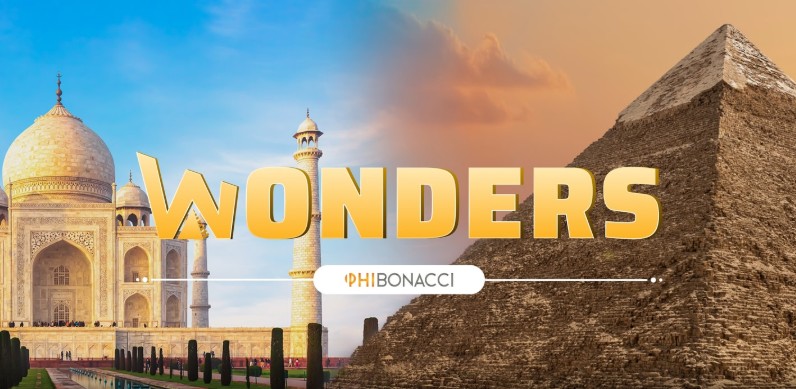
🏛️ Free to Download · 3 Wonders Now · More Coming Soon
WONDERS is free on the Meta Quest Store with no upfront cost. Three wonders are currently available — the Pyramids of Giza, the Taj Mahal and the Statue of Unity — with more announced as coming soon. This is a growing platform rather than a finished product: the developer is actively adding new wonders over time. Each wonder is a fully interactive 3D environment, not a passive 360° video — you explore it freely with guided narration, time travel sequences and access to restricted areas normally closed to the public.
Platform: Meta Quest 2/3/3S/Pro ·
Price: Free ·
Wonders: Pyramids of Giza · Taj Mahal · Statue of Unity ·
More: Coming soon
About the App
What is WONDERS?
WONDERS is a free VR educational experience for Meta Quest that places students inside some of the world's most famous historical monuments — not as passive observers watching a video, but as active explorers navigating fully interactive 3D environments. The concept is simple and powerful: visit the places that most students will never be able to afford to reach in person, and do it with access that even tourists who do visit in real life would never be granted — inside burial chambers, up restricted staircases, through cordoned-off galleries.
Each wonder functions as a "living VR museum" — the framing used by reviewers who have experienced the app. You are guided through the monument by narration that weaves together historical facts, architectural detail, and the human stories behind each structure. A time travel mechanic allows certain locations to be experienced both in their modern state and as they appeared in the past — stepping from present-day Giza back to the era of the pharaohs, or from the Taj Mahal today back to the moment of its completion in 1653.
WONDERS goes beyond what a real visit could offer: you can enter areas permanently closed to tourists — inner chambers of the pyramids normally sealed to visitors, restricted upper galleries of the Taj Mahal, internal spaces of the Statue of Unity. Virtual reality makes the impossible possible: not just visiting these wonders, but experiencing them from perspectives and depths that no living person could access in reality.
WONDERS is an actively growing platform — currently three wonders are available at launch, with more announced. This means schools investing time in using it will find its library expanding over time, adding new monuments and civilisations as the developer adds to the platform.
The Three Wonders
What's Inside
🔺
Pyramids of Giza — All Four: Khufu, Khafre, Menkaure & the Sphinx
Explore 3D replicas of all four structures on the Giza plateau — the Great Pyramid of Khufu (one of the Seven Wonders of the Ancient World and the only one still standing), Khafre, the smaller Menkaure, and the Great Sphinx. Enter internal chambers and passages normally closed to the public, follow guided narration through the history and architecture of each structure, and engage in interactive activities scattered throughout. The time travel mechanic transports you back to the era of construction — seeing the pyramids as they appeared in ancient Egypt, their limestone casing intact and gleaming white, the plateau alive with workers and activity. For History students studying Ancient Egypt, this is the most vivid and complete classroom supplement available.
🕌
Taj Mahal — The Marble Mausoleum, Restricted Areas & A Story of Love
Step inside the Taj Mahal — the white marble mausoleum built by Mughal Emperor Shah Jahan in memory of his wife Mumtaz Mahal between 1631 and 1653. The guided experience covers the love story at its heart, the architectural genius of its design (perfect bilateral symmetry, optical illusions built into its proportions, the minarets angled outward to fall away from the tomb in an earthquake), and the restricted areas of the complex normally off-limits to tourists. The Taj Mahal is one of the most studied buildings in the world — for History, RS, Art & Design and Cultural Studies, the ability to walk inside its interior and examine its inlaid marble decorations and calligraphy in detail is extraordinary.
🗿
Statue of Unity — Museum, Galleries, Gardens & Aerial Views
The Statue of Unity in Gujarat, India is the tallest statue in the world at 182 metres — depicting Sardar Vallabhbhai Patel, the "Iron Man of India" and key figure in Indian independence and unification. WONDERS takes you through its internal museum, galleries dedicated to Patel's life and legacy, the surrounding memorial gardens, and aerial perspectives from the observation deck near the statue's chest — a view that in real life costs a significant entry fee and requires travelling to rural Gujarat. For History students studying 20th-century independence movements, colonialism and post-colonial nation-building, this is a compelling and unusual primary source. For Geography, the landscape of the Narmada River valley and the engineering of the structure itself are also curriculum-relevant.
School Value
Curriculum & Educational Fit
History (Ancient Egypt)95%
History (Mughal / India)85%
Art & Design / Architecture78%
Content breadth (3 wonders)42%
WONDERS is most directly valuable for History — specifically Ancient Egyptian history and Mughal Empire history, both of which appear regularly in KS2–KS4 curricula. The Pyramids of Giza alone cover: pharaonic power, ancient Egyptian religion and the afterlife, engineering achievement, social organisation, the Seven Wonders of the Ancient World, and 4,500 years of human history. The Taj Mahal spans: Mughal Empire history, Islamic art and architecture, the role of women in history (Mumtaz Mahal), India under Mughal rule, and the history of love and grief expressed through building.
For Religious Studies, both the Taj Mahal (Islamic architecture, the Five Pillars, significance of Quranic calligraphy as decoration) and the Pyramids (ancient Egyptian religion, gods, afterlife beliefs, mummification) are key RS case study contexts. For Art & Design, the architectural study potential is exceptional — the Taj Mahal's geometry, the optical illusions engineered into its proportions, the inlaid marble pietra dura work, the calligraphy panels — all can be examined in detail impossible from a photograph. For Geography, the physical settings of all three wonders — the Nile delta and Saharan desert, the Yamuna river plain, the Narmada valley — provide human and physical geography context. The Statue of Unity is a less commonly taught topic but opens rich discussions about post-colonial nationhood, historical memory, and the politics of monumental architecture. Suitable for all ages — no content concerns at any level.
Best use in school: KS2–KS3 Ancient Egypt unit · KS3 Mughal India / Taj Mahal · GCSE History · RS study of Islamic art & architecture · Art & Design architectural analysis · PSHE global citizenship · Geography human landscapes.
XR School Verdict
Historical depth & context9/10
Value for money (FREE)10/10
Interactivity & access8/10
Age appropriateness10/10
Number of wonders (3)5/10
Update certainty5/10
Bottom line: An outstanding free History and RS VR tool — step inside the Pyramids of Giza, Taj Mahal and Statue of Unity with access to restricted areas, time travel and expert guided narration. The three-wonder library is modest but growing, and at zero cost there is no reason not to install it. For any school teaching Ancient Egypt, Mughal India or Islamic architecture, WONDERS is currently the best free VR resource available on Meta Quest.
Pros & Cons
✓ Completely FREE
✓ Interactive 3D — not passive 360° video
✓ Restricted access to closed areas
✓ Time travel mechanic — past and present
✓ Guided historical narration
✓ Pyramids of Giza — all 4 structures
✓ Taj Mahal — restricted galleries
✓ Statue of Unity — aerial views
✓ All ages · zero content concerns
✓ More wonders coming — growing library
✗ Only 3 wonders currently
✗ Update pace uncertain — small developer
✗ Limited rating data available
✗ In-app purchases may be introduced
Quick Info
| Platform | Meta Quest 2/3/3S/Pro |
| Price | FREE |
| Wonders | 3 (more coming) |
| Type | Interactive 3D guided tour |
| Time travel | ✓ Past & present |
| Restricted access | ✓ Closed areas unlocked |
| Narration | ✓ Guided history |
| Age rating | ✓ Everyone · All ages |
| Best for | History · RS · Art & Design |
🏛️ Current Wonders
🔺 Pyramids of Giza
Khufu · Khafre · Menkaure · Sphinx · restricted inner chambers · time travel to ancient Egypt
🕌 Taj Mahal
Marble mausoleum · restricted areas · Shah Jahan & Mumtaz Mahal · Mughal architecture
🗿 Statue of Unity
World's tallest statue · museum · galleries · aerial views · Sardar Vallabhbhai Patel · Gujarat
More wonders announced as coming soon.
📚 Curriculum Links
🏺 History KS2–3 — Ancient Egypt, pharaohs, pyramids, afterlife
🕌 History KS3–4 — Mughal Empire, Shah Jahan, Taj Mahal
🕊️ History KS4 — Indian independence, Sardar Patel, colonialism
🌙 RS — Islamic architecture, Taj Mahal, Egyptian religion
🎨 Art & Design — Architectural analysis, Islamic geometric art
🌍 Geography — Human landscapes, Nile, Yamuna, Narmada
🏛️
Get Free on Meta Store
WONDERS · Free to download & play