
BiologyFree

Proteus

The XR SchoolScienceBiology › Proteus
Free Biology / Life Sciences Careers in STEM Meta Quest T Level Ready
FourPlus Immersive • University of Birmingham

Proteus

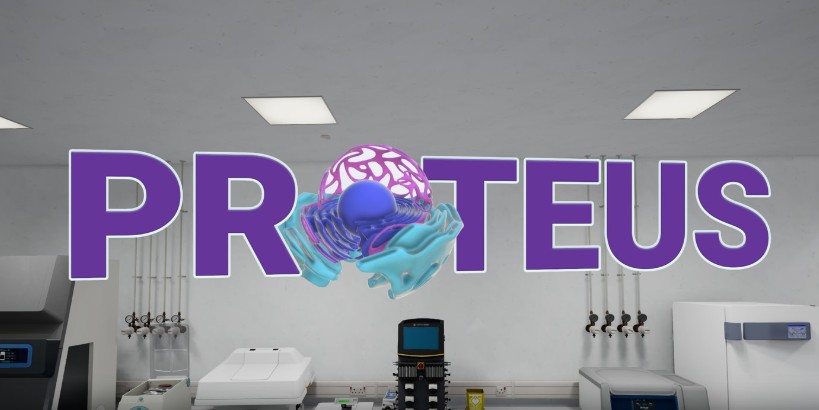
A free Meta Quest experience taking students inside a real cell and gene therapy manufacturing facility, then into a cell suspension, and finally inside a human cell itself. Built for UK science education with government and industry backing.

Developer: FourPlus Immersive, Birmingham
Price: Free
Platform: Meta Quest (standalone)
Backed by: Innovate UK, CGT Catapult, Gatsby Foundation
★ Institutional backing:
9.2
/10
XR School Score
Highly Recommended
One of the most credible, free, and curriculum-relevant biology VR experiences available for UK schools
FREE Meta Quest • Standalone
Overview

Proteus is a free educational VR experience developed by FourPlus Immersive, a Birmingham-based life sciences VR company co-founded by Professor Ivan Wall of the University of Birmingham and Dr Hayley Mulhall. It is explicitly designed to address a real skills gap: the UK cell and gene therapy sector needs thousands of trained manufacturing professionals and technicians over the coming decade, and Proteus aims to be the gateway experience that generates that interest among young people.

The experience takes students on a journey from the clinical context — patients receiving life-saving cell and gene therapies — through a real Good Manufacturing Practice (GMP) production facility, into a suspension of living cells, and finally inside a human cell itself. Each stage is grounded in real science and real facilities: the manufacturing environment is modelled on the Cell and Gene Therapy Catapult's large-scale GMP facility in Stevenage.

Purpose-Built for UK Education Proteus is explicitly designed for T Level science students, GCSE and A Level Biology classrooms, and careers and recruitment events in the life sciences. It was developed with direct support from the Department for Education, the Gatsby Charitable Foundation, the Cell and Gene Therapy Catapult, and Innovate UK. This is not a general-purpose science app repurposed for education: it was built from scratch with UK curriculum and careers objectives as its core brief.

The app runs on standalone Meta Quest headsets, requiring no PC or wired connection. That makes deployment in classrooms straightforward: a set of Meta Quest headsets can be pre-loaded with Proteus from the App Lab store and used without internet connectivity during the session itself. The experience is self-contained, guided, and approximately 15–20 minutes long, fitting comfortably within a lesson period.

The Three-Stage Journey
Stage 1
The Manufacturing Facility
Step inside a virtual recreation of a real GMP (Good Manufacturing Practice) cleanroom production facility. Students encounter the controlled environment, specialised equipment, and professional roles that define cell therapy manufacturing. The setting is based on the CGT Catapult's Stevenage facility, making this a genuinely authentic representation rather than a generic laboratory.
Stage 2
Inside the Cell Suspension
Shrink to explore the cell suspension used in therapy production. Students move among living cells, experiencing the biological scale that production technicians work with every day. This bridges classroom biology knowledge about cell structure with the real-world manufacturing context introduced in Stage 1.
Stage 3
Inside a Human Cell
Enter the interior of a human cell and explore organelles, membranes, and the molecular machinery that makes cell and gene therapies possible. Students encounter the biological structures they study in GCSE and A Level Biology, now at immersive, navigable scale. This directly contextualises textbook content within a cutting-edge medical application.
Institutional Backing and Credentials
🏠
Cell & Gene Therapy Catapult
Primary industry partner; Stevenage GMP facility underpins the virtual environment; coordinates Advanced Therapies Skills Training Network
🇬🇧
Innovate UK
Government funder of the broader FourPlus VR training platform (£1 million investment); directly supports Proteus development
🏫
University of Birmingham
Co-founder Prof. Ivan Wall holds a Professorship of Regenerative Medicine; academic scientific credibility underpins the content
🌿
Gatsby Charitable Foundation
Funds STEM careers initiatives; involvement signals alignment with UK science education strategy and the Gatsby Benchmarks
🏭
Department for Education
Formally supportive of the initiative; T Level science student focus aligns with DfE post-16 technical education strategy
🔬
BioIndustry Association
UK life sciences trade body; Proteus forms part of a broader sector-wide workforce development initiative
Cell & Gene Therapy: A UK Growth Sector The UK is one of the world's leading centres for cell and gene therapy research and manufacturing. The sector is growing rapidly but faces a significant skills shortage: not enough trained GMP operators, quality assurance specialists, and manufacturing technicians to meet projected demand. Proteus is part of a coordinated government and industry response to this gap, making it directly relevant to careers education and CEIAG (Careers Education, Information, Advice and Guidance) requirements.
Curriculum Fit
GCSE Biology
9.0
A Level Biology
8.8
T Level Science
9.6
CEIAG / Careers
9.4
Cell Biology (KS4/5)
9.2
KS3 Science
6.8
What Industry and Educators Say
Steve Stewart, Head of Skills, Cell and Gene Therapy Catapult CGT Catapult
"The main benefit is to have that almost real-world experience for apprentices who may not have been inside a physical lab. They're going to get all the knowledge and understanding and awareness of the processes in that virtual environment, prior to entering the lab space itself."
Jacqueline Jooste, Scientific Content Design, CGTC STL CGT Catapult
"Unique learning experience for trainees. Allows slower learners to build confidence. Links confidence and competence. Working with the apprentices today, they've really enjoyed it. It's a really simple and easy to use tool."
Prof. Ivan Wall, Co-Founder, FourPlus / University of Birmingham FourPlus
"VR is going to transform, particularly in education, how students are trained. It's also going to help to increase that funnel of bringing people into relevant jobs in life sciences. It has a huge impact on how students are taught."
Strengths and Limitations
Strengths
  • Completely free on Meta Quest App Lab
  • Standalone Meta Quest: no PC or wires needed in the classroom
  • Content grounded in real GMP facility (Stevenage CGT Catapult)
  • Backed by Innovate UK, Gatsby Foundation, DfE, BioIndustry Association
  • Direct T Level science and GCSE/A Level biology curriculum alignment
  • Strong CEIAG value: introduces students to a real UK growth career sector
  • Self-contained ~15–20 minute session, fits a lesson period
  • Suitable for careers fairs and recruitment events as well as classrooms
  • Co-developed with a Professor of Regenerative Medicine
Considerations
  • Meta Quest App Lab only; not on standard Meta Quest store
  • No independent public review data available
  • Content is relatively narrow: cell and gene therapy specifically, not general biology
  • Best suited to KS4 and above; may be too specialised for younger students
  • Teachers may need to pre-brief students on what cell and gene therapy is for maximum impact
FREE
Meta Quest App Lab • Standalone
Get on Meta Quest →
Quick Facts
Developer
FourPlus Immersive, Birmingham, UK
Co-founders
Prof. Ivan Wall & Dr Hayley Mulhall
Price
Free
Platform
Meta Quest (standalone, App Lab)
Duration
~15–20 minutes
Age Rating
Everyone
Backed By
Innovate UK, CGT Catapult, Gatsby Foundation, University of Birmingham, DfE
Best For
T Level Science, GCSE/A Level Biology, Careers events
Verdict
One of the strongest, most credible free educational VR experiences available for UK schools. The institutional backing from Innovate UK, the Cell and Gene Therapy Catapult, the Gatsby Foundation, and the Department for Education is simply unmatched by most free VR apps. The content is scientifically rigorous, the setting is based on a real facility, and the T Level science and GCSE Biology curriculum connections are direct and substantial. On standalone Meta Quest, it requires no technical expertise to deploy. For science and careers teachers at KS4 and above, this should be near the top of any VR shortlist.