Overview
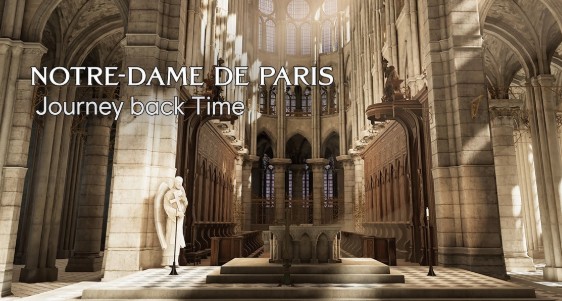
When the spire of Notre-Dame de Paris collapsed in flames on 15 April 2019, the world watched in shock. Ubisoft responded by releasing this free VR experience, adapted from the 3D model of the cathedral built for Assassin's Creed: Unity in 2014. That model represents 5,000 hours of detailed graphic reconstruction, guided by historians, and captures the cathedral as it appeared in 18th-century Paris — during the French Revolutionary period.
The experience was first unveiled at UNESCO Headquarters during Heritage Days in 2019, before the restoration was complete. It later opened to the public in an exhibition at the Archaeological Crypt of Paris from 2021 to 2022. Since Notre-Dame's full reopening in December 2024, the VR experience now serves a different purpose: it preserves a pre-fire record of the cathedral's interior, offering a historical document as well as a virtual visit.
The AC: Unity Model
The reconstruction underlying this experience involved 140 stained-glass windows, the full nave, the choir, the rose windows, the spire, and the cathedral's exterior. The spire depicted is historically accurate to Notre-Dame before its 19th-century modification — it was added by Viol let-le-Duc in 1859 and was the one that collapsed in the 2019 fire. The model is one of the most detailed architectural VR reconstructions ever created by a games studio.
The experience is not interactive in the conventional sense. You stand at a series of fixed viewpoints — inside the nave, before the altar, in the choir, outside with the flying buttresses — and look around. The only interaction is pointing your gaze to trigger the next viewpoint. It ends with a hot-air balloon flight over 18th-century Paris, accompanied throughout by J.S. Bach performed on Notre-Dame's legendary Cavaillé-Coll organ.
What the Experience Includes
⛪
The Nave and Interior
Fixed-viewpoint exploration of the cathedral's main nave, choir and altar, captured at a scale that communicates the Gothic ambition of the building. The stone columns, vaulted ceiling, and stained-glass light are faithfully reproduced from the AC: Unity model.
🌝
The Rose Windows
Notre-Dame's three great rose windows — north, south, and west — are among the finest examples of Gothic stained glass in existence. In VR you can look up at them from positions no modern tourist photograph captures, because the restored cathedral now limits visitor movement.
🎉
Hot-Air Balloon Finale
The experience ends with a hot-air balloon flight over a recreated 18th-century Paris skyline, with Notre-Dame and the Île de la Cité below. Reviewers are divided on this sequence: some find it genuinely spectacular, others feel it tips into theme-park territory. It runs approximately 2 minutes.
🎸
Bach on the Cavaillé-Coll Organ
Throughout the experience, J.S. Bach plays on Notre-Dame's grand Cavaillé-Coll organ — the instrument that shaped French Romantic organ music. The organ, installed in 1868, survived the 2019 fire and has been restored. The musical accompaniment is genuinely atmospheric and a curriculum hook for music teachers.
Key Limitation: No Free Movement
This experience uses fixed viewpoints only. You cannot walk around, open doors, climb stairs, or navigate freely. The only control is gazing to trigger the next scene. PCGamingWiki notes there are no settings, no input controls, and no save feature. Users expecting to explore Notre-Dame as they would in a game will be disappointed. Teachers should brief students on this before the session.
Historical and Curriculum Context
Notre-Dame de Paris was begun in 1163 under Bishop Maurice de Sully and took nearly two centuries to complete. It is one of the finest examples of French Gothic architecture, notable for its early use of flying buttresses, its three great rose windows, and the scale of its nave. Victor Hugo's 1831 novel Notre-Dame de Paris (known in English as The Hunchback of Notre-Dame) made the cathedral globally famous and triggered a restoration movement that saved the building from Revolutionary-era damage.
Curriculum Hooks
The experience connects directly to several curriculum areas. In History, Notre-Dame sits at the intersection of medieval church architecture, the French Revolution (the setting of the VR experience), and Napoleon's coronation in 1804. In French and Languages, it is foundational cultural knowledge. In Music, the Cavaillé-Coll organ connects to Bach, French Romantic organ music, and composers including César Franck and Charles-Marie Widor who played it. In Art, the Gothic style, rose windows, and flying buttresses are core architectural vocabulary. The 2019 fire and 2024 restoration also provide a powerful contemporary heritage conservation case study.
Curriculum Fit
History (Medieval / French)
8.2
Heritage Conservation
8.0
Interactivity / Engagement
3.8
What Visitors Say
Steam Reviewer
Positive
"Absolutely breathtaking. I've been to Notre-Dame in person but standing inside it in VR with that organ music playing was genuinely emotional. The balloon finale is spectacular. It's short but I've returned to it several times."
Steam Reviewer
Negative
"No locomotion at all. You can't move. You just look around from fixed spots. The textures are clearly from a 2014 game and look pixelated up close. For an 8GB download this feels very thin. You'd get more from watching a YouTube video."
Steam Reviewer
Positive
"A peaceful retreat. The sense of presence in the nave is unlike anything else. I don't need to interact with it — sometimes just being somewhere is enough. Recommended for anyone who loves architecture or simply needs a moment of calm."
Steam: Mostly Positive, 73% of 97 reviews. Negative reviews focus primarily on the lack of free movement and the 2014-era texture quality. Positive reviews emphasise the atmosphere, the organ music, and the emotional significance of seeing the cathedral in VR after the 2019 fire.
Strengths and Limitations
Strengths
- Completely free on both Steam and Meta Quest
- Available on standalone Meta Quest — no PC required
- 5,000 hours of historically guided 3D reconstruction
- The only VR experience of Notre-Dame's pre-fire interior at this level of detail
- Bach on the Cavaillé-Coll organ — atmospheric and curriculum-relevant
- Strong multi-subject hooks: History, French, Art, Music, Heritage
- Unveiled at UNESCO; shown at Paris Archaeological Crypt
- Relevant as a heritage document now Notre-Dame has reopened (Dec 2024)
Considerations
- No locomotion: fixed viewpoints only, no free exploration
- Textures from a 2014 game engine — look dated up close
- Very short: approximately 10–15 minutes including the balloon
- No information panels, narration, or educational content within the experience
- Some VR headset compatibility issues reported on Steam version
- Teachers must supply historical context; the experience itself is purely atmospheric