
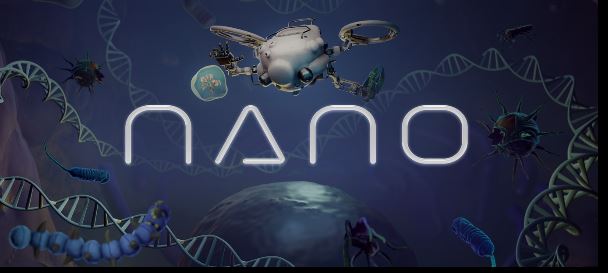
Nano
Nano
Shrink down to the size of a cell and fight a global virus outbreak from the inside. A full-blown biology game with real science in its DNA — covering cell biology, protein synthesis and Mendelian genetics, with a complete 3-week classroom curriculum included.
What Is It?
Nano is a VR biology adventure game from Lighthaus Inc., an award-winning educational technology studio funded by the NIH and the US Department of Education. It has been in development and iteration since 2016, and the Meta Quest version — released in October 2023 — represents the mature, polished product of nearly a decade of research and refinement.
The premise is compelling: a mysterious virus is spreading globally, and you — a trainee in a secret bioresearch programme — remotely pilot a nanodrone injected into infected patients' bloodstreams. You take control of a synthetic immune cell, navigating inside the cytoplasm, interacting with organelles, and managing the cell's living systems to fight infections and ultimately track down the virus itself.
The key distinction from most educational VR apps is Lighthaus's explicit mission: this is a game first. The science is real and rigorous — cell biology, protein synthesis, DNA, immune response, Mendelian genetics — but it is delivered through genuine gameplay mechanics rather than passive narration or guided tours. Students don't watch biology; they do it.
Two Full Biology Modules
The Meta Quest app on the store page covers the Cell module. The full school bundle from Lighthaus includes both Nano: Cell and Nano: Genetics as a complete VR Science Bundle — each a three-week standards-aligned unit.
What Makes Nano Different
The Biology Inside the Game
The cell biology covered in Nano: Cell aligns directly with GCSE and A-level biology content on cell structure and function. Students who play the game will have directly experienced the following concepts:
Protein synthesis in particular — one of the most challenging GCSE and A-level biology concepts, and notoriously difficult to convey through a static textbook diagram — is rendered as an active gameplay system. Students don't memorise a process; they execute it.
What People Are Saying
"There should be a version of this for every education lesson and job training program out there."
"This is exactly what VR education should be. I genuinely learned how protein synthesis works by playing it — I've tried to understand it from textbooks for years and it never clicked until now."
Rated Nano a top pick, describing it as "a perfect mix of educational content and interactive gameplay, turning difficult biology topics into engaging VR experiences. You can explore, experiment, and observe how cells function in real time — something textbooks or videos just can't replicate."
XR School Scores
Nano is the standard by which all other educational VR biology apps should be judged. It is a research-backed, curriculum-complete, game-quality VR experience that makes protein synthesis and cell biology genuinely fun to learn — and has 128 four-and-five-star reviews to prove it actually works. At $14.99, it is extraordinary value. It should be on every secondary biology department's headsets, and the school bundle from Lighthaus turns it into a complete teaching resource that removes almost all of the usual friction of implementing VR in lessons. An unqualified recommendation.
Lighthaus has received research funding from the National Institutes of Health (NIH) and the US Department of Education. This gives the app's scientific content and educational approach a level of institutional validation unusual for a consumer VR product.
The $14.99 Meta Store app is the consumer version of Nano: Cell. The full school bundle from Lighthaus includes both Cell and Genetics modules, complete curriculum packs, teacher training, and optional headset procurement — contact Lighthaus directly for school pricing.