
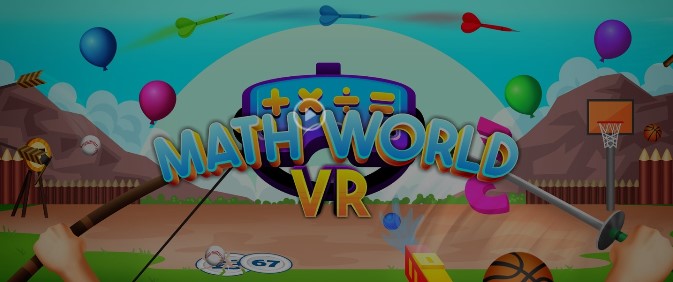
Math World VR
Math World VR
Twelve physical VR mini-games — axe throwing, bow and arrow, carnival darts, basketball, paintball and more — each woven around arithmetic challenges. Shoot a bow at the correct equation answer. Throw an axe at the right number. Slice falling numbers. Punch plates displaying correct multiples. A STEM.org accredited maths fluency tool that gets students physically moving while practising arithmetic, built for all ages and playable completely stationary.
Math World VR carries a STEM.org accreditation seal — STEM.org is a multinational organisation that develops and evaluates educational STEM curricula, giving teachers an independent quality assurance marker. Crucially for classroom use: all 12 mini-games can be played completely stationary, meaning no large play space is required and students can use the headset in a standard classroom seat. Casting support lets the teacher see what the student sees on an external screen — essential for monitoring progress and keeping the class engaged during one-at-a-time headset sessions.
What is Math World VR?
Math World VR is a STEM.org accredited educational VR game that wraps arithmetic practice inside twelve physically active mini-games set in a carnival and outdoor challenge environment. Instead of tapping answers on a screen, students throw axes, fire bows, slam plates and hurl frisbees — all at mathematically correct targets. The result is a maths fluency practice tool that is fundamentally more active and engaging than any equivalent app on a flat screen, even if the underlying maths content is deliberately accessible rather than deep.
The Educational App Store describes it as "a practice app that complements kids' existing math curricula" — an accurate framing. Math World VR is not trying to teach new mathematical concepts or develop deep understanding; it is trying to build fluency and speed in the arithmetic operations students have already been taught. The VR layer adds two things that a worksheet or app cannot: physical movement (the arm motions of throwing, aiming and striking) and genuine fun. Both of these meaningfully improve engagement with what would otherwise be repetitive drill practice.
Compatibility is broader than most VR maths apps: Meta Quest (all generations), PSVR2, and Pico headsets are all supported — making it usable regardless of which headset platform a school has adopted. All twelve mini-games can be played completely stationary, which is a critical practical feature: students do not need to clear space, stand up or move around the room.
Every Game Explained
Curriculum & Educational Fit
Math World VR is at its best as a maths fluency and engagement tool for KS1 and lower KS2 — roughly ages 5–9. Its sweet spot is mental arithmetic practice: the four operations (addition, subtraction, multiplication, division), even and odd numbers, and multiples. The twelve different physical mechanics keep sessions feeling fresh across multiple uses, and the physical movement of throwing, aiming and striking adds genuine kinaesthetic engagement that worksheets and digital apps cannot replicate.
For KS1 and lower KS2 Maths, Math World VR is a genuinely strong warm-up or reward session tool — the physical engagement is motivating, the content is clearly matched to curriculum expectations at this level, and the STEM.org accreditation gives teachers a quality assurance anchor. The Multiples Paintball game is directly applicable to times tables practice; Carnival Darts to even/odd work; Number Slicer and Punch the Plates to rapid arithmetic recall. For kinaesthetic learners who struggle to engage with abstract number work on paper, the combination of physical action and immediate visual feedback is particularly effective. The Educational App Store notes it "helps kids develop fluency in different areas of math, which can help both speed and accuracy" — an honest description of its value.
Honest limitation: The maths is deliberately basic — and one reviewer fairly asks "whether the same content would not work just as well on a 2D screen." The answer is: the maths content could. But the physical engagement, the sense of occasion, and the novelty factor of VR cannot be replicated on a screen. For a short session of arithmetic practice, that novelty and physical engagement has real value — especially for students who find standard drill practice demotivating. Math World VR is best understood as a motivational supplement to classroom arithmetic, not a replacement for structured teaching.
| Platform | Quest · PSVR2 · Pico |
| Price | $15 |
| Accreditation | ✓ STEM.org seal |
| Mini-games | 12 |
| Maths content | Arithmetic · multiples · even/odd |
| Stationary play | ✓ All 12 games |
| Casting | ✓ Teacher monitoring |
| Languages | English · Chinese · Spanish |
| Age rating | ✓ Everyone · All ages |
| Best for | KS1–KS2 · Arithmetic fluency |