Overview
What Is It?
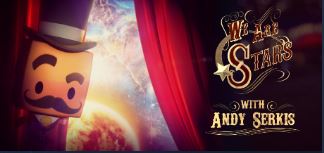
We Are Stars is a 25-minute cinematic VR experience — not a game, not an interactive simulation, but a film. Produced by NSC Creative, the immersive storytelling studio based at the National Space Centre in Leicester, it takes viewers on a journey through 13.8 billion years of cosmic history, from the Big Bang through stellar nucleosynthesis to the formation of the solar system, Earth, and the first living organisms.
It is narrated by Andy Serkis — best known for playing Gollum, Caesar the chimpanzee, and Supreme Leader Snoke — who voices "the Time Master": a Victorian gentleman with a time tent who guides viewers through cosmic time. The production was made with expert input from cosmologists, astrophysicists, astrochemists, planetary scientists, and astrobiologists, and the original score was composed by Rhian Sheehan.
What makes We Are Stars historically significant is its format: it was the world's first science documentary designed and produced simultaneously for both VR headsets and fulldome planetarium screens. The same film that plays in the Sir Patrick Moore Planetarium at the National Space Centre — and in 600+ venues across 30 countries — is the one you watch in your VR headset on Steam.
Content
The 13.8 Billion Year Journey
The film traces a single thread from the beginning of the universe to the emergence of life — the chemical story of how the atoms that make up your body were forged in stellar furnaces and distributed across the cosmos. This is why the XR School categorises it under Chemistry: the subject matter is fundamentally astrochemistry and stellar nucleosynthesis.
The Big Bang & First Atoms
The universe begins. Within minutes, protons and neutrons fuse to form hydrogen and helium nuclei — the simplest atoms. The chemical story starts here, 13.8 billion years ago.
Stellar Nucleosynthesis
Stars are born and become nuclear furnaces — fusing hydrogen into helium, then helium into carbon, and heavier elements beyond. Every atom of carbon in your body was forged inside a star. When massive stars die in supernova explosions, they seed the cosmos with these elements.
Astrochemistry & Molecular Clouds
In the cold of interstellar space, elements combine into molecules — including the organic molecules that are the building blocks of life. Complex chemistry happens in nebulae long before planets form.
Solar System & Earth Formation
A new star and its planets condense from a cloud of stardust. Earth forms — a rocky world that inherits the chemistry of the cosmos. Water arrives. Conditions for life emerge.
The Origin of Life
From cosmic chemistry to biochemistry — the first self-replicating molecules, the first cells. The film closes with the realisation that every living thing is made of atoms that were born in stars. We are, quite literally, made of star stuff.
"The cosmos is also within us. We're made of star stuff. We are a way for the cosmos to know itself."
Carl Sagan — the sentiment at the heart of We Are Stars
Producer
NSC Creative & the National Space Centre
NSC Creative is the award-winning immersive production studio based at the National Space Centre in Leicester — the UK's largest space attraction. Established in 2001 to produce the inaugural digital planetarium show for the National Space Centre itself, the studio has built a library of world-class fulldome films licensed to over 600 venues in more than 30 countries. They are the world leader in digital planetarium film production.
We Are Stars is the third film in NSC Creative's "We Are…" series — following We Are Astronomers (narrated by David Tennant) and We Are Aliens (narrated by Rupert Grint). Each film is produced with genuine scientific rigor: the team works with leading researchers to ensure accuracy while translating complex concepts into stylised, accessible visualisations.
🌍 The world's first cross-platform immersive film.
We Are Stars holds the distinction of being the world's first science documentary designed and produced simultaneously for VR headsets and immersive dome screens. The same production quality that plays on the 18-metre Sir Patrick Moore Planetarium dome at the National Space Centre is what you experience in your headset.
Classroom
How to Use It Educationally
We Are Stars is a film, not a lesson — and that shapes how it should be deployed. At 25 minutes it fills a substantial portion of a lesson period, and its non-interactive, cinematic format means it is best experienced as a stimulus, a reward, or an immersive introduction rather than primary curriculum delivery.
🔭 Topic starter
Open a unit on the origins of elements, stellar evolution, or atomic structure with a 25-minute cinematic journey that makes the scale and significance of the chemistry emotionally immediate.
🎉 End-of-topic experience
After teaching stellar nucleosynthesis, Big Bang nucleosynthesis, or the origin of the elements, let students experience the story in cinematic VR as a consolidation and celebration.
🎭 STEM careers inspiration
The combination of genuine science communication, professional production values, and Andy Serkis's narration makes this aspirational viewing — the kind of thing that stays with a student who becomes an astrophysicist or astrobiologist.
🎓 Curriculum relevance.
The chemistry content — Big Bang nucleosynthesis, stellar fusion, carbon synthesis, astrochemistry — maps most directly onto A-level Physics (nuclear physics, stellar evolution) and A-level Chemistry (origins of elements). GCSE students will find it awe-inspiring even without full technical grounding. The astrobiological thread (origins of life) also connects to GCSE and A-level Biology.
Honest View
What to Be Aware Of
⚠️
PC VR only — not standalone Quest. Requires a Windows PC and SteamVR. Schools with standalone Quest fleets cannot use this without a connected PC. The production values are exceptional but the platform requirement limits classroom deployment.
⚠️
Completely non-interactive. We Are Stars is a film. You cannot move, interact, pause, or affect anything. Some students may find a 25-minute passive VR experience less engaging than interactive apps — particularly those accustomed to games. Set expectations clearly before putting the headset on.
⚠️
2016–17 production era. While the pre-rendered 4K×4K quality holds up well — it was designed for planetarium screens — some stylistic choices feel of their time. The Victorian time tent framing device may or may not land with every audience.
✅
Planetarium-grade production values. This is the same film that plays in professional digital planetariums worldwide. The 4K×4K stereoscopic pre-rendering, immersive score, and Hollywood narration are a significant step above most educational VR apps. For students who have never experienced a planetarium show, this is that experience in their bedroom or classroom.
✅
Expert scientific input throughout. Not a dramatisation of guesswork — the script was developed with leading cosmologists, astrophysicists, astrochemists, planetary scientists, and astrobiologists. The science is current and the communication is authoritative.
✅
Andy Serkis narration. The Time Master character gives the film genuine cinematic warmth. Serkis brings the same commitment to this role that he brings to every performance — it's not a token celebrity voice-over, it's a well-crafted guide character. Students familiar with his films will engage with the voice immediately.
✅
UK institution — a badge of quality. This isn't an indie side project. The National Space Centre is the UK's most visited space attraction and NSC Creative has been producing world-class planetarium content for over 20 years. The institutional credibility is the highest of any producer in this chemistry series.
Our Verdict
XR School Scores
Scientific Accuracy & Depth
9 / 10
Developed with leading scientists across multiple disciplines. Accurately presents current understanding of stellar nucleosynthesis, astrochemistry, and the origins of life. The simplifications are appropriate for the audience, not sloppy.
Cinematic & Production Quality
10 / 10
4K×4K pre-rendered stereoscopic 3D designed for planetarium screens. Hollywood narration. Original award-worthy score. The highest production quality of any VR experience in this chemistry series, by a significant margin.
Classroom Fit (interactive use)
5 / 10
Non-interactive, PC VR only, 25 minutes of passive viewing. Excellent as a stimulus, reward, or whole-class screen experience but not a curriculum tool in the same sense as Futuclass or Molecule Builder.
Awe & Inspiration
10 / 10
Standing inside a supernova while Andy Serkis explains that the iron in your blood was forged in a dying star is an experience that is genuinely difficult to provide any other way. This is the score for what We Are Stars does best.
Value for Money
9 / 10
Priced around £3.99–£4.99 on Steam for a 25-minute planetarium-quality VR film by a UK national institution with a Hollywood narrator. Outstanding value for what is being delivered.
Bottom Line
We Are Stars is the most cinematically accomplished experience in this chemistry series — a 25-minute planetarium-quality VR film from the National Space Centre, narrated by Andy Serkis, that traces the chemical origins of everything from the Big Bang to the first living cells. It is not interactive and it requires PC VR, which limits its classroom versatility. But as an experience — as something to show a student when you want them to feel the staggering scale of cosmic chemistry in a way no textbook diagram can achieve — it is unmatched. For any teacher covering stellar nucleosynthesis, the origin of elements, or the astrochemical roots of life, We Are Stars is exactly the kind of experience that makes students look at the periodic table differently.